
DHPS Antibodies
Background
The DHPS gene encodes dihydropteridine synthase, which is a key enzyme in the folate biosynthesis pathway. It mainly participates in catalyzing the reaction where dihydropteridine combines with p-aminobenzoic acid to form dihydropteridine. This gene is highly conserved in various organisms including bacteria, plants, and some protists, but it does not exist in mammals. Therefore, the enzyme encoded by this gene becomes an important target for antibacterial drugs (such as sulfonamides). The loss or mutation of the function of the DHPS gene will lead to the inhibition of folate synthesis, thereby affecting cell division and growth. In pathogens, the corresponding mutations are often associated with the resistance to sulfonamides. The research on the DHPS gene and its products not only deepens our understanding of metabolic pathways and drug action mechanisms, but also provides an important molecular basis for the development of new antibacterial strategies.
Structure of DHPS
The dihydropteridine synthase encoded by the DHPS gene is a relatively small protein with a molecular weight of approximately 30-35 kDa. There are certain differences in the molecular weight of this enzyme among different species, which mainly result from the subtle variations in the length and composition of its amino acid sequence.
| Species | Escherichia coli | Mycobacterium tuberculosis | Yeast | Plasmodium falciparum |
| Molecular Weight (kDa) | 31.0 | 33.5 | 34.2 | 30.8 |
| Primary Structural Differences | Typical structure of a prokaryotic enzyme | Regions with characteristic mutations related to drug resistance | Contains the N-terminal extension sequence specific to eukaryotes | Having a unique substrate-binding cavity to adapt to the parasitic environment |
This protein is composed of approximately 280 to 320 amino acid residues and folds into a compact spherical structure. Its three-dimensional structure is composed of multiple α-helices and β-sheets, collectively forming a crucial binding pocket to accommodate its substrate, p-aminobenzoic acid (pABA), and cofactor. The precise geometric shape of this active site is the core of its catalytic function and precisely targets the action of sulfonamide drugs. The conserved aspartic acid and lysine residues are crucial for the catalytic reaction, while the differences in species-specific regions directly affect its sensitivity to different drugs.
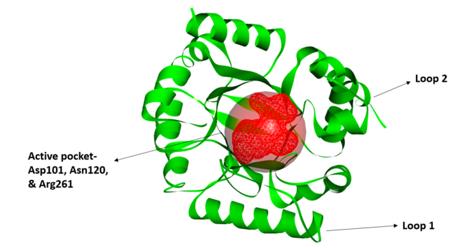 Fig. 1 The crystal structure of DHPS.1
Key structural properties of DHPS:
- The globular core structure is composed of multiple α-helices and β-folds
- Hydrophobic active bags are used to bind the substrate para-aminobenzoic acid (pABA)
- Conserved asparty-lysine catalytic residue pairs perform core enzymatic functions
- Variable flexible regions affect substrate specificity and are associated with drug resistance
Functions of DHPS
The main function of the dihydropteroate synthase encoded by the DHPS gene is to catalyze the key step in the folate biosynthesis pathway. Additionally, this enzyme and its metabolic network are also involved in various cellular processes and are closely related to the mechanism of drug action.
| Function | Description |
| Folic Acid Synthesis | Catalyzes the condensation of dihydropteridine and p-aminobenzoic acid (pABA) to form dihydrofolate, which is an irreversible step in the synthesis of tetrahydrofolate. |
| Cellular Proliferation Support | By participating in the production of tetrahydrofolic acid (a carrier of one-carbon units), it provides raw materials for the synthesis of purines, pyrimidines, and certain amino acids, thereby supporting DNA replication and cell division. |
| Drug Target | It is the specific target for sulfonamide antibacterial drugs. The drug competitively inhibits the binding of pABA, thereby blocking the synthesis of folic acid. |
| Drug Resistance Formation | The mutations in their genes (especially near the active site) can alter the affinity of the enzyme for the drug, which is one of the main molecular mechanisms by which pathogenic microorganisms develop resistance to sulfonamide drugs. |
| Metabolic Network Node | As the rate-limiting enzyme in the folate synthesis pathway, its activity level directly affects the flow of the entire metabolic pathway and serves as a crucial regulatory point in metabolism. |
The catalytic mechanism of this enzyme involves a typical nucleophilic substitution reaction. The substrate binding specificity (its high affinity for pABA) and the drug inhibitory effect (sulfonamides as structural analogues of pABA) directly determine its biological function and clinical application value.
Applications of DHPS and DHPS Antibody in Literature
1. Alabbas, Alhumaidi. "Integrating Multi-Domain Approach for Identification of Neo Anti-DHPS Inhibitors Against Pathogenic Stenotrophomonas maltophilia." Biology 14.8 (2025): 1030. https://doi.org/10.3390/biology14081030
In this study, three novel DHPS inhibitors (CHEMBL2322256, etc.) were screened out by using computational technology. They have high molecular stability and strong binding ability to target proteins, and may become potential drugs to combat bacterial resistance.
2. Azzam, Rasha A., Heba A. Elboshi, and Galal H. Elgemeie. "Synthesis, physicochemical properties and molecular docking of new benzothiazole derivatives as antimicrobial agents targeting DHPS enzyme." Antibiotics 11.12 (2022): 1799. https://doi.org/10.3390/antibiotics11121799
In this paper, novel benzothiazole derivatives were synthesized, among which compound 16c showed significant antibacterial activity against Staphylococcus aureus. The DHPS enzyme inhibition experiment and molecular docking showed that some compounds could effectively target DHPS and had good potential for drug development.
3. Pearce, Richard J., et al. "Multiple origins and regional dispersal of resistant dhps in African Plasmodium falciparum malaria." PLoS medicine 6.4 (2009): e1000055. https://doi.org/10.1371/journal.pmed.1000055
This study, by analyzing the evolutionary origin and distribution of drug resistance mutations of the dihydrobutterfly acid synthase (dhps) gene in Plasmodium africum, found that drug resistance originated independently and had different molecular mechanisms in East and West Africa, revealing the diverse evolution and transmission paths of antimalarial drug resistance in Africa over the past 20 years.
4. Venkatesan, Meenakshi, et al. "Molecular mechanism of plasmid-borne resistance to sulfonamide antibiotics." Nature Communications 14.1 (2023): 4031. https://doi.org/10.1038/s41467-023-39778-7
This study reveals that bacteria can specifically distinguish and resist sulfonamide drugs by obtaining the DHPS enzyme variant encoded by the Sul gene. The dynamic changes in the Ph-Gly sequence and conformation of the active site can be achieved while retaining the binding ability to the substrate pABA, providing a molecular mechanism basis for the development of new anti-resistant sulfonamide drugs.
5. Wang, Chao, et al. "Extracellular signal-regulated kinases associate with and phosphorylate DHPS to promote cell proliferation." Oncogenesis 9.9 (2020): 85. https://doi.org/10.1038/s41389-020-00271-1
This study first discovered that ERK1/2 can directly bind to and phosphorylate deoxyhydroxylamine synthase (DHPS), and this modification drives cell proliferation by regulating protein translation. The high expression of DHPS is associated with a poor prognosis of lung cancer and can enhance the resistance of cancer cells to ERK1/2 pathway inhibitors, suggesting that it can serve as a key therapeutic target and biomarker.
Creative Biolabs: DHPS Antibodies for Research
Creative Biolabs specializes in the production of high-quality DHPS antibodies for research and industrial applications. Our portfolio includes monoclonal antibodies tailored for ELISA, Flow Cytometry, Western blot, immunohistochemistry, and other diagnostic methodologies.
- Custom DHPS Antibody Development: Tailor-made solutions to meet specific research requirements.
- Bulk Production: Large-scale antibody manufacturing for industry partners.
- Technical Support: Expert consultation for protocol optimization and troubleshooting.
- Aliquoting Services: Conveniently sized aliquots for long-term storage and consistent experimental outcomes.
For more details on our DHPS antibodies, custom preparations, or technical support, contact us at email.
Reference
- Alabbas, Alhumaidi. "Integrating Multi-Domain Approach for Identification of Neo Anti-DHPS Inhibitors Against Pathogenic Stenotrophomonas maltophilia." Biology 14.8 (2025): 1030. https://doi.org/10.3390/biology14081030
Anti-DHPS antibodies
 Loading...
 Compare




Hot products 
-
Mouse Anti-GSDMA Recombinant Antibody (CBLG1-2983) (CBMAB-G5128-LY)

-
Mouse Anti-DISP2 Monoclonal Antibody (F66A4B1) (CBMAB-1112CQ)

-
Rabbit Anti-ENO2 Recombinant Antibody (BA0013) (CBMAB-0272CQ)

-
Mouse Anti-FAS2 Monoclonal Antibody (1D4) (CBMAB-0071-CN)

-
Rat Anti-4-1BB Recombinant Antibody (V2-1558) (CBMAB-0953-LY)

-
Mouse Anti-DDC Recombinant Antibody (8E8) (CBMAB-0992-YC)

-
Mouse Anti-BPGM Recombinant Antibody (CBYY-1806) (CBMAB-2155-YY)

-
Mouse Anti-AAV9 Recombinant Antibody (V2-634029) (CBMAB-AP023LY)

-
Mouse Anti-B2M Recombinant Antibody (CBYY-0050) (CBMAB-0050-YY)

-
Mouse Anti-FOXL1 Recombinant Antibody (CBXF-0845) (CBMAB-F0462-CQ)

-
Rabbit Anti-AKT3 Recombinant Antibody (V2-12567) (CBMAB-1057-CN)

-
Human Anti-SARS-CoV-2 Spike Recombinant Antibody (CR3022) (CBMAB-CR014LY)

-
Mouse Anti-CD164 Recombinant Antibody (CBFYC-0077) (CBMAB-C0086-FY)

-
Mouse Anti-EPO Recombinant Antibody (CBFYR0196) (CBMAB-R0196-FY)

-
Armenian hamster Anti-CD40 Recombinant Antibody (HM40-3) (CBMAB-C10365-LY)

-
Mouse Anti-ENO2 Recombinant Antibody (85F11) (CBMAB-0276CQ)

-
Rat Anti-ADGRE4 Recombinant Antibody (V2-160163) (CBMAB-F0011-CQ)

-
Mouse Anti-CRYAB Recombinant Antibody (A4345) (CBMAB-A4345-YC)

-
Mouse Anti-DMPK Recombinant Antibody (CBYCD-324) (CBMAB-D1200-YC)

-
Mouse Anti-CD63 Recombinant Antibody (CBXC-1200) (CBMAB-C1467-CQ)

- AActivation
- AGAgonist
- APApoptosis
- BBlocking
- BABioassay
- BIBioimaging
- CImmunohistochemistry-Frozen Sections
- CIChromatin Immunoprecipitation
- CTCytotoxicity
- CSCostimulation
- DDepletion
- DBDot Blot
- EELISA
- ECELISA(Cap)
- EDELISA(Det)
- ESELISpot
- EMElectron Microscopy
- FFlow Cytometry
- FNFunction Assay
- GSGel Supershift
- IInhibition
- IAEnzyme Immunoassay
- ICImmunocytochemistry
- IDImmunodiffusion
- IEImmunoelectrophoresis
- IFImmunofluorescence
- IGImmunochromatography
- IHImmunohistochemistry
- IMImmunomicroscopy
- IOImmunoassay
- IPImmunoprecipitation
- ISIntracellular Staining for Flow Cytometry
- LALuminex Assay
- LFLateral Flow Immunoassay
- MMicroarray
- MCMass Cytometry/CyTOF
- MDMeDIP
- MSElectrophoretic Mobility Shift Assay
- NNeutralization
- PImmunohistologyp-Paraffin Sections
- PAPeptide Array
- PEPeptide ELISA
- PLProximity Ligation Assay
- RRadioimmunoassay
- SStimulation
- SESandwich ELISA
- SHIn situ hybridization
- TCTissue Culture
- WBWestern Blot
