
GAD2 Antibodies
Background
The GAD2 gene encodes a protein called glutamic acid decarboxylase 2, which is mainly distributed in the central nervous system and pancreatic β cells of vertebrates. This enzyme catalyzes the conversion of glutamic acid to γ -aminobutyric acid (GABA), thereby playing a key regulatory role in the balance of neurotransmitter synthesis and metabolism. Research has found that GAD2 participates in the regulation of neural activities such as anxiety and epilepsy by influencing GABAergic signaling, and is closely related to the insulin secretion mechanism. This gene was cloned and identified in the 1990s. The study of its function has provided an important basis for understanding the molecular mechanisms of neurotransmitter dynamic balance, metabolic diseases and mental disorders, and has become one of the key objects in the field of neurobiology and metabolism research.
Structure of GAD2
The molecular weight of the glutamic acid decarboxylase 2 protein encoded by the GAD2 gene is approximately 65-67 kDa. There are minor differences among different species, mainly due to slight changes in their amino acid sequences.
| Species | Human | Mouse | Rat |
|---|---|---|---|
| Molecular Weight (kDa) | About 65.5 | About 65.2 | About 65.0 |
| Primary Structural Differences | Contains catalytic domain and coenzyme binding site | There are subtle differences in the N-terminal sequence | High homology with human, function conservation |
This protein is composed of approximately 585 amino acids and folds into two main domains, forming a functional homodimer. Its active center contains a pyridoxal phosphate (a derivative of vitamin B6) binding site, which is the key to catalyzing the decarboxylation of glutamic acid to γ -aminobutyric acid (GABA). Its three-dimensional structure, through a specific combination of α -helices and β -folds, forms a hydrophobic channel that guides the substrate into and stabilizes the reaction intermediate. A key lysine residue covalently binds to the coenzyme, while the conserved aspartic acid and histidine residues located in the active pocket work in synergy to precisely regulate the progress of the decarboxylation reaction.
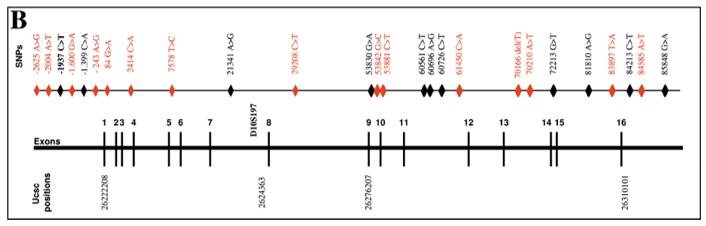 Fig. 1 SNP map of the GAD2 gene.1
Key structural properties of GAD2:
- Homodimer structure
- Pyridoxal phosphate (PLP) -dependent active centers
- Substrate channels and binding pockets
Functions of GAD2
The core function of the protein encoded by the GAD2 gene (glutamic acid decarboxylase 2) is to catalyze the conversion of glutamic acid into γ -aminobutyric acid (GABA), which is the main inhibitory neurotransmitter in the central nervous system. Its specific functions are as follows:
| Function | Description |
|---|---|
| GABA synthesis | In the neurons of the central nervous system and pancreatic β cells, the irreversible decarboxylation of glutamic acid into GABA is the main synthetic pathway of GABA in the brain. |
| Neural excitability regulation | By generating inhibitory GABA, it precisely balances excitability (glutamic acid energy) signals, maintains the stability of neural networks, and prevents overexcitation. |
| Anxiety and Epilepsy Regulation | Dysfunction of the GABAergic signaling pathway is closely related to anxiety disorders, epileptic seizures, etc. GAD2 is the key rate-limiting enzyme of this pathway. |
| Insulin Secretion regulation | In the islets of the pancreas, the GABA it produces affects β -cell function and insulin release in an autocrine/paracrine manner. |
| Energy Metabolism Connection | As a key molecular node connecting central nervous system excitability with peripheral energy metabolism (especially glucose homeostasis). |
Unlike GAD1 (GAD67), which is mainly distributed in synaptic vesicles and is responsible for the rapid response of GABA synthesis, the enzymatic activity of GAD2 (GAD65) is highly sensitive to the availability of the coenzyme pyridoxal phosphate (PLP), which enables its activity to be rapidly regulated to adapt to the instantaneous changes in neuronal activity, playing the role of an "adjustable reserve".
Applications of GAD2 and GAD2 Antibody in Literature
1. Boutin, Philippe, et al. "GAD2 on chromosome 10p12 is a candidate gene for human obesity." PLoS biology 1.3 (2003): e68. https://doi.org/10.1371/journal.pbio.0000068
The article indicates that the GAD2 gene is associated with morbid obesity. Its -243A>G variation can enhance promoter activity, increase hunger, and affect insulin secretion. Haplotype analysis suggests that specific allele combinations have protective effects, supporting the role of the GABAergic system in regulating eating and the occurrence of obesity.
2. Davis, Kasey N., et al. "GAD2 alternative transcripts in the human prefrontal cortex, and in schizophrenia and affective disorders." PLoS One 11.2 (2016): e0148558. https://doi.org/10.1371/journal.pone.0148558
The article indicates that the GAD2 gene is abnormally expressed in the prefrontal cortex of patients with schizophrenia and mood disorders. The expression of full-length transcripts decreased, while the truncated variants changed in opposite directions in different diseases. Its expression level is affected by suicidal behavior and nicotine exposure.
3. Boutin, Philippe, et al. "GAD2 on chromosome 10p12 is a candidate gene for human obesity." PLoS biology 1.3 (2003): e68. https://doi.org/10.1371/journal.pbio.0000068
The article indicates that GAD2 gene variations affect the risk of morbid obesity. Its -243A>G variation enhances promoter activity and is associated with higher hunger. The +61450C>A and +83897T>A haplotypes have protective effects and are associated with lower insulin secretion.
4. Swarbrick, Michael M., et al. "Lack of support for the association between GAD2 polymorphisms and severe human obesity." PLoS biology 3.9 (2005): e315. https://doi.org/10.1371/journal.pbio.0030315
The article indicates that in the expanded sample study, the association between GAD2 gene polymorphisms (including -243 A>G) and severe obesity was not repeatedly verified. Neither meta-analysis nor functional studies supported the pathological role of this genetic variation in this type of obesity.
5. Liu, Dan, et al. "Sugar beverage habitation relieves chronic stress-induced anxiety-like behavior but elicits compulsive eating phenotype via vLSGAD2 neurons." International Journal of Molecular Sciences 24.1 (2022): 661. https://doi.org/10.3390/ijms24010661
Studies have shown that under chronic stress, excessive intake of sucrose can relieve anxiety, but it can induce binge eating and compulsive eating behaviors in mice and lead to weight gain. Activating GABAergic neurons in the ventrolateral septum of the brain can simulate this compulsive eating phenotype, suggesting it as a potential intervention target.
Creative Biolabs: GAD2 Antibodies for Research
Creative Biolabs specializes in the production of high-quality GAD2 antibodies for research and industrial applications. Our portfolio includes monoclonal antibodies tailored for ELISA, Flow Cytometry, Western blot, immunohistochemistry, and other diagnostic methodologies.
- Custom GAD2 Antibody Development: Tailor-made solutions to meet specific research requirements.
- Bulk Production: Large-scale antibody manufacturing for industry partners.
- Technical Support: Expert consultation for protocol optimization and troubleshooting.
- Aliquoting Services: Conveniently sized aliquots for long-term storage and consistent experimental outcomes.
For more details on our GAD2 antibodies, custom preparations, or technical support, contact us at email.
Reference
- Boutin, Philippe, et al. "GAD2 on chromosome 10p12 is a candidate gene for human obesity." PLoS biology 1.3 (2003): e68. https://doi.org/10.1371/journal.pbio.0000068
Anti-GAD2 antibodies
 Loading...
 Compare




Hot products 
-
Mouse Anti-ADIPOR2 Recombinant Antibody (V2-179983) (CBMAB-A1369-YC)

-
Mouse Anti-AMIGO2 Recombinant Antibody (CBYY-C0756) (CBMAB-C2192-YY)

-
Rabbit Anti-B2M Recombinant Antibody (CBYY-0059) (CBMAB-0059-YY)

-
Rat Anti-AChR Recombinant Antibody (V2-12500) (CBMAB-0990-CN)

-
Mouse Anti-DLC1 Recombinant Antibody (D1009) (CBMAB-D1009-YC)

-
Mouse Anti-ENPP1 Recombinant Antibody (CBFYE-0159) (CBMAB-E0375-FY)

-
Mouse Anti-ARHGDIA Recombinant Antibody (CBCNA-009) (CBMAB-R0415-CN)

-
Mouse Anti-FPR2 Recombinant Antibody (1D6) (CBMAB-F2628-CQ)

-
Mouse Anti-APCS Recombinant Antibody (CBYC-A663) (CBMAB-A3054-YC)

-
Mouse Anti-GPRC5C Recombinant Antibody (CBFYH-0464) (CBMAB-H0521-FY)

-
Mouse Anti-ADGRE2 Recombinant Antibody (V2-261270) (CBMAB-C0813-LY)

-
Mouse Anti-ENO1 Recombinant Antibody (8G8) (CBMAB-E1329-FY)

-
Mouse Anti-ALPL Antibody (B4-78) (CBMAB-1009CQ)

-
Mouse Anti-BCL6 Recombinant Antibody (CBYY-0442) (CBMAB-0445-YY)

-
Mouse Anti-Gram Positive Bacteria LTA Recombinant Antibody (CBMC-C0664) (CBMAB-V208-1410-CQ)

-
Mouse Anti-ACLY Recombinant Antibody (V2-179314) (CBMAB-A0610-YC)

-
Mouse Anti-CGAS Recombinant Antibody (CBFYM-0995) (CBMAB-M1146-FY)

-
Rabbit Anti-CBL Recombinant Antibody (D4E10) (CBMAB-CP0149-LY)

-
Mouse Anti-CD247 Recombinant Antibody (6B10.2) (CBMAB-C1583-YY)

-
Mouse Anti-CASP8 Recombinant Antibody (CBYY-C0987) (CBMAB-C2424-YY)

- AActivation
- AGAgonist
- APApoptosis
- BBlocking
- BABioassay
- BIBioimaging
- CImmunohistochemistry-Frozen Sections
- CIChromatin Immunoprecipitation
- CTCytotoxicity
- CSCostimulation
- DDepletion
- DBDot Blot
- EELISA
- ECELISA(Cap)
- EDELISA(Det)
- ESELISpot
- EMElectron Microscopy
- FFlow Cytometry
- FNFunction Assay
- GSGel Supershift
- IInhibition
- IAEnzyme Immunoassay
- ICImmunocytochemistry
- IDImmunodiffusion
- IEImmunoelectrophoresis
- IFImmunofluorescence
- IGImmunochromatography
- IHImmunohistochemistry
- IMImmunomicroscopy
- IOImmunoassay
- IPImmunoprecipitation
- ISIntracellular Staining for Flow Cytometry
- LALuminex Assay
- LFLateral Flow Immunoassay
- MMicroarray
- MCMass Cytometry/CyTOF
- MDMeDIP
- MSElectrophoretic Mobility Shift Assay
- NNeutralization
- PImmunohistologyp-Paraffin Sections
- PAPeptide Array
- PEPeptide ELISA
- PLProximity Ligation Assay
- RRadioimmunoassay
- SStimulation
- SESandwich ELISA
- SHIn situ hybridization
- TCTissue Culture
- WBWestern Blot
