
CD36 Antibodies
Background
CD36 is a glycoprotein located on the surface of cell membranes, mainly expressed in various tissues such as adipocytes, macrophages, cardiomyocytes and vascular endothelial cells. The protein encoded by this gene, as a multifunctional receptor, participates in important physiological processes such as the uptake of long-chain fatty acids, the regulation of platelet aggregation, and innate immune responses. CD36 plays a key role in metabolic diseases, and its abnormal function is closely related to pathological processes such as insulin resistance and atherosclerosis. This gene was first cloned by the Fernandez-Ruiz team in 1993. Its unique double-stranded transmembrane structure provides an important model for studying lipid metabolism and inflammatory responses. As a member of the pattern recognition receptor family, the research on the structure and function of CD36 has greatly promoted people's understanding of the molecular mechanisms of metabolic regulation and immune response.
Structure of CD36
CD36 is a transmembrane glycoprotein with a molecular weight of approximately 88 kDa. Its molecular weight varies among different species, mainly due to the varying degrees of glycosylation modification.
| Species | Human | Mouse | Rat | Pig | Bovine |
| Molecular Weight (kDa) | 88 | 85 | 86 | 87 | 89 |
| Primary Structural Differences | Highly conserved, containing multiple glycosylation sites | Extracellular region is slightly different | Fatty acid binding domains are similar | Across the membrane area highly homologous | Different glycation patterns |
CD36 is composed of 472 amino acids and features two transmembrane domains and a large extracellular circular structure. Its secondary structure is mainly composed of β -folding, forming hydrophobic ligand-binding pockets that can recognize various molecules, such as oxidized low-density lipoprotein (oxLDL) and long-chain fatty acids. The N-terminal and C-terminal of CD36 are both located in the cytoplasm, while the extracellular domain in the middle contains multiple glycosylation sites, which affect its stability and function. The key functional sites of this protein include the fatty acid binding domain (amino acids at positions 127-279) and the thromboreactive protein binding domain (amino acids at positions 155-183), which enable it to play a core role in metabolic regulation and inflammatory responses.
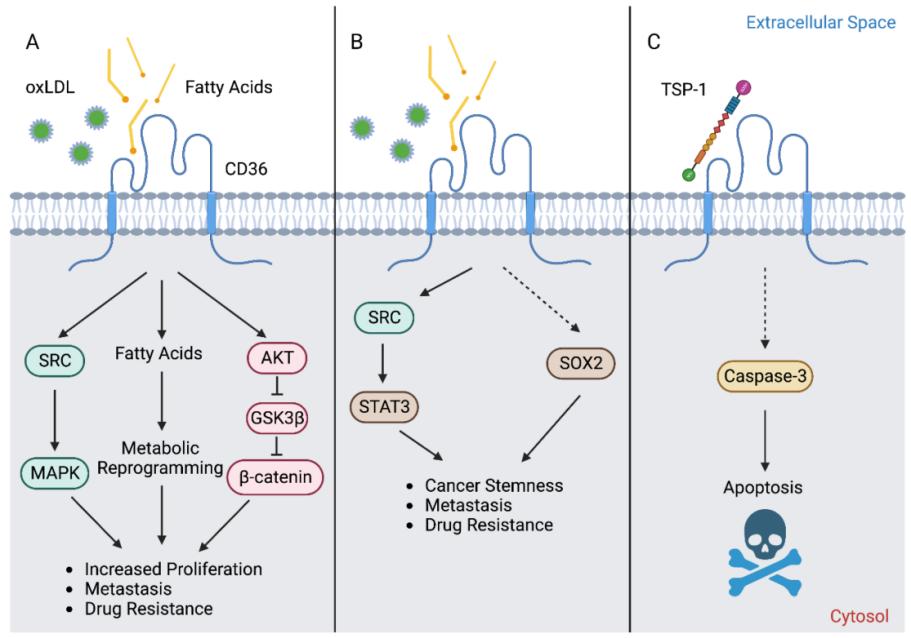 Fig. 1 CD36 exhibits multiple distinct functions in cancer cells.1
Key structural properties of CD36:
- Double-span membrane domain
- Hydrophobic ligand-binding pocket
- Highly glycosylated modification
- Functional domain
- Disulfide bonds stabilize the structure
Functions of CD36
The main function of the CD36 gene-encoded protein is to act as a multifunctional receptor to participate in lipid metabolism and immune regulation, and at the same time play a key role in various physiological and pathological processes.
| Function | Description |
| Fatty acid transport | As a Class B scavenger receptor, it mediates the transmembrane transport of long-chain fatty acids and affects fat metabolism and energy balance. |
| Immune regulation | Identify pathogen-associated molecular patterns (PAMPs) and damage-associated molecular patterns (DAMPs) to activate innate immune responses. |
| Angiogenesis regulation | By regulating the function of vascular endothelial cells, it affects the angiogenesis process of ischemic diseases. |
| Platelet activation | Participate in platelet aggregation reaction, play an important role in thrombosis. |
| Recognition of oxidized lipoproteins | Specifically binds to oxidized low-density lipoprotein (oxLDL), promotes the formation of foam cells, and affects the development of atherosclerosis. |
The binding of CD36 to ligands shows broad-spectrum specificity, and its affinity is significantly regulated by the membrane microenvironment (such as lipid raft distribution) and post-translational modifications (such as palmitoylation). Unlike single-function receptors, CD36 achieves diversity in signal transduction by forming multi-protein complexes (such as in coordination with TLR4/6 dimers), a characteristic that makes it a key node in metabolism-inflammation cross-regulation.
Applications of CD36 and CD36 Antibody in Literature
1. Wang, gchun, and Yongsheng Li. "CD36 tango in cancer: signaling pathways and functions." Theranostics 9.17 (2019): 4893.https://www.thno.org/v09p4893.htm
Research has found that CD36 is a transmembrane glycoprotein that participates in lipid uptake, immune recognition, and inflammation processes. It inhibits tumor angiogenesis by binding to platelet reactive protein-1, and the lipid metabolism reprogramming it mediates promotes tumor immune tolerance, making it a potential anti-cancer target.
2. Feng, William W., Hannah T. Zuppe, and Manabu Kurokawa. "The role of CD36 in cancer progression and its value as a therapeutic target." Cells 12.12 (2023): 1605.https://doi.org/10.3390/cells12121605
The article indicates that CD36 is a multifunctional scavenger receptor that promotes tumor progression in breast cancer, brain cancer and ovarian cancer by regulating fatty acid uptake, metastasis, drug resistance and immune escape. Drugs targeting CD36 (such as VT1021) have entered the late clinical stage, and their therapeutic potential is not limited to cancer but also involves metabolic diseases.
3. Maréchal, Loïze, et al. "The CD36-PPARγ pathway in metabolic disorders." International Journal of Molecular Sciences 19.5 (2018): 1529. https://doi.org/10.3390/ijms19051529
The article indicates that CD36 regulates lipid and energy metabolism by mediating the activation of PPARγ through growth hormone-releasing peptide (GHRP), improving atherosclerosis, liver cholesterol synthesis and mitochondrial generation, providing a new target for the treatment of metabolic disorders.
4. Liqun, et al. "Ligand-dependent CD36 functions in cancer progression, metastasis, immune response, and drug resistance." Biomedicine & Pharmacotherapy 168 (2023): 115834. https://doi.org/10.1016/j.biopha.2023.115834
The article indicates that CD36, as a multifunctional receptor, plays a dual role in tumor growth, metastasis, drug resistance and immunosuppression by binding to ligands such as fatty acids, oxLDL and TSP1. Its ligand-dependent function has become a new target and research challenge for cancer treatment.
5. Jiang, Muwei, et al. "CD36 as a double-edged sword in cancer." Immunology Letters 265 (2024): 7-15. https://doi.org/10.1016/j.imlet.2023.12.002
The article indicates that CD36, as a multifunctional membrane protein, plays a dual role in tumors: it can promote cancer metastasis and drug resistance through lipid transport, and also bind to TSP1 to inhibit angiogenesis. Its complex regulatory mechanisms in cancer cells and immune cells bring both challenges and opportunities to targeted therapy.
Creative Biolabs: CD36 Antibodies for Research
Creative Biolabs specializes in the production of high-quality CD36 antibodies for research and industrial applications. Our portfolio includes monoclonal antibodies tailored for ELISA, Flow Cytometry, Western blot, immunohistochemistry, and other diagnostic methodologies.
- Custom CD36 Antibody Development: Tailor-made solutions to meet specific research requirements.
- Bulk Production: Large-scale antibody manufacturing for industry partners.
- Technical Support: Expert consultation for protocol optimization and troubleshooting.
- Aliquoting Services: Conveniently sized aliquots for long-term storage and consistent experimental outcomes.
For more details on our CD36 antibodies, custom preparations, or technical support, contact us at email.
Reference
- Feng, William W., Hannah T. Zuppe, and Manabu Kurokawa. "The role of CD36 in cancer progression and its value as a therapeutic target." Cells 12.12 (2023): 1605.https://doi.org/10.3390/cells12121605
Anti-CD36 antibodies
 Loading...
 Compare




Hot products 
- AActivation
- AGAgonist
- APApoptosis
- BBlocking
- BABioassay
- BIBioimaging
- CImmunohistochemistry-Frozen Sections
- CIChromatin Immunoprecipitation
- CTCytotoxicity
- CSCostimulation
- DDepletion
- DBDot Blot
- EELISA
- ECELISA(Cap)
- EDELISA(Det)
- ESELISpot
- EMElectron Microscopy
- FFlow Cytometry
- FNFunction Assay
- GSGel Supershift
- IInhibition
- IAEnzyme Immunoassay
- ICImmunocytochemistry
- IDImmunodiffusion
- IEImmunoelectrophoresis
- IFImmunofluorescence
- IGImmunochromatography
- IHImmunohistochemistry
- IMImmunomicroscopy
- IOImmunoassay
- IPImmunoprecipitation
- ISIntracellular Staining for Flow Cytometry
- LALuminex Assay
- LFLateral Flow Immunoassay
- MMicroarray
- MCMass Cytometry/CyTOF
- MDMeDIP
- MSElectrophoretic Mobility Shift Assay
- NNeutralization
- PImmunohistologyp-Paraffin Sections
- PAPeptide Array
- PEPeptide ELISA
- PLProximity Ligation Assay
- RRadioimmunoassay
- SStimulation
- SESandwich ELISA
- SHIn situ hybridization
- TCTissue Culture
- WBWestern Blot
