
Lipid A Antibodies
Background
Lipid A, as a highly conserved glycolipid molecule, mainly exists in the asymmetric bilayer structure of the outer membrane of Gram-negative bacteria. This molecule is anchored to the cell membrane through its hydrophobic acyl chain and specifically binds to the host's innate immune receptor TLR4/MD-2 complex with a negatively charged phosphate group, thereby activating the downstream inflammatory signaling pathway. Due to its immunogenic characteristics, lipid A is regarded as the core toxic unit of bacterial endotoxins and plays a key role in systemic inflammatory responses such as sepsis. The lipid A biosynthetic pathway elucidated by Christian Reifberg et al. in the 1970s involves a cascade catalytic reaction of more than ten conserved enzyme systems such as LpxA and LpxC. The related research not only promotes the development of new adjuvants and vaccines, but also provides key molecular targets for the design of targeted antibacterial drugs. Its unique "structure-function" relationship model continuously provides a paradigm reference for the study of host-pathogen interaction mechanisms.
Structure of Lipid A
Lipid A is a conserved glycolipid structural unit with a molecular weight typically ranging from 1.8 to 2.2 kDa, and its specific value varies depending on the type of bacteria and the number of acyl chains.
| Species | E. coli | S. typhimurium | H. pylori | Bacteroides |
| Molecular Weight (kDa) | ~2.0 | ~2.0 | ~1.8 | ~2.2 |
| Primary Structural Differences | Hexacyl, bisphosphate group symmetrical structure | Hexacyl, with a highly conserved structure | Tetraacyl and phosphate group modifications are relatively few | Pentacyl or variant acyl chains, with strong structural heterogeneity |
This molecule is composed of a β-1', 6-bond linked disaccharide amine skeleton, on which multiple (usually 4-6) saturated hydroxy fatty acid chains are connected by amide bonds and ester bonds. Its hydrophobic core is composed of these acyl chains, which are responsible for anchoring to the bacterial outer membrane. The hydrophilic head is modified by a negatively charged phosphate group and is a key domain for activating the host's innate immune receptor TLR4/MD-2 complex. This amphiphilic structural feature is the molecular basis for its endotoxin toxicity and immunostimulatory activity.
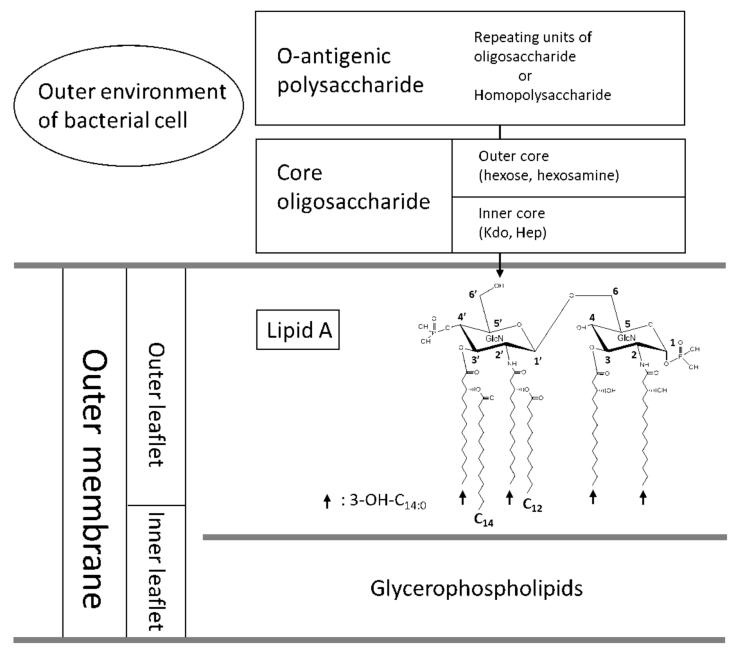 Fig. 1 Schematic elucidation of outer membrane and chemical structure of lipid A region with the numbering of carbon atoms in the glucosamine–disaccharide backbone.1
Key structural properties of Lipid A:
- Highly conserved β-1', 6-glycosidic bond linked disglycoamine skeleton
- Hydrophobic acyl chains (usually 4 to 6) are anchored by amide and ester bonds
- Negatively charged phosphate groups mediate host immune recognition
Functions of Lipid A
The core function of Lipid A is to serve as a structural anchoring molecule for the outer membrane of Gram-negative bacteria and a pathogenic factor that triggers a strong immune response in the host. In addition, its structural variations are also involved in processes such as bacterial virulence regulation and host adaptability.
| Function | Description |
| Structural anchoring | By embedding hydrophobic acyl chains into the bacterial outer membrane, it provides structural stability for lipopolysaccharide (LPS) and maintains the integrity of the outer membrane. |
| Immune activation | As an endotoxin, it binds to the host TLR4/MD-2 receptor, triggering a strong pro-inflammatory cytokine response and leading to pathological processes such as sepsis. |
| Virulence regulation | The number, length of the acyl chain and the modification of the phosphate group can alter its immunogenicity and affect the ability of bacteria to evade the host's immune clearance. |
| Host adaptability | In specific environments (such as the intestine), its structural variations help bacteria tolerate host antimicrobial peptides and achieve immune escape. |
| Adjuvant activity | Due to its strong immune stimulating properties, lipid A that has been attenuated or structurally modified can be used as a vaccine adjuvant to enhance the immune response. |
The immune activation of lipid A shows a dose-dependent feature of "all or none", which is completely different from the gradient response of protein antigens, reflecting its role as an alarm in innate immune recognition.
Applications of Lipid A and Lipid A Antibody in Literature
1. Kawahara, Kazuyoshi. "Variation, modification and engineering of lipid A in endotoxin of Gram-negative bacteria." International Journal of Molecular Sciences 22.5 (2021): 2281. https://doi.org/10.3390/ijms22052281
The article indicates that lipid A is the core active component of endotoxin in Gram-negative bacteria, and its structure is highly diverse, mainly reflected in the length of fatty acid chains, modification of phosphate groups, and substitution of glycosamines, etc. By genetically engineering the structure of lipid A, it is expected to develop new vaccine adjuvants or antagonist drugs.
2. Guillotte, Mark L., et al. "Lipid A structural divergence in Rickettsia pathogens." Msphere 6.3 (2021): 10-1128. https://doi.org/10.1128/msphere.00184-21
The article indicates that there are interspecific differences in the lipid A structure of rickettsiae. The length of its acyl chain and the modification mode may affect the interaction with the host MD2/TLR4 receptor and inflammatory activity, providing a new perspective for understanding the phenotypic differences of different rickettsiae diseases.
3. Di Lorenzo, Flaviana, et al. "The structure of the lipid a of gram-negative cold-adapted Bacteria isolated from Antarctic environments." Marine drugs 18.12 (2020): 592. https://doi.org/10.3390/md18120592
The article indicates that Antarctic Gram-negative bacteria adapt to severe cold by altering the structure of lipid A, such as increasing the unsaturation and branching of the acyl chain. These structural changes not only concern its low-temperature survival mechanism but also provide a natural template for the development of new immune drugs.
4. Piloto, Ana Margarida, et al. "Plastic antibodies tailored on quantum dots for an optical detection of myoglobin down to the femtomolar range." Scientific reports 8.1 (2018): 4944. https://doi.org/10.1007/s10482-017-0872-0
The article indicates lipid A of Phyllobacterium trifolii features a unique di-GlcpN3N backbone with rare long-chain hydroxylated and methoxylated fatty acids. Its high structural similarity to Mesorhizobium lipid A suggests shared genetic adaptations in symbiotic nitrogen-fixing bacteria.
5. Aissa, Ibrahim, Anikó Kilár, and Ágnes Dörnyei. "Study on the CID fragmentation pathways of deprotonated 4'-monophosphoryl lipid A." Molecules 26.19 (2021): 5961. https://doi.org/10.3390/molecules26195961
This study revealed A novel cleavage pathway for synthetic lipid A derivatives through mass spectrometry analysis, including the generation mechanisms of special intermediates such as epoxides and cyclic phosphoric acid, providing a key basis for distinguishing lipid A positional isomers and analyzing natural structures.
Creative Biolabs: Lipid A Antibodies for Research
Creative Biolabs specializes in the production of high-quality Lipid A antibodies for research and industrial applications. Our portfolio includes monoclonal antibodies tailored for ELISA, Flow Cytometry, Western blot, immunohistochemistry, and other diagnostic methodologies.
- Custom Lipid A Antibody Development: Tailor-made solutions to meet specific research requirements.
- Bulk Production: Large-scale antibody manufacturing for industry partners.
- Technical Support: Expert consultation for protocol optimization and troubleshooting.
- Aliquoting Services: Conveniently sized aliquots for long-term storage and consistent experimental outcomes.
For more details on our Lipid A antibodies, custom preparations, or technical support, contact us at email.
Reference
- Kawahara, Kazuyoshi. "Variation, modification and engineering of lipid A in endotoxin of Gram-negative bacteria." International Journal of Molecular Sciences 22.5 (2021): 2281. https://doi.org/10.3390/ijms22052281
Anti-Lipid A antibodies
 Loading...
 Compare




Hot products 
- AActivation
- AGAgonist
- APApoptosis
- BBlocking
- BABioassay
- BIBioimaging
- CImmunohistochemistry-Frozen Sections
- CIChromatin Immunoprecipitation
- CTCytotoxicity
- CSCostimulation
- DDepletion
- DBDot Blot
- EELISA
- ECELISA(Cap)
- EDELISA(Det)
- ESELISpot
- EMElectron Microscopy
- FFlow Cytometry
- FNFunction Assay
- GSGel Supershift
- IInhibition
- IAEnzyme Immunoassay
- ICImmunocytochemistry
- IDImmunodiffusion
- IEImmunoelectrophoresis
- IFImmunofluorescence
- IGImmunochromatography
- IHImmunohistochemistry
- IMImmunomicroscopy
- IOImmunoassay
- IPImmunoprecipitation
- ISIntracellular Staining for Flow Cytometry
- LALuminex Assay
- LFLateral Flow Immunoassay
- MMicroarray
- MCMass Cytometry/CyTOF
- MDMeDIP
- MSElectrophoretic Mobility Shift Assay
- NNeutralization
- PImmunohistologyp-Paraffin Sections
- PAPeptide Array
- PEPeptide ELISA
- PLProximity Ligation Assay
- RRadioimmunoassay
- SStimulation
- SESandwich ELISA
- SHIn situ hybridization
- TCTissue Culture
- WBWestern Blot
