
CRIPT Antibodies
Background
CRIPT is a small zinc finger structural protein that mainly exists in the nervous system of mammals. This protein participates in regulating synaptic plasticity and neural signal transmission processes through its interaction with proteins in the postsynaptic dense region, and plays an important role in maintaining the normal function of neurons. CRIPT was first discovered in 1995. Its unique PDZ domain binding feature makes it a classic model for studying synaptic protein interaction networks. The exquisite three-dimensional structure of this protein and its binding mechanism with multiple ligands provide an important paradigm for the functional study of neural cell adhesion molecules and synaptic scaffold proteins, greatly promoting people's understanding of the molecular regulatory mechanism of the nervous system.
Structure of CRIPT
CRIPT is a postsynaptic scaffold protein with a molecular weight of approximately 22kDa, and its molecular characteristics are conserved across different species:
| Species | Human | Mice | Nematodes |
| Molecular Weight (kDa) | 22.1 | 21.8 | 20.5 |
| Primary Structural Differences | Contains CXXC domain | Highly conservative | Simplify the domain |
CRIPT is a neuron-specific protein composed of 198 amino acids. Its structural features include an N-terminal hydrophobic transmembrane domain, a central CXXC zinc finger motif, and a C-terminal conserved PDZ binding motif (-TXL). This protein maintains structural stability by forming intramolecular disulfide bonds through the CXXC motif, and its PDZ binding motif specifically recognizes the PDZ3 domain of scaffold proteins such as PSD-95/SAP97 in a β -folding conformation. Functionally, the CXXC domain of CRIPT is involved in REDOX regulation, while the 58th cysteine, as a key site for zinc ion coordination, jointly regulates synaptic plasticity and dendrite morphogenesis in neurons with the C-terminal PDZ binding motif. This unique structural feature makes CRIPT one of the important molecular scaffolds in the postsynaptic dense region.
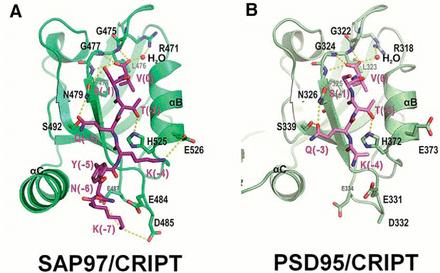 Fig. 1 Structural model of SAP97 PDZ3 in complex with the CRIPT C-terminal tail.1
Key structural properties of CRIPT:
- Contains a conserved CXXC zinc finger domain
- C-terminal with PDZ-binding motifs (-TXL)
- Maintain structural stability through disulfide bonds
- PDZ binding motifs mediate specific interactions with synaptic scaffold proteins
Functions of CRIPT
The core functions and mechanisms of action of CRIPT proteins:
| Function | Description |
| Regulation of synaptic plasticity | The protein network assembly in the postsynaptic dense region is regulated by binding to the PSD-95/SAP97 scaffold protein through the PDZ domain. |
| REDOX regulation | The CXXC domain is involved in the intracellular REDOX balance and protects neurons from oxidative damage. |
| Synaptic signal transduction | As a key component of the scaffold protein complex, it participates in the spatiotemporal coordination of synaptic signal transmission. |
| Neuroprotective effect | Maintaining synaptic stability shows protective functions in neurodegenerative disease models. |
| Dendritic morphogenesis | It participates in the development of neuronal dendrite branches and affects the formation of neural circuits. |
This protein forms a dynamic regulatory network through the specific interaction of its C-terminal PDZ-binding motif (-TXL) with scaffold proteins, and its mode of action presents a typical "domain-motif" recognition feature. Studies have shown that CRIPT plays a pivotal role in neural development and synaptic plasticity, and its functional abnormalities are associated with a variety of neurological diseases.
Applications of CRIPT and CRIPT Antibody in Literature
1. Zhang, Lei, et al. "SAP97 binding partner CRIPT promotes dendrite growth in vitro and in vivo." Eneuro 4.6 (2017).https://doi.org/10.1523/ENEURO.0175-17.2017
The article indicates that CRIPT, as the binding partner of the SAP97 PDZ3 domain, co-locates with the GluA1-AMPA receptor on dendrites and regulates the dendrites of spinal motor neurons. Nematode experiments have confirmed that the absence of CRIPT leads to a reduction in dendrite branches of PVD neurons and tactile defects, while human CRIPT can restore this function, revealing its crucial role in the development and plasticity of the nervous system.
2. Laursen, Louise, et al. "Divergent evolution of a protein–protein interaction revealed through ancestral sequence reconstruction and resurrection." Molecular biology and evolution 38.1 (2021): 152-167. https://doi.org/10.1093/molbev/msaa198
Research has found that the interaction between CRIPT and the PDZ3 domain of the DLG protein has existed in the ancestors of eukaryotes and maintains a high affinity in most animals, but the affinity is significantly reduced in nematodes and insects. This ancient protein interaction shows dynamic evolutionary characteristics in different species and may undergo functional differentiation or loss.
3. Rademacher, Nils, et al. "Intramolecular domain dynamics regulate synaptic MAGUK protein interactions." Elife 8 (2019): e41299. https://doi.org/10.7554/eLife.41299
Research reveals that CRIPT regulates the cascade binding of the G protein subunit Gnb5 by binding to the PDZ3 domain of PSD-95 and inducing conformational changes in the SH3-GK domain, thereby clarifying its key role in the hierarchical assembly of the postsynaptic protein complex.
4. Mahedy, Liam, et al. "Investigation of genetic determinants of cognitive change in later life." Translational Psychiatry 14.1 (2024): 31. https://doi.org/10.1038/s41398-023-02726-6
The research found that the CRIPT/ATP6V1E2 gene variation (rs34743896) was significantly associated with decreased attention in the elderly (p=5×10⁻¹⁰). This genome-wide association study has for the first time revealed the potential role of the CRIPT gene in cognitive decline, providing a new target for delaying cognitive degeneration.
5. Laursen, Louise, et al. "Functional interplay between protein domains in a supramodular structure involving the postsynaptic density protein PSD-95." Journal of Biological Chemistry 295.7 (2020): 1992-2000. https://doi.org/10.1074/jbc.RA119.011050
The article indicates that when the PSG supermodule (PDZ-SH3-GuK) of PSD-95 is combined with CRIPT, there are two conformational states. Although the affinity is similar, the binding rates are different. Research has found that the supertertiary structures formed by adjacent domains regulate protein interactions through conformational changes, revealing the shaping effect of conformational transitions on the binding energy landscape in multi-domain proteins.
Creative Biolabs: CRIPT Antibodies for Research
Creative Biolabs specializes in the production of high-quality CRIPT antibodies for research and industrial applications. Our portfolio includes monoclonal antibodies tailored for immunoprecipitation, immunofluorescence, Western blot, and other diagnostic methodologies.
- Custom CRIPT Antibody Development: Tailor-made solutions to meet specific research requirements.
- Bulk Production: Large-scale antibody manufacturing for industry partners.
- Technical Support: Expert consultation for protocol optimization and troubleshooting.
- Aliquoting Services: Conveniently sized aliquots for long-term storage and consistent experimental outcomes.
For more details on our CRIPT antibodies, custom preparations, or technical support, please contact us.
Reference
- Zhang, Lei, et al. "SAP97 binding partner CRIPT promotes dendrite growth in vitro and in vivo." Eneuro 4.6 (2017).https://doi.org/10.1523/ENEURO.0175-17.2017
Anti-CRIPT antibodies
 Loading...
 Compare




Hot products 
- AActivation
- AGAgonist
- APApoptosis
- BBlocking
- BABioassay
- BIBioimaging
- CImmunohistochemistry-Frozen Sections
- CIChromatin Immunoprecipitation
- CTCytotoxicity
- CSCostimulation
- DDepletion
- DBDot Blot
- EELISA
- ECELISA(Cap)
- EDELISA(Det)
- ESELISpot
- EMElectron Microscopy
- FFlow Cytometry
- FNFunction Assay
- GSGel Supershift
- IInhibition
- IAEnzyme Immunoassay
- ICImmunocytochemistry
- IDImmunodiffusion
- IEImmunoelectrophoresis
- IFImmunofluorescence
- IGImmunochromatography
- IHImmunohistochemistry
- IMImmunomicroscopy
- IOImmunoassay
- IPImmunoprecipitation
- ISIntracellular Staining for Flow Cytometry
- LALuminex Assay
- LFLateral Flow Immunoassay
- MMicroarray
- MCMass Cytometry/CyTOF
- MDMeDIP
- MSElectrophoretic Mobility Shift Assay
- NNeutralization
- PImmunohistologyp-Paraffin Sections
- PAPeptide Array
- PEPeptide ELISA
- PLProximity Ligation Assay
- RRadioimmunoassay
- SStimulation
- SESandwich ELISA
- SHIn situ hybridization
- TCTissue Culture
- WBWestern Blot
