
SLC7A5 Antibodies
Background
The SLC7A5 gene encodes a large neutral amino acid transporter, which is mainly expressed on the cell membrane, especially being highly active in the endothelial cells of the blood-brain barrier and various tumor cells. This protein is responsible for transporting essential amino acids such as leucine and phenylalanine into the cells, thereby directly regulating the mammalian target of rapamycin (mTOR) signaling pathway and influencing cell growth, proliferation, and metabolic processes. Researchers first identified and cloned SLC7A5 in the 1990s. Its function is closely related to the progression of various cancers and the regulation of the immune microenvironment, and has become an important target for tumor metabolic therapy research. The continuous analysis of the structure and function of this transporter has deepened our understanding of biological processes such as nutrient sensing, tumor metabolic reprogramming, and the regulation of immune cell functions.
Structure of SLC7A5
The protein encoded by the SLC7A5 gene is an amino acid transporter with a molecular weight of approximately 55-60 kDa. The exact value may vary slightly depending on different splicing variants or post-translational modifications (such as glycosylation). The secondary structure of the human SLC7A5 protein is mainly composed of transmembrane α-helices, forming a highly conserved 12-transmembrane domain, which is the basis of its transport function. The N-terminal and C-terminal regions are located in the cytoplasm, while the core domain of the protein forms a hydrophilic channel within the membrane, responsible for specifically recognizing and transporting neutral amino acids such as leucine and phenylalanine. The functional activity of this protein is highly dependent on the heterodimeric complex formed with the auxiliary protein SLC3A2 (CD98hc), and this interaction is crucial for ensuring the correct membrane localization and stability of the transport protein.
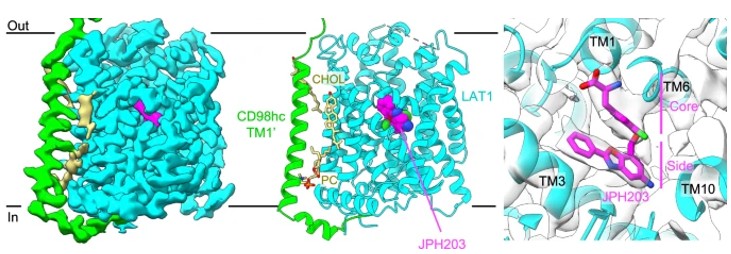 Fig. 1 Cryo-EM map and the overall structure of LAT1(SLC7A5) bound to JPH203.1
Key structural properties of SLC7A5:
- 12 transmembrane α-helical domains constitute the main frame of the structure
- Highly hydrophobic transmembrane regions form selective amino acid transport channels
- The N-terminal and C-terminal domains in the cytoplasm are involved in protein interactions and regulation
Functions of SLC7A5
The main function of the SLC7A5 protein is to act as an essential amino acid transporter on the cell membrane. However, it is also involved in a variety of crucial pathological and physiological processes, including tumor metabolic reprogramming and regulation of the immune microenvironment.
| Function | Description |
| Amino Acid Transport | It efficiently and specifically transports large-molecular neutral amino acids such as leucine and phenylalanine into the cell, serving as a crucial gateway for cells to obtain nutrients. |
| Activation of the mTOR pathway | The leucine that is transported into the cell directly activates the mammalian target of rapamycin (mTOR) signaling pathway, driving cell growth, proliferation and anabolic metabolism. |
| Tumor Growth Support | It is highly expressed in various cancer cells, meeting the abnormal amino acid requirements for their rapid proliferation. This is a key link in the metabolic dependence of tumors. |
| Immune Cell Regulation | By regulating the amino acid levels within immune cells such as T cells, it influences their activation, differentiation and function, thereby participating in the regulation of immune responses. |
| Blood-brain barrier function | Expressed within the endothelial cells of the blood-brain barrier, it is responsible for the supply of essential amino acids to the central nervous system, and affects brain metabolism and function. |
The transport kinetics of this protein exhibits a typical "Mie-Mann saturation feature". Compared to other broad-spectrum amino acid transporters, it has a high affinity and strict selectivity for the substrate, which determines its precise regulatory role in cellular metabolic perception.
Applications of SLC7A5 and SLC7A5 Antibody in Literature
1. Lee, Yongchan, et al. "Structural basis of anticancer drug recognition and amino acid transport by LAT1." Nature Communications 16.1 (2025): 1635. https://doi.org/10.1038/s41467-025-56903-w
This article presents six structures of the amino acid transporter LAT1(SLC7A5) in three conformations, revealing its substrate recognition and drug inhibition mechanism. The clinical anti-cancer drug JPH203 locks it in the outward-open conformation, while the physiological substrate and inhibitor BCH induce different conformational changes, providing a structural basis for targeted drug design.
2. Nachef, Marianna, et al. "Targeting SLC1A5 and SLC3A2/SLC7A5 as a potential strategy to strengthen anti-tumor immunity in the tumor microenvironment." Frontiers in immunology 12 (2021): 624324. https://doi.org/10.3389/fimmu.2021.624324
The article indicates that the nutrient competition within the tumor microenvironment (TME) is a key challenge in immunotherapy. Upregulation of amino acid transporters (such as SLC7A5 and SLC1A5) can enhance the metabolic capacity and anti-tumor function of CAR-T/NK cells, and by activating pathways such as mTORC1, it can overcome the inhibition of the TME, providing a new strategy for improving immunotherapy.
3. Zhou, Zhiyuan, et al. "FBW7/GSK3β mediated degradation of IGF2BP2 inhibits IGF2BP2-SLC7A5 positive feedback loop and radioresistance in lung cancer." Journal of Experimental & Clinical Cancer Research 43.1 (2024): 34. https://doi.org/10.1186/s13046-024-02959-3
The study found that the m6A reading protein IGF2BP2 forms a positive feedback loop by stabilizing SLC7A5 mRNA, thereby promoting radiotherapy resistance in lung cancer. Targeting this pathway may enhance radiotherapy sensitivity and provide a new target for overcoming clinical radiotherapy resistance.
4. Fernandez-Gallego, Nieves, et al. "Restricting SLC7A5-mediated Leucine uptake in T cells prevents acute GVHD and maintains GVT response." EMBO molecular medicine 17.7 (2025): 1631. https://doi.org/10.1038/s44321-025-00250-2
This study has revealed the crucial role of the amino acid transporter SLC7A5 in acute graft-versus-host disease (aGVHD). Inhibiting SLC7A5 or its substrate leucine can regulate T cell metabolism and function, effectively alleviating aGVHD while preserving anti-tumor immune memory, providing a new strategy for immunotherapy.
5. Jiang, Chengfei, et al. "SLC7A5/E2F1/PTBP1/PKM2 axis mediates progression and therapy effect of triple-negative breast cancer through the crosstalk of amino acid metabolism and glycolysis pathway." Cancer Letters 617 (2025): 217612. https://doi.org/10.1016/j.canlet.2025.217612
The study found that SLC7A5 is highly expressed in TNBC and activates the amino acid pathway. Through the SLC7A5/E2F1/PTBP1 axis, it regulates the conversion of PKM1/PKM2, thereby coupling amino acid metabolism with glycolysis, promoting tumor progression and influencing treatment responses.
Creative Biolabs: SLC7A5 Antibodies for Research
Creative Biolabs specializes in the production of high-quality SLC7A5 antibodies for research and industrial applications. Our portfolio includes monoclonal antibodies tailored for ELISA, Flow Cytometry, Western blot, immunohistochemistry, and other diagnostic methodologies.
- Custom SLC7A5 Antibody Development: Tailor-made solutions to meet specific research requirements.
- Bulk Production: Large-scale antibody manufacturing for industry partners.
- Technical Support: Expert consultation for protocol optimization and troubleshooting.
- Aliquoting Services: Conveniently sized aliquots for long-term storage and consistent experimental outcomes.
For more details on our SLC7A5 antibodies, custom preparations, or technical support, contact us at email.
Reference
- Lee, Yongchan, et al. "Structural basis of anticancer drug recognition and amino acid transport by LAT1." Nature Communications 16.1 (2025): 1635. Distributed under the same Creative Commons license CC BY 4.0 as the original. Cropped from the original figure.https://doi.org/10.1038/s41467-025-56903-w
Anti-SLC7A5 antibodies
 Loading...
 Compare


Hot products 
- AActivation
- AGAgonist
- APApoptosis
- BBlocking
- BABioassay
- BIBioimaging
- CImmunohistochemistry-Frozen Sections
- CIChromatin Immunoprecipitation
- CTCytotoxicity
- CSCostimulation
- DDepletion
- DBDot Blot
- EELISA
- ECELISA(Cap)
- EDELISA(Det)
- ESELISpot
- EMElectron Microscopy
- FFlow Cytometry
- FNFunction Assay
- GSGel Supershift
- IInhibition
- IAEnzyme Immunoassay
- ICImmunocytochemistry
- IDImmunodiffusion
- IEImmunoelectrophoresis
- IFImmunofluorescence
- IGImmunochromatography
- IHImmunohistochemistry
- IMImmunomicroscopy
- IOImmunoassay
- IPImmunoprecipitation
- ISIntracellular Staining for Flow Cytometry
- LALuminex Assay
- LFLateral Flow Immunoassay
- MMicroarray
- MCMass Cytometry/CyTOF
- MDMeDIP
- MSElectrophoretic Mobility Shift Assay
- NNeutralization
- PImmunohistologyp-Paraffin Sections
- PAPeptide Array
- PEPeptide ELISA
- PLProximity Ligation Assay
- RRadioimmunoassay
- SStimulation
- SESandwich ELISA
- SHIn situ hybridization
- TCTissue Culture
- WBWestern Blot
