
USP1 Antibodies
Background
The USP1 gene encodes a deubiquitinating enzyme, which is mainly present in the nucleus of eukaryotic cells and participates in regulating the DNA damage repair process. This protein removes ubiquitin molecular chains to stabilize specific protein substrates, thereby ensuring that cells can maintain genomic integrity when encountering replication stress or DNA damage. Tumor cells often rely on the activity of USP1 to resist DNA damage caused by chemotherapy drugs, making it a potential target in cancer treatment. USP1 was first discovered and cloned by scientists in the late 1990s, and its functional research has subsequently been gradually deepened, especially in clarifying its key role in cross-injury DNA synthesis and Fanconi anemia pathways. The structure and regulatory mechanism of this gene have received increasing attention in recent years, providing important clues for understanding DNA repair, cell cycle checkpoints, and the mechanism of cancer occurrence.
Structure of USP1
The protein encoded by the USP1 gene has a molecular weight of approximately 88 kDa and is relatively conserved among different species. The sequence of this protein varies slightly, but the structure of the functional domain is basically the same.
| Species | Human | Mouse | Zebrafish | Fruit fly | Yeast |
| Molecular Weight (kDa) | 88.2 | 88.5 | 89.1 | 85.7 | 92.3 |
| Primary Structural Differences | Contains typical UCH domain | 93% homology to humans | Has two alternative splicing forms | Structural domain simplified | Significantly different regulatory mechanisms |
The USP1 protein consists of 785 amino acids and its spatial folding forms multiple functional domains. The core catalytic region of this protein contains a conserved Cys-box domain and a His-box domain, which together constitute the active center of the deubiquitinating enzyme. The N-terminal domain of USP1 is responsible for substrate recognition and binding, while the C-terminal extension region participates in protein stability regulation. There is a substrate-binding pocket formed by the zinc finger domain in the protein structure, which enables it to specifically recognize and cleave ubiquitin chains. The cysteine and histidine residues in the active site form a catalytic dimer, and the sulfur ester intermediate is formed through this process to achieve the deubiquitinating function.
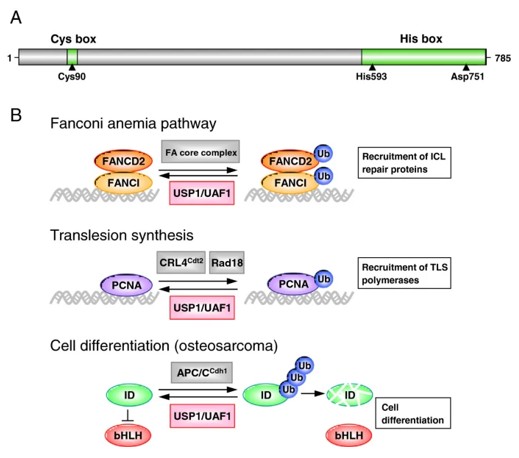 Fig. 1 USP1 Domain structure and summary of the cellular functions of the USP1/UAF1 complex.1
Key structural properties of USP1:
- Contains a catalytic core composed of Cys box and His box
- A substrate recognition pocket formed by zinc finger domain
- A conserved ubiquitin binding region responsible for substrate recruitment
- Aspartic acid residues participate in the formation of the triad and maintain the enzyme activity
Functions of USP1
The main function of USP1 is to regulate DNA damage repair and maintain genomic stability. Additionally, this gene is also involved in cell cycle regulation and the process of tumor occurrence and development.
| Function | Description |
| DNA repair regulation | USP1 deubiquinates substrate proteins such as FANCD2, activates the Fanconi anemia pathway, and promotes the repair of DNA strand cross-linking damage. |
| Replication stress response | When DNA replication is blocked, USP1 stabilizes the monoubiquitinated state of PCNA, regulating the cross-damage DNA synthesis pathway. |
| Cell cycle regulation | USP1 participates in the control of G1/S transition by influencing the stability of cycle-related proteins such as ID1/ID2. |
| Chemotherapy resistance | In tumor cells, high expression of USP1 enhances DNA damage repair ability, leading to resistance to chemotherapy drugs such as cisplatin. |
| Maintenance of hematopoietic stem cells | USP1 maintains normal hematopoietic function by regulating the cell cycle and self-renewal ability of hematopoietic stem cells. |
The mRNA expression level of USP1 varies significantly among different tissues, and it shows a dynamic response to DNA damage stimulation, demonstrating its regulatory characteristics in specific cellular states.
Applications of USP1 and USP1 Antibody in Literature
1. García-Santisteban, Iraia, et al. "USP1 deubiquitinase: cellular functions, regulatory mechanisms and emerging potential as target in cancer therapy." Molecular cancer 12.1 (2013): 91. https://doi.org/10.1186/1476-4598-12-91
USP1 plays a crucial role in the DNA damage response and its dysregulation is associated with cancer. Studies have shown that inhibiting USP1 can reverse cisplatin resistance in non-small cell lung cancer, making it a potential anti-cancer target. This article reviews the functional mechanism of USP1, combines data analysis to explore its relationship with cancer, and discusses the therapeutic effect of the inhibitor pimicin combined with cisplatin.
2. Tyagi, Apoorvi, et al. "CRISPR/Cas9-based genome-wide screening for deubiquitinase subfamily identifies USP1 regulating MAST1-driven cisplatin-resistance in cancer cells." Theranostics 12.13 (2022): 5949. https://doi.org/10.7150/thno.72826
The article indicates that USP1 stabilizes the MAST1 protein through deubiquitination, activates the MEK pathway, and drives tumor cisplatin resistance. Combined inhibition of USP1 and MAST1 can synergistically sensitize to cisplatin, providing a new strategy for overcoming drug resistance.
3. Aboukheili, Amir Mahdi Mazloumi, and Helen Walden. "USP1 in regulation of DNA repair pathways." DNA repair 146 (2025): 103807. https://doi.org/10.1016/j.dnarep.2025.103807
The article indicates that USP1, as a deubiquitinating enzyme, is highly expressed in various cancers and is associated with poor prognosis. It affects tumor occurrence and development by regulating processes such as DNA repair, and its activity is regulated by multiple mechanisms such as UAF1, making it a potential target for anti-cancer therapy.
4. Li, Xi-Ya, et al. "Inhibition of USP1 reverses the chemotherapy resistance through destabilization of MAX in the relapsed/refractory B-cell lymphoma." Leukemia 37.1 (2023): 164-177. https://doi.org/10.1038/s41375-022-01747-2
The article indicates that USP1 is highly expressed in drug-resistant DLBCL, and it stabilizes MAX through deubiquitination, promoting cancerogenesis. The inhibitor pimicin can inhibit tumor growth and synergistically enhance the efficacy with chemotherapy drugs, providing a new strategy for recurrent and refractory DLBCL.
5. Kim, Myung Sup, et al. "Deubiquitinase USP1 enhances CCAAT/enhancer-binding protein beta (C/EBPβ) stability and accelerates adipogenesis and lipid accumulation." Cell Death & Disease 14.11 (2023): 776. https://doi.org/10.1038/s41419-023-06317-7
The article indicates that USP1 stabilizes C/EBPβ through deubiquitination, thereby promoting fat production. Its inhibitor, ML323, can reduce the body weight of obese mice and improve metabolism, providing a potential new therapeutic strategy for metabolic diseases.
Creative Biolabs: USP1 Antibodies for Research
Creative Biolabs specializes in the production of high-quality USP1 antibodies for research and industrial applications. Our portfolio includes monoclonal and polyclonal antibodies tailored for ELISA, Flow Cytometry, Western blot, immunohistochemistry, and other diagnostic methodologies.
- Custom USP1 Antibody Development: Tailor-made solutions to meet specific research requirements.
- Bulk Production: Large-scale antibody manufacturing for industry partners.
- Technical Support: Expert consultation for protocol optimization and troubleshooting.
- Aliquoting Services: Conveniently sized aliquots for long-term storage and consistent experimental outcomes.
For more details on our USP1 antibodies, custom preparations, or technical support, contact us at email.
Reference
- García-Santisteban, Iraia, et al. "USP1 deubiquitinase: cellular functions, regulatory mechanisms and emerging potential as target in cancer therapy." Molecular cancer 12.1 (2013): 91. Distributed under Open Access license CC BY 2.0, without modification. https://doi.org/10.1186/1476-4598-12-91
Anti-USP1 antibodies
 Loading...
 Compare




Hot products 
- AActivation
- AGAgonist
- APApoptosis
- BBlocking
- BABioassay
- BIBioimaging
- CImmunohistochemistry-Frozen Sections
- CIChromatin Immunoprecipitation
- CTCytotoxicity
- CSCostimulation
- DDepletion
- DBDot Blot
- EELISA
- ECELISA(Cap)
- EDELISA(Det)
- ESELISpot
- EMElectron Microscopy
- FFlow Cytometry
- FNFunction Assay
- GSGel Supershift
- IInhibition
- IAEnzyme Immunoassay
- ICImmunocytochemistry
- IDImmunodiffusion
- IEImmunoelectrophoresis
- IFImmunofluorescence
- IGImmunochromatography
- IHImmunohistochemistry
- IMImmunomicroscopy
- IOImmunoassay
- IPImmunoprecipitation
- ISIntracellular Staining for Flow Cytometry
- LALuminex Assay
- LFLateral Flow Immunoassay
- MMicroarray
- MCMass Cytometry/CyTOF
- MDMeDIP
- MSElectrophoretic Mobility Shift Assay
- NNeutralization
- PImmunohistologyp-Paraffin Sections
- PAPeptide Array
- PEPeptide ELISA
- PLProximity Ligation Assay
- RRadioimmunoassay
- SStimulation
- SESandwich ELISA
- SHIn situ hybridization
- TCTissue Culture
- WBWestern Blot
