
FOXA1 Antibodies
Background
The FOXA1 gene encodes a nucleoprotein belonging to the Forkhead box transcription factor family and is mainly expressed in epithelial cells. This protein plays a key role in organ development, cell differentiation and metabolic homeostasis by binding to specific sequences in the promoter regions of target genes, regulating chromatin structure and promoting the binding of other transcription factors. It was first identified in the early 1990s and was called "hepatocyte nuclear factor 3α" (HNF3α) because it can activate the expression of liver-specific genes. As a typical representative of the pioneer factor, the discovery of FOXA1 has greatly deepened people's understanding of the molecular mechanisms of gene transcription initiation, hormone signal regulation, and related diseases (such as cancer and metabolic disorders), and has become an important molecule in the research of developmental biology and oncology.
Structure of FOXA1
FOXA1 is a forkhead box A1 transcription factor, and its molecular weight varies with different protein isotypes. The molecular weight of the main human FOXA1 subtype is approximately 49 kDa.
| Species | Human | Mouse | Rat |
| Molecular Weight (kDa) | ~49 | ~48 | ~49 |
| Primary Structural Differences | Highly conserved DNA-binding domains with species-specific differences in the trans-activation domain | The DNA binding domain is highly homologous to that of humans, but its regulatory functions are slightly different | Structure and function is similar to human height, is a common research model |
The FOXA1 protein is composed of approximately 470 amino acids, and its structure contains three key functional domains: a highly conserved "wing-shaped helical" DNA-binding domain (located in the C-terminal region), which is responsible for specifically recognizing and binding to DNA sequences; A nuclear localization signal located at the center, as well as an N-terminal trans activation domain involved in transcriptional regulation and protein-protein interactions. Its three-dimensional structure presents a typical fork-head frame family fold, enabling FOXA1 to act as a "pioneer factor", being the first to bind and activate target genes in a tight chromatin environment, laying the foundation for the recruitment of other transcription factors and co-regulatory proteins.
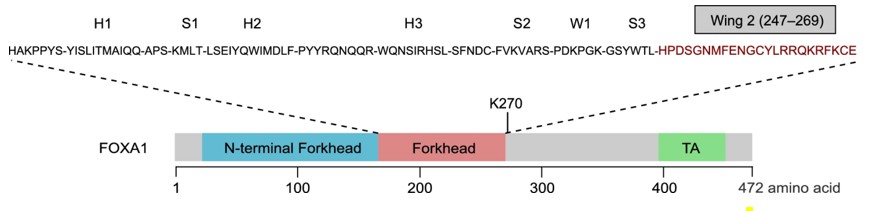 Fig. 1 Protein map of FOXA1 functional domains and secondary structures.1
Key structural properties of FOXA1:
- Wing-shaped helix (fork-head frame) DNA-binding domain
- Flexible connection area and verified location signal
- Inversely activate the domain
Functions of FOXA1
The core function of the FOXA1 gene is to act as a "pioneer factor" in transcriptional regulation to initiate gene expression and play a key role in cell differentiation, organ development and metabolic homeostasis.
| Function | Description |
| Chromatin opening | FOXA1 can bind to tightly wrapped nucleosome DNA, promoting the loosening of local chromatin structure and creating accessibility for the subsequent binding of other transcription factors. |
| Activation of target genes | By recruiting RNA polymerase II, universal transcription factors and histone modification enzymes (such as p300/CBP), the transcription of downstream target genes (such as hepatocellular specific genes and hormone receptor genes) is directly initiated. |
| Regulation of development and differentiation | In the liver, pancreas, prostate, and breast in early development and cell fate determination in organs, such as to play a leading role, guide the establishment of tissue specific gene expression program. |
| Hormone signal integration | As a key cofactor of nuclear receptors (such as estrogen receptors and androgen receptors), it assists hormone-receptor complexes in binding to chromatin and amplifies hormone signaling pathways. |
| Disease-related regulation | In hormone-dependent cancers such as prostate cancer and breast cancer, abnormal expression or mutation of FOXA1 can reprogram the enhancer sublandscape, driving tumor occurrence, progression and treatment resistance. |
Unlike common transcription factors, FOXA1 has the ability to bind and "pioneer" on tight chromatin first. Its role is similar to that of a "founder" of gene expression, laying the foundation for subsequent complex regulatory cascades.
Applications of FOXA1 and FOXA1 Antibody in Literature
1. Del Giudice, Marco, et al. "FOXA1 regulates alternative splicing in prostate cancer." Cell reports 40.13 (2022). https://doi.org/10.1016/j.celrep.2022.111404
The article indicates that FOXA1 dominates the transcriptome selective splicing disorder in prostate cancer by binding to the regulatory region of splicing factor genes, especially promoting the production of oncogenic splicing variants through SRSF1, inhibiting inrighteous-mediated degradation, and driving tumor progression and recurrence risk.
2. Chai, Yanfei, et al. "S1PR1 suppresses lung adenocarcinoma progression through p-STAT1/miR-30c-5 p/FOXA1 pathway." Journal of Experimental & Clinical Cancer Research 43.1 (2024): 304. https://doi.org/10.1186/s13046-024-03230-5
The article indicates that S1PR1 is down-regulated in lung adenocarcinoma, inhibits the expression of FOXA1 through the p-STAT1/miR-30c-5p axis, thereby reducing the levels of target genes such as COL5A1, and ultimately inhibits tumor proliferation and metastasis. Its low expression is associated with a poor prognosis.
3. Eyunni, Sanjana, et al. "Divergent FOXA1 mutations drive prostate tumorigenesis and therapy-resistant cellular plasticity." Science (2025): eadv2367. https://doi.org/10.1126/science.adv2367
The article indicates that FOXA1 mutations drive prostate cancer in mouse models with categorical differences. Class I mutations combined with p53 inactivation promote androgen-dependent adenocarcinoma through mTOR and AR signaling. Class II mutations reshape lumen cells to a progenitor cell-like state through KLF5 and other means, inducing castration-resistant progression.
4. Lv, Shidong, et al. "Integrated analysis reveals FOXA1 and Ku70/Ku80 as targets of ivermectin in prostate cancer." Cell death & disease 13.9 (2022): 754. https://doi.org/10.1038/s41419-022-05182-0
The article indicates that the antiparasitic drug ivermectin inhibits the AR signaling pathway and chromatin accessibility by directly targeting FOXA1, and simultaneously binds to Ku70/Ku80 proteins to block DNA damage repair, thereby inducing cycle arrest and apoptosis of prostate cancer cells and demonstrating anti-tumor potential.
5. Wu, Yongxin, et al. "FOXA1-dependent PUS1 regulates EIF3b stability in a non-enzymatic pathway mediating prostate cancer bone metastasis." International Journal of Biological Sciences 20.11 (2024): 4566. https://doi.org/10.7150/ijbs.100905
Research has found that FOXA1 drives bone metastasis of prostate cancer by activating PUS1 transcription and stabilizing the downstream EIF3b protein to inhibit its ubiquitination and degradation. Compounds targeting and inhibiting this axis have demonstrated anti-metastasis potential, suggesting new therapeutic directions.
Creative Biolabs: FOXA1 Antibodies for Research
Creative Biolabs specializes in the production of high-quality FOXA1 antibodies for research and industrial applications. Our portfolio includes monoclonal antibodies tailored for ELISA, Flow Cytometry, Western blot, immunohistochemistry, and other diagnostic methodologies.
- Custom FOXA1 Antibody Development: Tailor-made solutions to meet specific research requirements.
- Bulk Production: Large-scale antibody manufacturing for industry partners.
- Technical Support: Expert consultation for protocol optimization and troubleshooting.
- Aliquoting Services: Conveniently sized aliquots for long-term storage and consistent experimental outcomes.
For more details on our FOXA1 antibodies, custom preparations, or technical support, contact us at email.
Reference
- Teng, Mona, et al. "Pioneer of prostate cancer: past, present and the future of FOXA1." Protein & Cell 12.1 (2021): 29-38. https://doi.org/10.1007/s13238-020-00786-8
Anti-FOXA1 antibodies
 Loading...
 Compare




Hot products 
-
Rat Anti-(1-5)-α-L-Arabinan Recombinant Antibody (V2-501861) (CBMAB-XB0003-YC)

-
Mouse Anti-AQP2 Recombinant Antibody (E-2) (CBMAB-A3358-YC)

-
Mouse Anti-BHMT Recombinant Antibody (CBYY-0547) (CBMAB-0550-YY)

-
Mouse Anti-G6PD Recombinant Antibody (13B331) (CBMAB-G1553-LY)

-
Rat Anti-ADGRE4 Recombinant Antibody (V2-160163) (CBMAB-F0011-CQ)

-
Mouse Anti-2C TCR Recombinant Antibody (V2-1556) (CBMAB-0951-LY)

-
Rabbit Anti-ALOX5AP Recombinant Antibody (CBXF-1219) (CBMAB-F0750-CQ)

-
Mouse Anti-CCDC25 Recombinant Antibody (CBLC132-LY) (CBMAB-C9786-LY)

-
Mouse Anti-FN1 Monoclonal Antibody (D6) (CBMAB-1240CQ)

-
Mouse Anti-AKR1C3 Recombinant Antibody (V2-12560) (CBMAB-1050-CN)

-
Rabbit Anti-ALK (Phosphorylated Y1278) Recombinant Antibody (D59G10) (PTM-CBMAB-0035YC)

-
Mouse Anti-AOC3 Recombinant Antibody (CBYY-0014) (CBMAB-0014-YY)

-
Mouse Anti-4-Hydroxynonenal Recombinant Antibody (V2-502280) (CBMAB-C1055-CN)

-
Rat Anti-ABCC11 Recombinant Antibody (V2-179001) (CBMAB-A0236-YC)

-
Mouse Anti-FOXL1 Recombinant Antibody (CBXF-0845) (CBMAB-F0462-CQ)

-
Mouse Anti-FLT1 Recombinant Antibody (11) (CBMAB-V0154-LY)

-
Mouse Anti-ESR1 Recombinant Antibody (Y31) (CBMAB-1208-YC)

-
Mouse Anti-GFAP Recombinant Antibody (24) (CBMAB-G2927-LY)

-
Mouse Anti-GluRIIA Monoclonal Antibody (8B4D2) (CBMAB-0305-CN)

-
Mouse Anti-Gro Monoclonal Antibody (1) (CBMAB-0482-LY)

- AActivation
- AGAgonist
- APApoptosis
- BBlocking
- BABioassay
- BIBioimaging
- CImmunohistochemistry-Frozen Sections
- CIChromatin Immunoprecipitation
- CTCytotoxicity
- CSCostimulation
- DDepletion
- DBDot Blot
- EELISA
- ECELISA(Cap)
- EDELISA(Det)
- ESELISpot
- EMElectron Microscopy
- FFlow Cytometry
- FNFunction Assay
- GSGel Supershift
- IInhibition
- IAEnzyme Immunoassay
- ICImmunocytochemistry
- IDImmunodiffusion
- IEImmunoelectrophoresis
- IFImmunofluorescence
- IGImmunochromatography
- IHImmunohistochemistry
- IMImmunomicroscopy
- IOImmunoassay
- IPImmunoprecipitation
- ISIntracellular Staining for Flow Cytometry
- LALuminex Assay
- LFLateral Flow Immunoassay
- MMicroarray
- MCMass Cytometry/CyTOF
- MDMeDIP
- MSElectrophoretic Mobility Shift Assay
- NNeutralization
- PImmunohistologyp-Paraffin Sections
- PAPeptide Array
- PEPeptide ELISA
- PLProximity Ligation Assay
- RRadioimmunoassay
- SStimulation
- SESandwich ELISA
- SHIn situ hybridization
- TCTissue Culture
- WBWestern Blot
