
NFIX Antibodies
Background
The NFIX gene encodes a transcription factor of the nuclear factor I/X (NFI/X) family, which is mainly expressed during the development of the central nervous system, skeletal muscle and multiple organs. This protein regulates the transcription of downstream genes by binding to specific DNA sequences, thereby participating in important biological processes such as cell differentiation, tissue growth, and embryonic development. Research has found that functional abnormalities of the NFIX gene are closely related to various human diseases such as intellectual development disorders and abnormal bone development. Since its discovery, NFIX has become a key object of research in genetics and molecular biology due to its core role in developmental regulation, greatly promoting people's understanding of transcriptional regulatory mechanisms and their roles in development and disease.
Structure of NFIX
The molecular weight of the protein encoded by the NFIX gene is approximately 52-55 kDa. The specific molecular weight may vary slightly due to different splicing isomers (such as NFIX-S and NFIX-L). This protein belongs to the nuclear factor I (NFI) transcription factor family, and its primary structure contains a highly conserved N-terminal DNA-binding domain and a variable C-terminal transactivator domain. This protein regulates transcription by forming homologous or heterodimers and binding to a specific palindromic sequence (TTGGCN5GCCAA) in the promoter region of the target gene. Its function mainly relies on two key domains: the N-terminal domain is responsible for specific recognition and binding to DNA, while the C-terminal domain participates in protein-protein interactions and recruits other transcriptional co-regulatory factors, jointly regulating gene expression related to nervous system development, bone formation and cell differentiation. The subcellular localization of this protein is mainly located in the nucleus.
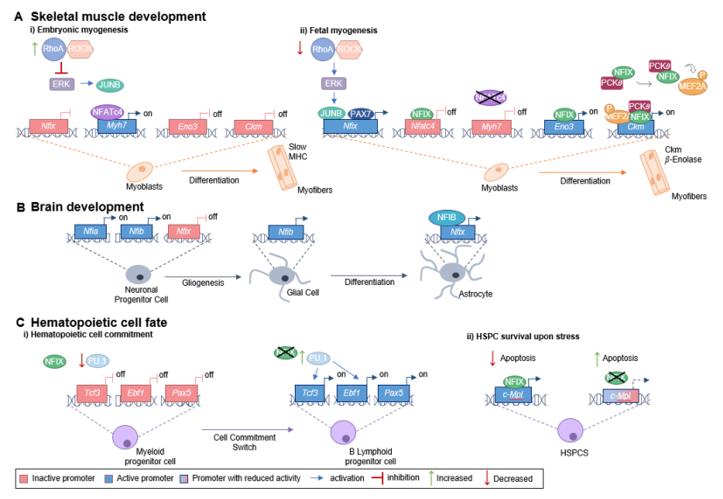 Fig. 1 Role of NFIX in development.1
Key structural properties of NFIX:
- Highly conserved N-terminal DNA binding domains
- Variable C-terminal trans-activated domain, rich in proline and acidic amino acids
- Functional units are formed by dimerization that bind palindromic sequence DNA
- Multiple phosphorylation sites in the C-terminal domain regulate transcriptional activity and subcellular localization
Functions of NFIX
The main function of the protein encoded by the NFIX gene is to regulate gene expression as a transcription factor, and its core role is reflected in embryonic development and tissue differentiation. The specific functions are as follows.
| Function | Description |
| Neurodevelopmental regulation | In the development of the central nervous system, NFIX regulates the proliferation, differentiation and migration of neural precursor cells, which is crucial for the normal formation of the hippocampus and cerebellum. |
| Regulation of Bone Development | It participates in the differentiation of osteoblasts and the formation of bone matrix, and is a key regulatory factor for the normal growth and development of bones. |
| Organ morphogenesis | During the development of multiple organs such as the heart and lungs, by regulating downstream target genes, it guides the correct determination of cell fate and tissue configuration. |
| Dual transcriptional regulation | It can either activate or inhibit the transcription of specific genes, depending on the co-regulatory factors they bind to and the background of the cellular environment. |
| Disease-related functions | Its functional loss or mutation is directly related to a variety of human diseases, such as Marsa syndrome (intellectual developmental disorder with skeletal abnormalities) and glioma occurrence, etc. |
The NFIX protein alters the local epigenetic state by binding to DNA and recruiting chromatin modification complexes, thereby achieving precise spatiotemporal regulation of downstream gene networks. Compared with other general transcription factors, its function has a high degree of tissue specificity and developmental stage specificity.
Applications of NFIX and NFIX Antibody in Literature
1. Ribeiro, Vanessa, et al. "NFIXing cancer: the role of NFIX in oxidative stress response and cell fate." International Journal of Molecular Sciences 24.5 (2023): 4293. https://doi.org/10.3390/ijms24054293
Research reveals that the regulatory mechanism of NFIX transcription factors is complex and crucial during embryonic development, but their expression is restricted in adulthood. Its role in cancer is dual, either promoting or inhibiting cancer, closely related to the perception of oxidative stress and multi-level regulation, and it is a key factor influencing the occurrence and development of tumors.
2. Ma, Hai-Yan, et al. "NFIX suppresses breast cancer cell proliferation by delaying mitosis through downregulation of CDK1 expression." Cell Death Discovery 11.1 (2025): 77. https://doi.org/10.1038/s41420-025-02361-8
Research has found that NFIX is down-regulated in breast cancer. By promoting the ubiquitination and degradation of CDK1 and competitively inhibiting its transcription, it blocks the cell cycle at the G2/M phase, thereby inhibiting tumor proliferation and exerting an anti-cancer effect. Its expression is regulated by promoter methylation.
3. Harkins, Danyon, et al. "Hydrocephalus in Nfix−/− mice is underpinned by changes in ependymal cell physiology." Cells 11.15 (2022): 2377. https://doi.org/10.3390/cells11152377
Research has found that the absence of NFIX leads to abnormal ciliary structure and adhesion protein localization of ependymal cells in the lateral ventricles of mice, disrupting intercellular connections and thereby causing hydrocephalus and cell shedding. This effect exists in both the developmental and adult periods, revealing that NFIX is a key factor in regulating the adhesion of ependymal cells.
4. Huang, Senlin, et al. "Loss of super-enhancer-regulated circRNA Nfix induces cardiac regeneration after myocardial infarction in adult mice." Circulation 139.25 (2019): 2857-2876. https://doi.org/10.1161/CIRCULATIONAHA.118.038361
Research has found that the circular RNA circNfix regulated by super enhancers is overexpressed in the myocardium. Inhibiting circNfix can promote the proliferation of myocardial cells and angiogenesis, and improve cardiac function after myocardial infarction. The mechanism involves preventing the degradation of Ybx1 protein and competitively binding to miR-214.
5. Kooblall, Kreepa G., et al. "A Mouse Model with a Frameshift Mutation in the Nuclear Factor I/X (NFIX) Gene Has Phenotypic Features of Marshall Smith Syndrome." Journal of Bone and Mineral Research Plus 7.6 (2023): e10739. https://doi.org/10.1002/jbm4.10739
Research has found that a frameshift mutation (Del2) in exon 7 of the NFIX gene, which escapes the NMD mechanism, can cause growth retardation, skeletal abnormalities and brain structural changes in mice, successfully simulating the phenotype of human Marshall-Smith syndrome and providing an animal model for the study of this disease.
Creative Biolabs: NFIX Antibodies for Research
Creative Biolabs specializes in the production of high-quality NFIX antibodies for research and industrial applications. Our portfolio includes monoclonal antibodies tailored for ELISA, Flow Cytometry, Western blot, immunohistochemistry, and other diagnostic methodologies.
- Custom NFIX Antibody Development: Tailor-made solutions to meet specific research requirements.
- Bulk Production: Large-scale antibody manufacturing for industry partners.
- Technical Support: Expert consultation for protocol optimization and troubleshooting.
- Aliquoting Services: Conveniently sized aliquots for long-term storage and consistent experimental outcomes.
For more details on our NFIX antibodies, custom preparations, or technical support, contact us at email.
Reference
- Ribeiro, Vanessa, et al. "NFIXing cancer: the role of NFIX in oxidative stress response and cell fate." International Journal of Molecular Sciences 24.5 (2023): 4293. https://doi.org/10.3390/ijms24054293
Anti-NFIX antibodies
 Loading...
 Compare




Hot products 
- AActivation
- AGAgonist
- APApoptosis
- BBlocking
- BABioassay
- BIBioimaging
- CImmunohistochemistry-Frozen Sections
- CIChromatin Immunoprecipitation
- CTCytotoxicity
- CSCostimulation
- DDepletion
- DBDot Blot
- EELISA
- ECELISA(Cap)
- EDELISA(Det)
- ESELISpot
- EMElectron Microscopy
- FFlow Cytometry
- FNFunction Assay
- GSGel Supershift
- IInhibition
- IAEnzyme Immunoassay
- ICImmunocytochemistry
- IDImmunodiffusion
- IEImmunoelectrophoresis
- IFImmunofluorescence
- IGImmunochromatography
- IHImmunohistochemistry
- IMImmunomicroscopy
- IOImmunoassay
- IPImmunoprecipitation
- ISIntracellular Staining for Flow Cytometry
- LALuminex Assay
- LFLateral Flow Immunoassay
- MMicroarray
- MCMass Cytometry/CyTOF
- MDMeDIP
- MSElectrophoretic Mobility Shift Assay
- NNeutralization
- PImmunohistologyp-Paraffin Sections
- PAPeptide Array
- PEPeptide ELISA
- PLProximity Ligation Assay
- RRadioimmunoassay
- SStimulation
- SESandwich ELISA
- SHIn situ hybridization
- TCTissue Culture
- WBWestern Blot
