
NRXN1 Antibodies
Background
The NRXN1 gene encodes axon protein-1, a cell adhesion molecule mainly distributed in the presynaptic membrane of the central nervous system. This protein interacts with other synaptic proteins to participate in regulating the formation, differentiation and functional maintenance of synapses, thereby influencing the release of neurotransmitters and signal transmission between neurons. This gene was first identified in 1992 and has become an important model in neuroscience research due to its crucial role in synaptic tissue. Abnormalities of the NRXN1 gene are closely related to various neurodevelopmental disorders, such as autism spectrum disorder and schizophrenia. The study of its molecular mechanism has greatly promoted people's understanding of synaptogenesis and the function of neural circuits.
Structure of NRXN1
Neurexin-1, encoded by the NRXN1 gene, is a transmembrane protein with a molecular weight of approximately 160-220 kDa. The specific value varies due to the length difference of its main splicing isomers (NRXN1-α and NRXN1-β).
| Species | Human | Mouse | Rat |
| Molecular Weight (kDa) | α: ~220, β: ~110 | α: ~210, β: ~105 | α: ~215, β: ~108 |
| Primary Structural Differences | Extracellular section contains multiple LNS structure domain and EGF sample repeat sequences | Highly homologous to humans, with a conserved core domain | The composition of the domain is consistent with the typical characteristics of rodent model animals |
The primary structure of this protein consists of a long extracellular domain, a transmembrane region and a short intracellular tail. The core feature lies in the presence of multiple laminin G-like domains and epidermal growth factor-like repeat sequences in the extracellular segment. These domains constitute the molecular interfaces for specific binding with other postsynaptic proteins (such as neuroligins), directly determining the specificity and functional diversity of the synapse. Through selective splicing, this gene can generate thousands of different protein subtypes, greatly enriching the molecular coding of neural connections.
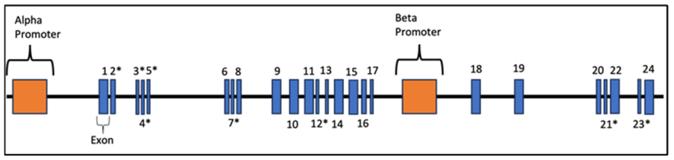 Fig. 1 NRXN1 gene structure.1
Key structural properties of NRXN1:
- The extracellular domain contains multiple laminin G-like domains and EGF-like repeats
- Transmembrane domains are anchored to the presynaptic membrane
- Intracellular period is shorter, PDZ domain structure combined with the base sequence
Functions of NRXN1
The core function of the protein encoded by the NRXN1 gene is to act as the organizer and regulator of synapses. Its main functions and corresponding descriptions are as follows:
| Function | Description |
| Synaptic tissue | By specifically binding to postsynaptic ligands (such as neuroligins) in the extracellular domain, it initiates and guides the formation of excitatory and inhibitory synapses, determining the type of synapse. |
| Signal Transduction | Its intracellular domain serves as a molecular scaffold, recruiting and anchoring presynaptic release machine proteins, and regulating the release probability and duration of neurotransmitters. |
| Neurodevelopment | Mediating axon orientation and specific recognition between neurons, it plays a crucial "molecular tag" role in the construction of neural networks. |
| Synaptic plasticity | Through selective splicing, various subtypes with different functions are generated, dynamically regulating synaptic strength and stability, and influencing learning and memory. |
| Association with Neurological Diseases | Its functional loss or mutation is directly related to various neurodevelopmental disorders (such as autism and schizophrenia), suggesting its core position in maintaining the homeostasis of neural circuits. |
The function of the NRXN1 protein is highly dependent on its complex splicing diversity and interactions with multiple ligands, making it a crucial, multifunctional synaptic signaling hub in the central nervous system.
Applications of NRXN1 and NRXN1 Antibody in Literature
1. Wang, Xinyue, et al. "A novel rabbit anti-myoglobin monoclonal antibody's potential application in rhabdomyolysis associated acute kidney injury."International Journal of Molecular Sciences 24.9 (2023): 7822. https://doi.org/10.1515/med-2024-0979
The article indicates that the clinical features of NRXN1-related diseases are diverse and atypical, mainly manifested as non-specific facial deformities and neurological symptoms, such as intellectual disability, autism and epilepsy. Its association with PTHSL2 still needs to be clarified, and the diagnosis depends on genetic testing.
2. Cooper, Jaimee N., et al. "Landscape of NRXN1 gene variants in phenotypic manifestations of autism spectrum disorder: a systematic review."Journal of clinical medicine 13.7 (2024): 2067. https://doi.org/10.3390/jcm13072067
The article indicates that NRXN1 gene variations are closely related to the pathological mechanism of autism spectrum disorder (ASD). Research has found that this gene mutation affects synaptic function and neural connections, leading to a high degree of heterogeneity in the clinical manifestations of ASD. A thorough clarification of its mechanism of action is expected to provide a new direction for treatment.
3. Sebastian, Rebecca, et al. "Schizophrenia-associated NRXN1 deletions induce developmental-timing-and cell-type-specific vulnerabilities in human brain organoids."Nature Communications 14.1 (2023): 3770. https://doi.org/10.1038/s41467-023-39420-6
The article indicates that the deletion of the NRXN1 gene significantly increases the risk of schizophrenia. Research has found that this deletion disrupts the synaptic function and network synchrony of neurons in different genetic backgrounds, and specifically interferes with the early neural precursor development trajectory in the patient background.
4. Wu, Di, et al. "NRXN1 depletion in the medial prefrontal cortex induces anxiety-like behaviors and abnormal social phenotypes along with impaired neurite outgrowth in rat."Journal of neurodevelopmental disorders 15.1 (2023): 6. https://doi.org/10.1186/s11689-022-09471-9
The article indicates that the down-regulation of the NRXN1 gene can damage the development of neurons in the prefrontal cortex, leading to anxiety and abnormal social behaviors. Proteomic analysis revealed that this change significantly affected the extracellular matrix and membrane structure-related pathways, revealing the key role of NRXN1 in neurodevelopmental disorders.
5. Maury, Eduardo A., et al. "Schizophrenia-associated somatic copy-number variants from 12,834 cases reveal recurrent NRXN1 and ABCB11 disruptions."Cell genomics 3.8 (2023). https://doi.org/10.1016/j.xgen.2023.100356
Research has found that somatic copy number variations (sCNVs) are more common in patients with schizophrenia. Among them, the specific somatic deletion of the NRXN1 gene disrupts its chromatin spatial structure, revealing a new mechanism by which this gene affects disease risk through somatic variations.
Creative Biolabs: NRXN1 Antibodies for Research
Creative Biolabs specializes in the production of high-quality NRXN1 antibodies for research and industrial applications. Our portfolio includes monoclonal antibodies tailored for ELISA, Flow Cytometry, Western blot, immunohistochemistry, and other diagnostic methodologies.
- Custom NRXN1 Antibody Development: Tailor-made solutions to meet specific research requirements.
- Bulk Production: Large-scale antibody manufacturing for industry partners.
- Technical Support: Expert consultation for protocol optimization and troubleshooting.
- Aliquoting Services: Conveniently sized aliquots for long-term storage and consistent experimental outcomes.
For more details on our NRXN1 antibodies, custom preparations, or technical support, contact us at email.
Reference
- Cooper, Jaimee N., et al. "Landscape of NRXN1 gene variants in phenotypic manifestations of autism spectrum disorder: a systematic review."Journal of clinical medicine 13.7 (2024): 2067. https://doi.org/10.3390/jcm13072067
Anti-NRXN1 antibodies
 Loading...
 Compare




Hot products 
- AActivation
- AGAgonist
- APApoptosis
- BBlocking
- BABioassay
- BIBioimaging
- CImmunohistochemistry-Frozen Sections
- CIChromatin Immunoprecipitation
- CTCytotoxicity
- CSCostimulation
- DDepletion
- DBDot Blot
- EELISA
- ECELISA(Cap)
- EDELISA(Det)
- ESELISpot
- EMElectron Microscopy
- FFlow Cytometry
- FNFunction Assay
- GSGel Supershift
- IInhibition
- IAEnzyme Immunoassay
- ICImmunocytochemistry
- IDImmunodiffusion
- IEImmunoelectrophoresis
- IFImmunofluorescence
- IGImmunochromatography
- IHImmunohistochemistry
- IMImmunomicroscopy
- IOImmunoassay
- IPImmunoprecipitation
- ISIntracellular Staining for Flow Cytometry
- LALuminex Assay
- LFLateral Flow Immunoassay
- MMicroarray
- MCMass Cytometry/CyTOF
- MDMeDIP
- MSElectrophoretic Mobility Shift Assay
- NNeutralization
- PImmunohistologyp-Paraffin Sections
- PAPeptide Array
- PEPeptide ELISA
- PLProximity Ligation Assay
- RRadioimmunoassay
- SStimulation
- SESandwich ELISA
- SHIn situ hybridization
- TCTissue Culture
- WBWestern Blot
