
PROX1 Antibodies
Background
The PROX1 gene encodes a transcription factor that plays a crucial role in the embryonic development and tissue differentiation of vertebrates. This protein is mainly expressed in cells of organs such as the lymphatic system, nervous system, and pancreas, and regulates downstream target genes to guide cell fate determination and organ formation. Since it was first identified in mice in the 1990s, PROX1 has been proven to have an indispensable regulatory function in lymphatic vessel development. Its absence leads to severe lymphatic system defects. The molecular mechanism study of this gene not only deepens people's understanding of developmental biology but also provides important clues for the pathological exploration of related diseases (such as lymphedema and tumor metastasis).
Structure of PROX1
The PROX1 gene encodes a relatively large transcription factor protein with a molecular weight of approximately 85-90 kDa. This molecular weight varies among different species, mainly due to the conservation of its functional domains (such as the homologous domain and proline-rich region) as well as the existence of different transcript variants.
| Species | Human | Mouse | Zebrafish |
| Molecular Weight (kDa) | ~85 | ~83 | ~79 |
| Primary Structural Differences | Homologous domain, proline-rich region | Highly conservative homologous domain | Conserved homologous domains, regulating lymphatic vessel development |
This protein is composed of approximately 737 amino acids. Its core structure contains a homologous domain that is responsible for recognizing and binding to specific DNA sequences. Its three-dimensional structure enables this domain to be embedded in the deep groove of the DNA double helix, thereby regulating the transcription of downstream genes. The N-terminal and C-terminal regions of this protein usually have transcriptional activation or inhibition functions, and their activities are finely regulated by various post-translational modifications such as phosphorylation and acetylation.
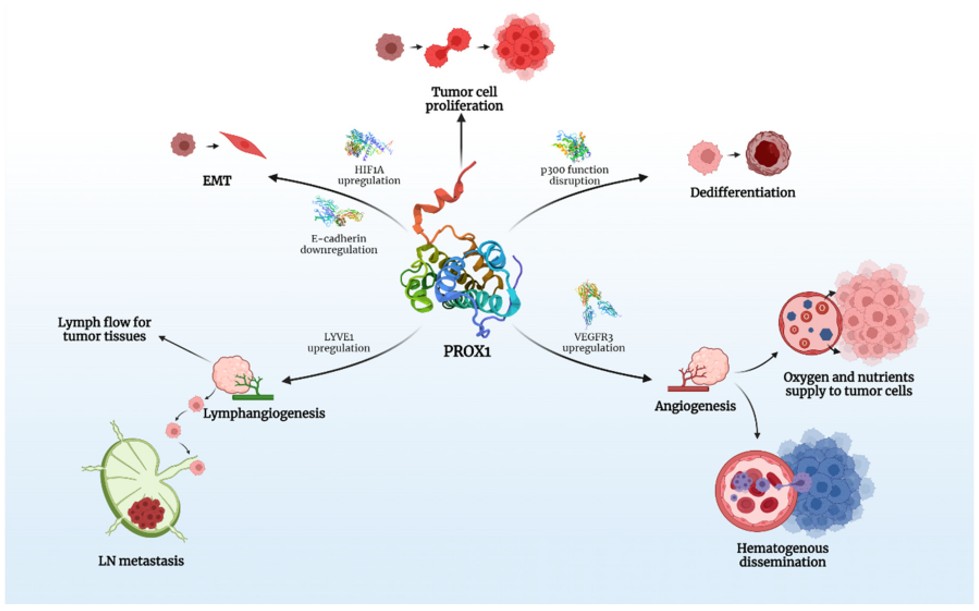 Fig. 1 The key roles of PROX1 in carcinogenesis. Created with BioRender.com.1
Key structural properties of PROX1:
- Contains a homeodomain for specific DNA binding
- Having a transcriptional regulatory region rich in proline
- The N-terminal and C-terminal domains are involved in protein interaction and regulation of transcriptional activity
Functions of PROX1
The PROX1 gene encodes a crucial transcription factor, whose primary function is to regulate cell fate determination and organ development. This protein plays a central role in the formation processes of organs such as the lymphatic system, nervous system, liver, and pancreas.
| Function | Description |
| Lymphatic vessel development | As a major regulatory factor, it induces endothelial cells to differentiate into lymphatic cell lineages, which is crucial for the formation of the lymphatic system. |
| Cell fate determination | It determines the development and differentiation of specific cell types in organs such as the nervous system, retina, and pancreas. |
| Transcriptional regulation | By binding to specific DNA sequences, it activates or inhibits the expression of downstream target genes, shaping the developmental program. |
| Tumor suppression function | It plays a tumor-suppressing role in some cancers (such as colon cancer, glioma), and its absence is associated with metastasis. |
| Metabolic regulation | It participates in maintaining the metabolic homeostasis of the liver and affects the expression of genes related to glucose and lipid metabolism. |
PROX1 precisely regulates the gene expression network by forming specific protein complexes. Its loss of function leads to severe developmental defects such as lymphedema, while its abnormal expression is closely related to various disease pathological processes.
Applications of PROX1 and PROX1 Antibody in Literature
1. Ntikoudi, Evangelia, et al. "The role of PROX1 in neoplasia: A key player often overlooked." Diagnostics 12.7 (2022): 1624. https://doi.org/10.3390/diagnostics12071624
The article indicates that the PROX1 gene, as a lymphatic marker, plays a complex role in tumor development, having both oncogenic and tumor-suppressing functions, and is related to clinical pathological features and patient prognosis. It is expected to become a new diagnostic, prognostic marker and therapeutic target.
2. Zhu, Lizhe, et al. "PROX1 promotes breast cancer invasion and metastasis through WNT/β-catenin pathway via interacting with hnRNPK." International journal of biological sciences 18.5 (2022): 2032. https://doi.org/10.7150/ijbs.68960
This study has confirmed that PROX1 is highly expressed in breast cancer and is associated with tumor progression. It activates the WNT/β-catenin pathway by interacting with hnRNPK, thereby promoting breast cancer metastasis. It can potentially serve as a diagnostic marker and therapeutic target.
3. Lee, Eun Jung, et al. "Restoration of retinal regenerative potential of Müller glia by disrupting intercellular Prox1 transfer." Nature Communications 16.1 (2025): 2928. https://doi.org/10.1038/s41467-025-58290-8
This study found that the PROX1 protein accumulates in the diseased retinas of mammals, and it inhibits the regenerative potential of Müller glial cells. By blocking the intercellular transmission of this protein with antibodies, it can promote neuronal regeneration and delay vision deterioration, providing a new strategy for the treatment of retinal degenerative diseases.
4. Duan, Zhi, et al. "PROX1 is an early driver of lineage plasticity in prostate cancer." The Journal of Clinical Investigation 135.11 (2025). https://doi.org/10.1172/JCI187490
This study reveals that the transcription factor PROX1 is upregulated at an early stage of prostate cancer lineage plasticity, and its expression is regulated by DNA methylation. PROX1 is crucial for the survival of castration-resistant prostate cancer cells. Inhibiting HDAC can effectively degrade PROX1 protein, providing a new strategy for the treatment of such tumors.
5. Bui, Khoa, and Young-Kwon Hong. "Ras pathways on Prox1 and lymphangiogenesis: insights for therapeutics." Frontiers in Cardiovascular Medicine 7 (2020): 597374. https://doi.org/10.3389/fcvm.2020.597374
The article indicates that the role of the lymphatic system in diseases is becoming increasingly prominent. The key transcription factor Prox1, which regulates its generation, interacts with the Ras signaling pathway, and is an important therapeutic target. This article reviews its mechanism in order to provide new ideas for targeted therapies targeting lymphatic vessel generation.
Creative Biolabs: PROX1 Antibodies for Research
Creative Biolabs specializes in the production of high-quality PROX1 antibodies for research and industrial applications. Our portfolio includes monoclonal antibodies tailored for ELISA, Flow Cytometry, Western blot, immunohistochemistry, and other diagnostic methodologies.
- Custom PROX1 Antibody Development: Tailor-made solutions to meet specific research requirements.
- Bulk Production: Large-scale antibody manufacturing for industry partners.
- Technical Support: Expert consultation for protocol optimization and troubleshooting.
- Aliquoting Services: Conveniently sized aliquots for long-term storage and consistent experimental outcomes.
For more details on our PROX1 antibodies, custom preparations, or technical support, contact us at email.
Reference
- Ntikoudi, Evangelia, et al. "The role of PROX1 in neoplasia: A key player often overlooked." Diagnostics 12.7 (2022): 1624. Distributed under Open Access license CC BY 4.0, without modification.https://doi.org/10.3390/diagnostics12071624
Anti-PROX1 antibodies
 Loading...
 Compare




Hot products 
-
Mouse Anti-GFAP Recombinant Antibody (5) (CBMAB-G0346-LY)

-
Mouse Anti-BIRC7 Recombinant Antibody (88C570) (CBMAB-L0261-YJ)

-
Mouse Anti-ENO1 Recombinant Antibody (CBYC-A950) (CBMAB-A4388-YC)

-
Mouse Anti-GGT1 Recombinant Antibody (1F9) (CBMAB-G3273-LY)

-
Mouse Anti-BLNK Recombinant Antibody (CBYY-0623) (CBMAB-0626-YY)

-
Mouse Anti-F11R Recombinant Antibody (402) (CBMAB-0026-WJ)

-
Rabbit Anti-ABL1 (Phosphorylated Y245) Recombinant Antibody (V2-505716) (PTM-CBMAB-0465LY)

-
Mouse Anti-BCL6 Recombinant Antibody (CBYY-0435) (CBMAB-0437-YY)

-
Mouse Anti-ADV Recombinant Antibody (V2-503423) (CBMAB-V208-1364-FY)

-
Mouse Anti-ALDOA Recombinant Antibody (A2) (CBMAB-A2316-YC)

-
Mouse Anti-ADIPOR2 Recombinant Antibody (V2-179983) (CBMAB-A1369-YC)

-
Mouse Anti-14-3-3 Pan Recombinant Antibody (V2-9272) (CBMAB-1181-LY)

-
Mouse Anti-ATP1A2 Recombinant Antibody (M7-PB-E9) (CBMAB-A4013-YC)

-
Rabbit Anti-CCN1 Recombinant Antibody (CBWJC-3580) (CBMAB-C4816WJ)

-
Mouse Anti-FOSB Recombinant Antibody (CBXF-3593) (CBMAB-F2522-CQ)

-
Mouse Anti-AOC3 Recombinant Antibody (CBYY-0014) (CBMAB-0014-YY)

-
Mouse Anti-ACO2 Recombinant Antibody (V2-179329) (CBMAB-A0627-YC)

-
Mouse Anti-ADGRE5 Recombinant Antibody (V2-360335) (CBMAB-C2088-CQ)

-
Rabbit Anti-AKT2 (Phosphorylated S474) Recombinant Antibody (V2-556130) (PTM-CBMAB-0605LY)

-
Mouse Anti-ANXA7 Recombinant Antibody (A-1) (CBMAB-A2941-YC)

- AActivation
- AGAgonist
- APApoptosis
- BBlocking
- BABioassay
- BIBioimaging
- CImmunohistochemistry-Frozen Sections
- CIChromatin Immunoprecipitation
- CTCytotoxicity
- CSCostimulation
- DDepletion
- DBDot Blot
- EELISA
- ECELISA(Cap)
- EDELISA(Det)
- ESELISpot
- EMElectron Microscopy
- FFlow Cytometry
- FNFunction Assay
- GSGel Supershift
- IInhibition
- IAEnzyme Immunoassay
- ICImmunocytochemistry
- IDImmunodiffusion
- IEImmunoelectrophoresis
- IFImmunofluorescence
- IGImmunochromatography
- IHImmunohistochemistry
- IMImmunomicroscopy
- IOImmunoassay
- IPImmunoprecipitation
- ISIntracellular Staining for Flow Cytometry
- LALuminex Assay
- LFLateral Flow Immunoassay
- MMicroarray
- MCMass Cytometry/CyTOF
- MDMeDIP
- MSElectrophoretic Mobility Shift Assay
- NNeutralization
- PImmunohistologyp-Paraffin Sections
- PAPeptide Array
- PEPeptide ELISA
- PLProximity Ligation Assay
- RRadioimmunoassay
- SStimulation
- SESandwich ELISA
- SHIn situ hybridization
- TCTissue Culture
- WBWestern Blot
