
BEGAIN Antibodies
Background
The BEGAIN gene encodes a postsynaptic protein that is highly expressed in the brain, especially in the hippocampus and olfactory bulb, and its protein products are involved in regulating neuronal signal transduction and synaptic plasticity. This protein plays a significant role in the formation of learning and memory by influencing the function of glutamatergic synapses and is associated with the underlying mechanisms of neural development and certain neurological diseases. Since its first identification in 1996, BEGAIN has become one of the important molecular models for studying neural cell signaling networks and complex brain functions due to its key role in neural circuit specificity and cognitive function, providing continuous research value for understanding the development and functional mechanisms of the nervous system.
Structure of BEGAIN
BEGAIN is a postsynaptic protein with a molecular weight of approximately 50 kDa. This weight may vary slightly among different species.
| Species | Human | Mouse | Rat |
| Molecular Weight (kDa) | ~50 | ~50 | ~50 |
| Primary Structural Differences | Contains multiple PDZ domains that mediate protein interaction | Highly conserved sequence | The structural function is highly homologous to human |
This protein is composed of approximately 440 amino acids. Its structure includes the N-terminal PDZ domain and the C-terminal region rich in proline, which together form its functional modules. Its three-dimensional structure enables it to act as a scaffold protein and specifically bind to various signaling molecules (such as GluA1 subunits and PICK1) in the postsynaptic dense region (PSD) of neurons, thereby regulating the transport of AMPA receptors and synaptic plasticity. Its expression is brain region-specific and is particularly abundant in the hippocampus and olfactory bulb.
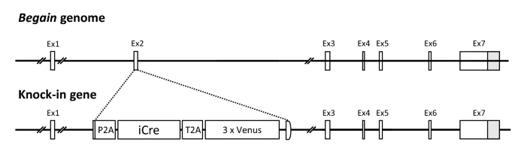 Fig. 1 Schematic of the BEGAIN Gene and iCre-3xVenus Knock-in Construct.1
Key structural properties of BEGAIN:
- Contains the N-terminal PDZ domain, which serves as the core protein interaction module
- Has the c-terminal region rich in proline, mediating specific molecular recognition
- Overall conformational allow it as postsynaptic scaffolding protein, integration of a variety of signal molecules
Functions of BEGAIN
The main function of the BEGAIN gene-encoded protein is to act as a scaffold in the synaptic of neurons and regulate signal transduction. Its specific functions are as follows:
| Function | Description |
| Synaptic scaffold | As the core scaffold protein of the postsynaptic dense region (PSD), it integrates and anchors multiple signaling molecules to maintain the stability of synaptic structure. |
| Regulation of AMPA receptors | By binding to the AMPA receptor subunit (such as GluA1) through its PDZ domain, it regulates the transport, endocytosis and membrane localization of the receptor on the synaptic membrane, thereby directly affecting synaptic strength. |
| Regulation of synaptic plasticity | Participating in synaptic plasticity processes such as long-term enhancement (LTP) and long-term inhibition (LTD) is crucial for the formation of learning and memory. |
| Neuron development support | During the development of the nervous system, it affects the formation, maturation and specific connection of synapses, especially playing a significant role in the olfactory bulb and the hippocampus. |
| Signal path integration | With PICK1, GRIP, such as protein interactions, connected to the cell surface receptors and intracellular signaling network, coordination of postsynaptic signaling precise space-time dynamic. |
Unlike some widely expressed scaffold proteins, the expression of BEGAIN is highly specific to brain regions, suggesting that it plays a fine regulatory role in information processing and storage in specific neural circuits.
Applications of BEGAIN and BEGAIN Antibody in Literature
- Wang, Xinyue, et al. "A novel rabbit anti-myoglobin monoclonal antibody's potential application in rhabdomyolysis associated acute kidney injury." International Journal of Molecular Sciences 24.9 (2023): 7822. https://doi.org/10.18632/aging.205275
Studies have shown that the increase in father's age can reduce the methylation level of the BEGAIN gene in sperm and the umbilical cord blood of male offspring, and this phenomenon is associated with the risk of autism spectrum disorder in men, suggesting that it may mediate the influence of father's age on the neurodevelopment of offspring.
- Dastsooz, Hassan, et al. "Involvement of N4BP2L1, PLEKHA4, and BEGAIN genes in breast cancer and muscle cell development." Frontiers in Cell and Developmental Biology 12 (2024): 1295403. https://doi.org/10.3389/fcell.2024.1295403
Research has found that the N4BP2L1, PLEKHA4 and BEGAIN genes are highly expressed in normal breast myoepithelial cells, but significantly down-regulated in breast cancer tissues. Low expression is associated with a higher risk in specific patient groups, suggesting that they may have tumor suppressor effects.
- Katano, Tayo, et al. "Brain-enriched guanylate kinase-associated protein, a component of the post-synaptic density protein complexes, contributes to learning and memory." Scientific reports 13.1 (2023): 22027. https://doi.org/10.1038/s41598-023-49537-9
Research has found that BEGAIN protein is enriched in the dense postsynaptic region of the hippocampus and is related to learning and memory functions. Gene knockout mice showed significant impairment in behavioral tests such as spatial reference memory and fear conditioning, confirming their key role in excitatory synapses.
- Katano, Tayo, et al. "Involvement of brain-enriched guanylate kinase-associated protein (BEGAIN) in chronic pain after peripheral nerve injury." eneuro 3.5 (2016). https://doi.org/10.1523/ENEURO.0110-16.2016
Research has found that the BEGAIN protein is a key molecule in maintaining neuropathic pain. It is located at the spinal dorsal horn synapse, and its expression is regulated by tyrosine phosphorylation of the GluN2B subunit. Its absence can alleviate abnormal pain but does not affect the normal pain threshold.
- Yao, Ikuko, et al. "Synaptic and nuclear localization of brain-enriched guanylate kinase-associated protein." Journal of Neuroscience 22.13 (2002): 5354-5364. https://doi.org/10.1523/JNEUROSCI.22-13-05354.2002
Research has found that the BEGAIN protein has both nuclear localization and synaptic targeting functions in neurons. It is located at the synapse through N-terminal region-dependent PSD-95/SAP90 and NMDA receptor activity and participates in postsynaptic signal regulation.
Creative Biolabs: BEGAIN Antibodies for Research
Creative Biolabs specializes in the production of high-quality BEGAIN antibodies for research and industrial applications. Our portfolio includes monoclonal antibodies tailored for ELISA, Flow Cytometry, Western blot, immunohistochemistry, and other diagnostic methodologies.
- Custom BEGAIN Antibody Development: Tailor-made solutions to meet specific research requirements.
- Bulk Production: Large-scale antibody manufacturing for industry partners.
- Technical Support: Expert consultation for protocol optimization and troubleshooting.
- Aliquoting Services: Conveniently sized aliquots for long-term storage and consistent experimental outcomes.
For more details on our BEGAIN antibodies, custom preparations, or technical support, contact us at email.
Reference
- Katano, Tayo, et al. "Brain-enriched guanylate kinase-associated protein, a component of the post-synaptic density protein complexes, contributes to learning and memory." Scientific reports 13.1 (2023): 22027. https://doi.org/10.1038/s41598-023-49537-9
Anti-BEGAIN antibodies
 Loading...
 Compare




Hot products 
-
Mouse Anti-BCL6 Recombinant Antibody (CBYY-0435) (CBMAB-0437-YY)

-
Mouse Anti-ACTN4 Recombinant Antibody (V2-6075) (CBMAB-0020CQ)

-
Mouse Anti-FOSB Recombinant Antibody (CBXF-3593) (CBMAB-F2522-CQ)

-
Mouse Anti-CD19 Recombinant Antibody (CBXC-1224) (CBMAB-C1491-CQ)

-
Mouse Anti-ANXA7 Recombinant Antibody (A-1) (CBMAB-A2941-YC)

-
Rabbit Anti-ENO2 Recombinant Antibody (BA0013) (CBMAB-0272CQ)

-
Mouse Anti-BAD (Phospho-Ser136) Recombinant Antibody (CBYY-0138) (CBMAB-0139-YY)

-
Mouse Anti-ACLY Recombinant Antibody (V2-179314) (CBMAB-A0610-YC)

-
Mouse Anti-BBS2 Recombinant Antibody (CBYY-0253) (CBMAB-0254-YY)

-
Mouse Anti-BCL2L1 Recombinant Antibody (H5) (CBMAB-1025CQ)

-
Mouse Anti-CEMIP Recombinant Antibody (3C12) (CBMAB-K0296-LY)

-
Mouse Anti-DMPK Recombinant Antibody (CBYCD-324) (CBMAB-D1200-YC)

-
Mouse Anti-AKT1/AKT2/AKT3 (Phosphorylated T308, T309, T305) Recombinant Antibody (V2-443454) (PTM-CBMAB-0030YC)

-
Mouse Anti-BSN Recombinant Antibody (219E1) (CBMAB-1228-CN)

-
Mouse Anti-C5B-9 Recombinant Antibody (CBFYA-0216) (CBMAB-X0304-FY)

-
Mouse Anti-ADAM12 Recombinant Antibody (V2-179752) (CBMAB-A1114-YC)

-
Mouse Anti-ALPL Antibody (B4-78) (CBMAB-1009CQ)

-
Mouse Anti-BRCA2 Recombinant Antibody (CBYY-0790) (CBMAB-0793-YY)

-
Mouse Anti-BACE1 Recombinant Antibody (CBLNB-121) (CBMAB-1180-CN)

-
Mouse Anti-CCDC6 Recombinant Antibody (CBXC-0106) (CBMAB-C5397-CQ)

- AActivation
- AGAgonist
- APApoptosis
- BBlocking
- BABioassay
- BIBioimaging
- CImmunohistochemistry-Frozen Sections
- CIChromatin Immunoprecipitation
- CTCytotoxicity
- CSCostimulation
- DDepletion
- DBDot Blot
- EELISA
- ECELISA(Cap)
- EDELISA(Det)
- ESELISpot
- EMElectron Microscopy
- FFlow Cytometry
- FNFunction Assay
- GSGel Supershift
- IInhibition
- IAEnzyme Immunoassay
- ICImmunocytochemistry
- IDImmunodiffusion
- IEImmunoelectrophoresis
- IFImmunofluorescence
- IGImmunochromatography
- IHImmunohistochemistry
- IMImmunomicroscopy
- IOImmunoassay
- IPImmunoprecipitation
- ISIntracellular Staining for Flow Cytometry
- LALuminex Assay
- LFLateral Flow Immunoassay
- MMicroarray
- MCMass Cytometry/CyTOF
- MDMeDIP
- MSElectrophoretic Mobility Shift Assay
- NNeutralization
- PImmunohistologyp-Paraffin Sections
- PAPeptide Array
- PEPeptide ELISA
- PLProximity Ligation Assay
- RRadioimmunoassay
- SStimulation
- SESandwich ELISA
- SHIn situ hybridization
- TCTissue Culture
- WBWestern Blot
