
DKK1 Antibodies
Background
The DKK1 gene encodes a secreted glycoprotein, mainly acting as an antagonist of the Wnt signaling pathway. It inhibits the activity of the classical Wnt pathway by binding to the LRP5/6 receptors, thereby regulating key biological processes such as embryonic development, bone metabolism, and tumor occurrence. This gene is highly conserved in mammals, and its abnormal expression is closely related to various diseases such as osteoporosis, cancer metastasis, and Alzheimer's disease. Since its first identification in 1998, the structure and functional mechanism of the DKK1 protein have been gradually elucidated through techniques such as nuclear magnetic resonance and cryo-electron microscopy, providing an important molecular basis for the development of drugs targeting the Wnt pathway and significantly promoting the research progress in developmental biology and disease treatment.
Structure of DKK1
DKK1 is a secreted glycoprotein, and its molecular weight varies depending on different post-translational modifications and cleavage variants, ranging approximately from 28 to 35 kDa. The difference in molecular weight mainly results from the degree of glycosylation and the presence of different isoforms.
| Species | Human | Mouse | Rat | Zebrafish |
| Molecular Weight (kDa) | ~28-35 | ~30-33 | ~29-34 | ~25-28 |
| Primary Structural Differences | Containing two conserved cysteine-rich domains | Highly similar to humans in terms of origin and function | Structurally highly conservative | There are homologous genes with similar domains. |
The core structure of the DKK1 protein consists of two distinct cysteine-rich domains. The N-terminal domain directly and with high affinity binds to the Wnt co-receptors LRP5/6, which is the key region for exerting the Wnt signaling inhibition function. The C-terminal domain participates in the interaction with other cell surface proteins, jointly regulating the specificity and intensity of the signaling pathway. This modular structure enables it to precisely control cell fate during embryonic development, tissue homeostasis, and disease progression.
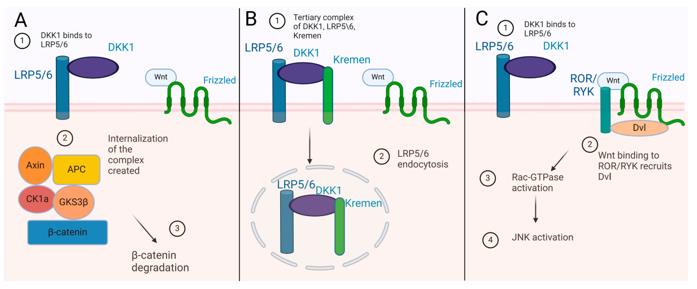 Fig. 1 The role of DKK1.1
Key structural properties of DKK1:
- Secreted glycoprotein composed of two cysteine-rich domains, CRD1 and CRD2
- CRD1 structure domain directly LRP5/6 receptor, inhibition of Wnt signaling pathway
- CRD2 domains are involved in regulating the stability and function of protein complexes
Functions of DKK1
The core function of the protein encoded by the DKK1 gene is to act as an effective inhibitor of the classical Wnt/β-catenin signaling pathway. However, it is also involved in various physiological and pathological processes such as bone development, cancer progression, and stem cell maintenance.
| Function | Description |
| Inhibition of Wnt signaling | DKK1 directly binds to the Wnt co-receptors LRP5/6, blocking the binding of Wnt ligands to the receptors, thereby inhibiting the downstream signaling. |
| Regulating bone development | By inhibiting the differentiation of osteoblasts, it plays a crucial negative regulatory role in embryonic bone formation and adult bone remodeling. |
| Promotes Tumor Formation | It is highly expressed in various cancers (such as multiple myeloma, liver cancer), and by inhibiting the Wnt pathway, it promotes tumor growth, invasion, and immune evasion. |
| Affects Neural Development | It participates in the development processes of the cerebral cortex, the eyes, and the neural crest, and regulates the proliferation and differentiation of neural precursor cells. |
| Maintaining Stem Cell Homeostasis | In the microenvironment of embryonic stem cells and some adult stem cells, the undifferentiated state of stem cells is maintained by regulating the level of the Wnt signal. |
The inhibitory effect of DKK1 on the Wnt pathway is usually rapid and efficient. Its mechanism is similar to a "molecular switch", which can quickly down-regulate excessive Wnt signal activity. This is comparable to the rapid response characteristic of Myoglobin as an efficient oxygen storage protein. Its high expression in bones and its specific functions make it an important biomarker and therapeutic target for bone diseases such as osteoporosis.
Applications of DKK1 and DKK1 Antibody in Literature
1. Zhang, Zhanqin, and Jianguo Hu. "DKK1 loss promotes endometrial fibrosis via autophagy and exosome-mediated macrophage-to-myofibroblast transition." Journal of Translational Medicine 22.1 (2024): 617. https://doi.org/10.1186/s12967-024-05402-5
This study reveals the mechanism by which the DKK1 gene affects endometrial fibrosis by regulating autophagy. Research has found that the expression of DKK1 is decreased in IUA patients and mouse models, autophagy is weakened, and fibrosis is exacerbated. Activation of autophagy can alleviate this phenotype, suggesting that DKK1 can serve as a potential diagnostic and therapeutic target for IUA.
2. Despotidis, Markos, et al. "DKK1 and Its Receptors in Esophageal Adenocarcinoma: A Promising Molecular Target." Diagnostics 15.1 (2025): 85. https://doi.org/10.3390/diagnostics15010085
This study reveals that DKK1, as a Wnt/β-catenin antagonist, can exert carcinogenic effects in esophageal adenocarcinoma through the novel receptor CKAP4. This article reviews the key roles of DKK1 and its receptor in cancer occurrence, emphasizing their potential as biomarkers and therapeutic targets for the diagnosis and treatment of esophageal adenocarcinoma.
3. Jiang, Hewen, et al. "Drug discovery of DKK1 inhibitors." Frontiers in pharmacology 13 (2022): 847387. https://doi.org/10.3389/fphar.2022.847387
This study reveals that DKK1 is an important Wnt pathway inhibitor, and its abnormal expression is associated with a variety of diseases. This article systematically reviews the latest progress and clinical application prospects of small molecule, antibody and nucleic acid inhibitors targeting DKK1, providing a reference for the treatment of related diseases.
4. Papukashvili, Dimitri, et al. "Perspectives on miRNAs targeting DKK1 for developing hair regeneration therapy." Cells 10.11 (2021): 2957. https://doi.org/10.3390/cells10112957
This article explores the potential of regulating the Wnt/β-catenin pathway through microRNA targeting DKK1 to treat androgenetic alopecia, providing new strategies and research directions for the development of safe and effective new AGA therapies.
5. Jo, Sungsin, et al. "DKK1 induced by 1, 25D3 is required for the mineralization of osteoblasts." Cells 9.1 (2020): 236. https://doi.org/10.3390/cells9010236
This study reveals that the anti-osteoporosis drug 1,25D3 promotes the expression and secretion of DKK1 by upregulating the transcription factor C/EBPβ, thereby positively regulating the osteoblast mineralization process, providing a new perspective for understanding the mechanism of bone formation.
Creative Biolabs: DKK1 Antibodies for Research
Creative Biolabs specializes in the production of high-quality DKK1 antibodies for research and industrial applications. Our portfolio includes monoclonal antibodies tailored for ELISA, Flow Cytometry, Western blot, immunohistochemistry, and other diagnostic methodologies.
- Custom DKK1 Antibody Development: Tailor-made solutions to meet specific research requirements.
- Bulk Production: Large-scale antibody manufacturing for industry partners.
- Technical Support: Expert consultation for protocol optimization and troubleshooting.
- Aliquoting Services: Conveniently sized aliquots for long-term storage and consistent experimental outcomes.
For more details on our DKK1 antibodies, custom preparations, or technical support, contact us at email.
Reference
- Despotidis, Markos, et al. "DKK1 and Its Receptors in Esophageal Adenocarcinoma: A Promising Molecular Target." Diagnostics 15.1 (2025): 85. https://doi.org/10.3390/diagnostics15010085
Anti-DKK1 antibodies
 Loading...
 Compare



Hot products 
-
Mouse Anti-CEMIP Recombinant Antibody (3C12) (CBMAB-K0296-LY)

-
Mouse Anti-ARHGDIA Recombinant Antibody (CBCNA-009) (CBMAB-R0415-CN)

-
Mouse Anti-FOXL1 Recombinant Antibody (CBXF-0845) (CBMAB-F0462-CQ)

-
Mouse Anti-CRTAM Recombinant Antibody (CBFYC-2235) (CBMAB-C2305-FY)

-
Rabbit Anti-ABL1 (Phosphorylated Y185) Recombinant Antibody (V2-443434) (PTM-CBMAB-0001YC)

-
Mouse Anti-ARID3A Antibody (A4) (CBMAB-0128-YC)

-
Human Anti-SARS-CoV-2 Spike Recombinant Antibody (CBC05) (CBMAB-CR005LY)

-
Mouse Anti-ATM Recombinant Antibody (2C1) (CBMAB-A3970-YC)

-
Mouse Anti-CD2AP Recombinant Antibody (BR083) (CBMAB-BR083LY)

-
Mouse Anti-CARD11 Recombinant Antibody (CBFYC-0811) (CBMAB-C0866-FY)

-
Mouse Anti-CDKL5 Recombinant Antibody (CBFYC-1629) (CBMAB-C1689-FY)

-
Mouse Anti-CSPG4 Recombinant Antibody (CBFYM-1050) (CBMAB-M1203-FY)

-
Mouse Anti-APOH Recombinant Antibody (4D9A4) (CBMAB-A3249-YC)

-
Mouse Anti-BLK Recombinant Antibody (CBYY-0618) (CBMAB-0621-YY)

-
Mouse Anti-ACO2 Recombinant Antibody (V2-179329) (CBMAB-A0627-YC)

-
Mouse Anti-CD8 Recombinant Antibody (C1083) (CBMAB-C1083-LY)

-
Mouse Anti-C5b-9 Recombinant Antibody (aE11) (CBMAB-AO138LY)

-
Mouse Anti-14-3-3 Pan Recombinant Antibody (V2-9272) (CBMAB-1181-LY)

-
Mouse Anti-APOE Recombinant Antibody (A1) (CBMAB-0078CQ)

-
Mouse Anti-CD59 Recombinant Antibody (CBXC-2097) (CBMAB-C4421-CQ)

- AActivation
- AGAgonist
- APApoptosis
- BBlocking
- BABioassay
- BIBioimaging
- CImmunohistochemistry-Frozen Sections
- CIChromatin Immunoprecipitation
- CTCytotoxicity
- CSCostimulation
- DDepletion
- DBDot Blot
- EELISA
- ECELISA(Cap)
- EDELISA(Det)
- ESELISpot
- EMElectron Microscopy
- FFlow Cytometry
- FNFunction Assay
- GSGel Supershift
- IInhibition
- IAEnzyme Immunoassay
- ICImmunocytochemistry
- IDImmunodiffusion
- IEImmunoelectrophoresis
- IFImmunofluorescence
- IGImmunochromatography
- IHImmunohistochemistry
- IMImmunomicroscopy
- IOImmunoassay
- IPImmunoprecipitation
- ISIntracellular Staining for Flow Cytometry
- LALuminex Assay
- LFLateral Flow Immunoassay
- MMicroarray
- MCMass Cytometry/CyTOF
- MDMeDIP
- MSElectrophoretic Mobility Shift Assay
- NNeutralization
- PImmunohistologyp-Paraffin Sections
- PAPeptide Array
- PEPeptide ELISA
- PLProximity Ligation Assay
- RRadioimmunoassay
- SStimulation
- SESandwich ELISA
- SHIn situ hybridization
- TCTissue Culture
- WBWestern Blot
