
RETN Antibodies
Background
RETN is a polypeptide hormone mainly secreted by adipocytes, serving as a key signaling molecule connecting obesity and insulin resistance. The protein encoded by this gene acts on insulin-sensitive tissues, interfering with the normal insulin signaling pathway, which may lead to the development of type 2 diabetes. It was first discovered in 2001 and got its name because it "resists" the effect of insulin in obese mouse models. As an important member of the adipokine family, resistin and its mechanism of action have become a hot topic in the research of metabolic syndrome and related diseases, greatly enhancing our understanding of adipose tissue as an endocrine organ and its role in systemic energy metabolism and inflammatory responses.
Structure of RETN
The resistin protein encoded by the RETN gene is a polypeptide hormone with a molecular weight of approximately 12.5 kDa. The molecular weight of this protein varies among different species, mainly due to the differences in its amino acid sequence composition and post-translational modifications.
| Species | Human | Mouse | Rat |
| Molecular Weight (kDa) | 12.5 | 10.8 | 12.3 |
| Primary Structural Differences | Rich in cysteine, it forms oligomers linked by disulfide bonds | There is sequence variation in the C-terminal domain | High homology with human resistin |
Resistin protein is composed of 108 amino acids (taking mice as an example), and its primary structure is characteristically rich in cysteine residues. These cysteines form a unique disulfide bond-linked oligomer structure of resistin through a specific disulfide bond connection mode, which is the basis for its secretion and the exertion of biological functions. Its secondary structure consists of multiple β-folded lamellae, which jointly assemble into the protein's unique spherical head and fibrous tail domain. This unique spatial conformation enables it to interact with specific receptors on the cell membrane, such as TLR4 or integrins, thereby activating downstream inflammatory signaling pathways and interfering with insulin signal transduction.
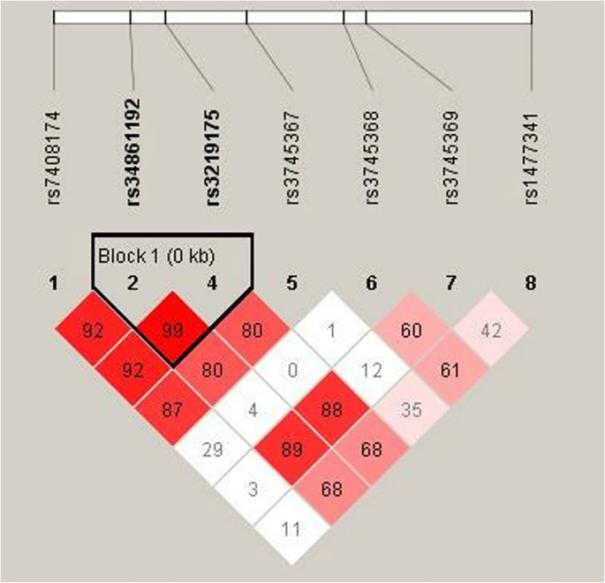 Fig. 1 Haplotype block map for the eight SNPs in the RETN gene.1
Key structural properties of RETN:
- Cysteine-rich oligomer structure
- Stable polymers are formed through disulfide bonds
- Specific receptor-binding epitopes mediate signal transduction
Functions of RETN
The resistin protein encoded by the RETN gene mainly functions to participate in the regulation of energy metabolism and inflammatory responses. However, it also involves a variety of pathophysiological processes, including the induction of insulin resistance and the regulation of vascular endothelial function.
| Function | Description |
| Insulin resistance induction | Resistin interferes with the insulin signaling pathways in tissues such as fat and muscle, reducing their glucose uptake capacity and thereby promoting systemic insulin resistance. |
| Association with metabolic disorders | As a key connecting factor between obesity and type 2 diabetes, elevated resistin levels are closely related to metabolic disorders such as hyperglycemia and dyslipidemia. |
| Promotion of inflammatory response | Able to activate and promote the mononuclear cells and endothelial cells produce a variety of inflammatory factors, such as TNF alpha, IL - 6, aggravate chronic low-grade inflammatory state. |
| Influence of vascular endothelium | Through the inflammatory pathway, it affects the function of endothelial cells and participates in the occurrence and development of vascular complications such as atherosclerosis. |
| Adipocyte differentiation | The former adipocyte differentiation process has a certain inhibitory effect, influence of adipose tissue function and energy storage. |
The mode of action of resistin is pleotropic and network. It does not act on a single target but interweeps between the metabolic and immune systems through various means such as endocrine and paracrine, which explains its core position in complex metabolic diseases.
Applications of RETN and RETN Antibody in Literature
1. Wang, Chao-Qun, et al. "Impacts of RETN genetic polymorphism on breast cancer development." Journal of Cancer 11.10 (2020): 2769. https://doi.org/10.7150/jca.38088
This study explored the relationship between the RETN polymorphism of the resistin gene and the risk of breast cancer in Han Chinese women. Research has found that the AG genotype and A allele of rs3219175 significantly increase the risk of disease. In addition, the CT genotype of rs7408174 is associated with advanced disease and high-grade pathological grades, and patients with resistin positivity are also more prone to high-grade lesions.
2. Luo, Fei, et al. "Association between the RETN-420C/G polymorphism and type 2 diabetes mellitus susceptibility: A meta-analysis of 23 studies." Frontiers in Endocrinology 13 (2022): 1039919. https://doi.org/10.3389/fendo.2022.1039919
Meta-analysis of RETN gene -420C/G polymorphism and type 2 diabetes showed no significant association with the overall risk of diabetes. However, age is an important influencing factor. This polymorphism may increase the risk of disease in young people, but has the opposite effect in older people. The conclusion still needs further research and verification.
3. An, Feimeng, et al. "Variants in RETN gene are associated with steroid-induced osteonecrosis of the femoral head risk among Han Chinese people." Journal of Orthopaedic Surgery and Research 15.1 (2020): 96. https://doi.org/10.1186/s13018-020-1557-3
This study has for the first time discovered in the Han Chinese population that polymorphisms at multiple loci of the RETN gene (such as rs34861192 and rs3219175) can significantly reduce the risk of steroid-induced femoral head necrosis. These variations are associated with lipid indicators, suggesting that they may be involved in the disease process by influencing lipid metabolism.
4. Chang, Ming-Ling, et al. "Resistin reinforces interferon λ-3 to eliminate hepatitis C virus with fine-tuning from RETN single-nucleotide polymorphisms." Scientific Reports 6.1 (2016): 30799. https://doi.org/10.1038/srep30799
This study found that in patients with hepatitis C, four RETN gene polymorphisms (such as rs3745367) affect resistin levels through synergistic effects. High resistin levels and specific genotypes are associated with the rate of sustained virology response, indicating that resistin produced by various liver cells can work in synergy with IFNL3 to clear HCV through immunomodulatory effects.
5. Uchiyama, Tomoko, et al. "Intermittent hypoxia up-regulates CCL2, RETN, and TNFα mRNAs in adipocytes via down-regulation of miR-452." International Journal of Molecular Sciences 20.8 (2019): 1960. https://doi.org/10.3390/ijms20081960
Studies have shown that intermittent hypoxia leads to the upregulation of multiple adipokine gene expressions, including RETN, by down-regulating miR-452 in adipocytes. This mechanism reveals a new pathway by which insulin resistance is induced by fat dysfunction in sleep apnea syndrome.
Creative Biolabs: RETN Antibodies for Research
Creative Biolabs specializes in the production of high-quality RETN antibodies for research and industrial applications. Our portfolio includes monoclonal antibodies tailored for ELISA, Flow Cytometry, Western blot, immunohistochemistry, and other diagnostic methodologies.
- Custom RETN Antibody Development: Tailor-made solutions to meet specific research requirements.
- Bulk Production: Large-scale antibody manufacturing for industry partners.
- Technical Support: Expert consultation for protocol optimization and troubleshooting.
- Aliquoting Services: Conveniently sized aliquots for long-term storage and consistent experimental outcomes.
For more details on our RETN antibodies, custom preparations, or technical support, contact us at email.
Reference
- An, Feimeng, et al. "Variants in RETN gene are associated with steroid-induced osteonecrosis of the femoral head risk among Han Chinese people." Journal of Orthopaedic Surgery and Research 15.1 (2020): 96. https://doi.org/10.1186/s13018-020-1557-3
Anti-RETN antibodies
 Loading...
 Compare




Hot products 
-
Mouse Anti-ACE2 Recombinant Antibody (V2-179293) (CBMAB-A0566-YC)

-
Mouse Anti-ENPP1 Recombinant Antibody (CBFYE-0159) (CBMAB-E0375-FY)

-
Mouse Anti-HTLV-1 gp46 Recombinant Antibody (CBMW-H1006) (CBMAB-V208-1154-FY)

-
Mouse Anti-CASQ1 Recombinant Antibody (CBFYC-0863) (CBMAB-C0918-FY)

-
Rabbit Anti-CAMK2A Recombinant Antibody (BA0032) (CBMAB-0137CQ)

-
Mouse Anti-ENO2 Recombinant Antibody (H14) (CBMAB-E1341-FY)

-
Mouse Anti-EMP3 Recombinant Antibody (CBFYE-0100) (CBMAB-E0207-FY)

-
Mouse Anti-FOXL1 Recombinant Antibody (CBXF-0845) (CBMAB-F0462-CQ)

-
Mouse Anti-CD24 Recombinant Antibody (HIS50) (CBMAB-C10123-LY)

-
Mouse Anti-ARHGAP5 Recombinant Antibody (54/P190-B) (CBMAB-P0070-YC)

-
Mouse Anti-ACTG1 Recombinant Antibody (V2-179597) (CBMAB-A0916-YC)

-
Mouse Anti-CDKL5 Recombinant Antibody (CBFYC-1629) (CBMAB-C1689-FY)

-
Mouse Anti-AKR1C3 Recombinant Antibody (V2-12560) (CBMAB-1050-CN)

-
Mouse Anti-CCND2 Recombinant Antibody (DCS-3) (CBMAB-G1318-LY)

-
Mouse Anti-CASP7 Recombinant Antibody (10-01-62) (CBMAB-C2005-LY)

-
Mouse Anti-ASH1L Monoclonal Antibody (ASH5H03) (CBMAB-1372-YC)

-
Mouse Anti-C5B-9 Recombinant Antibody (CBFYA-0216) (CBMAB-X0304-FY)

-
Mouse Anti-FPR2 Recombinant Antibody (1D6) (CBMAB-F2628-CQ)

-
Mouse Anti-ABCA3 Recombinant Antibody (V2-178911) (CBMAB-A0145-YC)

-
Mouse Anti-DLC1 Recombinant Antibody (D1009) (CBMAB-D1009-YC)

- AActivation
- AGAgonist
- APApoptosis
- BBlocking
- BABioassay
- BIBioimaging
- CImmunohistochemistry-Frozen Sections
- CIChromatin Immunoprecipitation
- CTCytotoxicity
- CSCostimulation
- DDepletion
- DBDot Blot
- EELISA
- ECELISA(Cap)
- EDELISA(Det)
- ESELISpot
- EMElectron Microscopy
- FFlow Cytometry
- FNFunction Assay
- GSGel Supershift
- IInhibition
- IAEnzyme Immunoassay
- ICImmunocytochemistry
- IDImmunodiffusion
- IEImmunoelectrophoresis
- IFImmunofluorescence
- IGImmunochromatography
- IHImmunohistochemistry
- IMImmunomicroscopy
- IOImmunoassay
- IPImmunoprecipitation
- ISIntracellular Staining for Flow Cytometry
- LALuminex Assay
- LFLateral Flow Immunoassay
- MMicroarray
- MCMass Cytometry/CyTOF
- MDMeDIP
- MSElectrophoretic Mobility Shift Assay
- NNeutralization
- PImmunohistologyp-Paraffin Sections
- PAPeptide Array
- PEPeptide ELISA
- PLProximity Ligation Assay
- RRadioimmunoassay
- SStimulation
- SESandwich ELISA
- SHIn situ hybridization
- TCTissue Culture
- WBWestern Blot
