
TGF-β Antibodies
Background
TGF-β (Transforming growth factor -β) is a cell signal transduction protein widely present in multicellular organisms, mainly involved in regulating key physiological processes such as cell proliferation, differentiation, apoptosis and immune response. As a secretory multifunctional cytokine, it plays a core role in embryonic development, tissue repair and maintaining homeostasis by activating the SMAD signaling pathway through binding to specific receptors. This protein family was first isolated and identified by Roberts and Sporn in 1981, and its three-dimensional structure analysis revealed a unique "cytokine folding" feature. The abnormal expression of TGF-β is closely related to fibrotic diseases, cancer metastasis and autoimmune diseases. This discovery provides a molecular basis for the development of related targeted drugs.
Structure of TGF-β
TGF-β form of mature activity is composed of 112 amino acid monomers, and formed through disulfide bond homologous dimers, present the stability of the beta folding barrel structure. Its core function relies on the highly conserved cystine knot domain, which is cross-linked and stabilized by multiple pairs of disulfide bonds, endowing the protein with extremely strong structural rigidity.
| Species | Human | Bovine | Mouse | Pig | Chicken |
| Molecular Weight (kDa) | 25 | 24.8 | 24.9 | 25.1 | 24.7 |
| Primary Structural Differences | Highly conserved in mammals, there are mainly three subtypes (TGF-β1, TGF-β2, TGF-β3), with slightly different sequences | Similar in structure to human TGF-β1, there is a small amount of amino acid substitution | Homology with human TGF-β1 is about 99%, but there may be differences in immunomodulatory function | With the combination of the receptor affinity with people TGF-β is slightly different | Sequence differences, but still retains the core function structure domain |
TGF-β is a homologous dimer protein linked by disulfide bonds. Each monomer contains 112 amino acids and has a characteristic cystine binding domain. This protein is secreted in the form of a latent complex, containing a latent associated peptide (LAP) and a mature TGF-β dimer. When LAP is cleaved by protease, the exposed receptor binding sites can successively bind to TβRII and TβRI receptors, regulating processes such as cell proliferation, differentiation and immune response through the Smad signaling pathway.
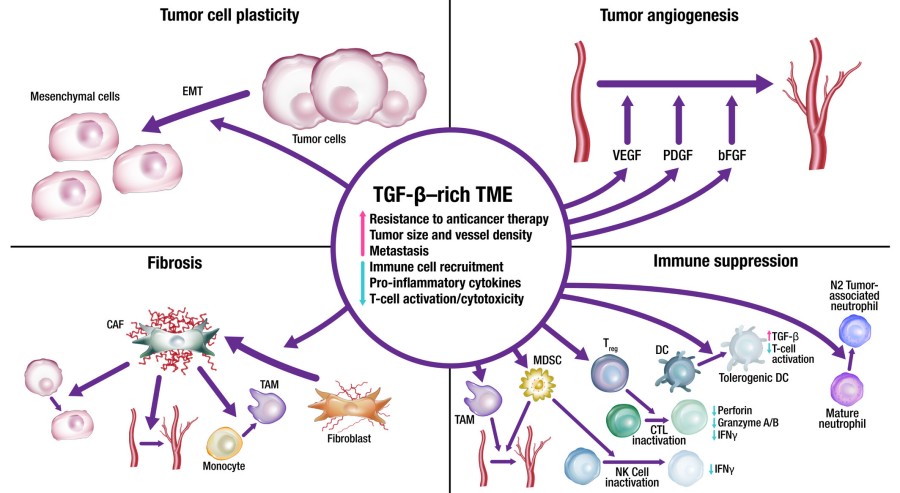 Fig. 1 TGF-β drives the multidimensional mechanism of TME immunosuppression and treatment resistance.1
Key structural properties of TGF-β:
- Cystine knot structural motifs stabilized by disulfide bonds
- Latent complexes are formed through non-covalently bound LAP
- β -fold interface with receptor binding ("wrist" region)
- Dimer conformation is the foundation of its biological activity
- Protein hydrolysis activation is required to release the function
Functions of TGF-β
TGF-β (Transforming growth factor-β) is a multifunctional cytokine, mainly involved in physiological processes such as cell growth, differentiation and immune regulation. Its core functions include:
| Function | Description |
| Regulation of cell proliferation | By inhibiting the expression of cyclin, the proliferation of epithelial cells and hematopoietic cells is inhibited. |
| Immune regulation | Inhibit the activation of T cells, promote the differentiation of regulatory T cells, and maintain immune tolerance. |
| Tissue repair | Stimulate the proliferation of fibroblasts and collagen synthesis, and promote wound healing. |
| Embryo development | Participate in the processes of embryonic morphogenesis and organ formation. |
| Tumor inhibition/promotion | Late early tumors, promoting tumor metastasis and formation of microenvironment. |
The signal transduction of TGF-β has typical biphasic characteristics: at low concentrations, it mainly shows growth inhibitory effects, while at high concentrations, it exhibits pro-fibrotic and pro-metastatic activities. This characteristic makes it play a complex and crucial role in maintaining tissue homeostasis and disease development.
Applications of TGF-β and TGF-β Antibody in Literature
1. Hülper, Petra, et al. "Tumor localization of an anti-TGF-β antibody and its effects on gliomas." International journal of oncology 38.1 (2011): 51-59.https://doi.org/10.3892/ijo_00000823
Studies have shown that intravenous injection of TGF-β neutralizing antibody 1D11 can be targeted and enriched in glioma tissues. In immune-healthy mice, 1D11 completely regressed subcutaneous GL261 tumors, but in situ tumors only inhibited invasion. Tumor growth accelerated in immunodeficient mice, indicating that the anti-tumor effect of TGF-β depends on the microenvironment and immune status.
2. Lee, Jung-Shun, et al. "Anti-IL-20 antibody improved motor function and reduced glial scar formation after traumatic spinal cord injury in rats." Journal of Neuroinflammation 17 (2020): 1-12. https://link.springer.com/article/10.1186/s12974-020-01814-4
Studies have shown that during the secondary injury process after spinal cord injury, the pro-inflammatory factor IL-20 may play a key role by regulating the expression of TGF-β1. In pathological processes such as renal fibrosis and liver cirrhosis, IL-20, as a pro-inflammatory factor, can up-regulate the expression of TGF-β1, thereby promoting the fibrosis process.
3. Yi, Ming, et al. "The construction, expression, and enhanced anti-tumor activity of YM101: a bispecific antibody simultaneously targeting TGF-β and PD-L1." Journal of hematology & oncology 14 (2021): 1-22. https://link.springer.com/article/10.1186/s13045-021-01045-x
Studies have shown that although anti-PD-1 /PD-L1 therapy can stimulate a persistent anti-tumor response, the clinical response rate is limited. Studies have found that the immune negative regulatory factor TGF-β can significantly weaken the efficacy of PD-1/PD-L1 inhibitors and lead to drug resistance. At present, the combined treatment regimen targeting both PD-1/PD-L1 and TGF-β simultaneously shows breakthrough potential and is expected to significantly improve the therapeutic effect and solve the problem of drug resistance.
4. Gulley, James L., et al. "Dual inhibition of TGF‐β and PD‐L1: a novel approach to cancer treatment." Molecular oncology 16.11 (2022): 2117-2134. https://doi.org/10.1002/1878-0261.13146
This article explains that TGF-β and PD-L1 cooperatively suppress immunity through complementary pathways in the tumor microenvironment (TME): TGF-β promotes fibrosis and immunosuppression, while PD-L1 inhibits T cell function. Anti-pd-l1 therapy is vulnerable to TGF-β -mediated drug resistance. Currently, dual-target drugs can simultaneously block both pathways, which is expected to improve the therapeutic effect and reduce toxicity.
5. Niu, Mengke, et al. "Synergistic efficacy of simultaneous anti-TGF-β/VEGF bispecific antibody and PD-1 blockade in cancer therapy." Journal of hematology & oncology 16.1 (2023): 94. https://link.springer.com/article/10.1186/s13045-023-01487-5
This article indicates that the efficacy of PD-1/PD-L1 antibodies is limited, and TGF-β is the key drug resistance factor. It significantly reduces the therapeutic effect by inhibiting the function of immune cells, promoting tumor fibrosis and immune escape. Targeting TGF-β combined with PD-1/PD-L1 blockade is expected to overcome the problem of drug resistance.
Creative Biolabs: TGF-β Antibodies for Research
Creative Biolabs specializes in the production of high-quality TGF-β antibodies for research and industrial applications. Our portfolio features monoclonal antibodies specifically optimized for ELISA, Flow Cytometry, Western Blot, Immunohistochemistry, and other advanced diagnostic applications.
- Custom TGF-β Antibody Development: Tailor-made solutions to meet specific research requirements.
- Bulk Production: Large-scale antibody manufacturing for industry partners.
- Technical Support: Expert consultation for protocol optimization and troubleshooting.
- Aliquoting Services: Conveniently sized aliquots for long-term storage and consistent experimental outcomes.
For more details on our TGF-β antibodies, custom preparations, or technical support, contact us at info@creative-biolabs.com.
Reference
- Gulley, James L., et al. "Dual inhibition of TGF‐β and PD‐L1: a novel approach to cancer treatment." Molecular oncology 16.11 (2022): 2117-2134. https://doi.org/10.1002/1878-0261.13146
Anti-TGFB antibodies
 Loading...
 Compare




Hot products 
-
Mouse Anti-CASP7 Recombinant Antibody (10-01-62) (CBMAB-C2005-LY)

-
Mouse Anti-ADAM12 Recombinant Antibody (V2-179752) (CBMAB-A1114-YC)

-
Mouse Anti-BHMT Recombinant Antibody (CBYY-0547) (CBMAB-0550-YY)

-
Mouse Anti-ADIPOR1 Recombinant Antibody (V2-179982) (CBMAB-A1368-YC)

-
Mouse Anti-Acetyl SMC3 (K105/K106) Recombinant Antibody (V2-634053) (CBMAB-AP052LY)

-
Mouse Anti-BrdU Recombinant Antibody (IIB5) (CBMAB-1038CQ)

-
Mouse Anti-CCT6A/B Recombinant Antibody (CBXC-0168) (CBMAB-C5570-CQ)

-
Mouse Anti-CDKL5 Recombinant Antibody (CBFYC-1629) (CBMAB-C1689-FY)

-
Rat Anti-ADAM10 Recombinant Antibody (V2-179741) (CBMAB-A1103-YC)

-
Mouse Anti-CRTAM Recombinant Antibody (CBFYC-2235) (CBMAB-C2305-FY)

-
Mouse Anti-CASQ1 Recombinant Antibody (CBFYC-0863) (CBMAB-C0918-FY)

-
Mouse Anti-dsRNA Recombinant Antibody (2) (CBMAB-D1807-YC)

-
Mouse Anti-ABIN2 Recombinant Antibody (V2-179106) (CBMAB-A0349-YC)

-
Mouse Anti-CD24 Recombinant Antibody (ALB9) (CBMAB-0176CQ)

-
Rabbit Anti-ALOX5AP Recombinant Antibody (CBXF-1219) (CBMAB-F0750-CQ)

-
Mouse Anti-ALB Recombinant Antibody (V2-180650) (CBMAB-A2186-YC)

-
Mouse Anti-ESR1 Recombinant Antibody (Y31) (CBMAB-1208-YC)

-
Mouse Anti-DHFR Recombinant Antibody (D0821) (CBMAB-D0821-YC)

-
Mouse Anti-C5B-9 Recombinant Antibody (CBFYA-0216) (CBMAB-X0304-FY)

-
Mouse Anti-APOE Recombinant Antibody (A1) (CBMAB-0078CQ)

- AActivation
- AGAgonist
- APApoptosis
- BBlocking
- BABioassay
- BIBioimaging
- CImmunohistochemistry-Frozen Sections
- CIChromatin Immunoprecipitation
- CTCytotoxicity
- CSCostimulation
- DDepletion
- DBDot Blot
- EELISA
- ECELISA(Cap)
- EDELISA(Det)
- ESELISpot
- EMElectron Microscopy
- FFlow Cytometry
- FNFunction Assay
- GSGel Supershift
- IInhibition
- IAEnzyme Immunoassay
- ICImmunocytochemistry
- IDImmunodiffusion
- IEImmunoelectrophoresis
- IFImmunofluorescence
- IGImmunochromatography
- IHImmunohistochemistry
- IMImmunomicroscopy
- IOImmunoassay
- IPImmunoprecipitation
- ISIntracellular Staining for Flow Cytometry
- LALuminex Assay
- LFLateral Flow Immunoassay
- MMicroarray
- MCMass Cytometry/CyTOF
- MDMeDIP
- MSElectrophoretic Mobility Shift Assay
- NNeutralization
- PImmunohistologyp-Paraffin Sections
- PAPeptide Array
- PEPeptide ELISA
- PLProximity Ligation Assay
- RRadioimmunoassay
- SStimulation
- SESandwich ELISA
- SHIn situ hybridization
- TCTissue Culture
- WBWestern Blot
