
IRS2 Antibodies
Background
The IRS2 gene encodes a crucial insulin receptor substrate protein, mainly functioning as an intracellular signal transduction molecule in the insulin and insulin-like growth factor signaling pathways. This protein regulates cell proliferation, metabolic balance, and survival by transmitting receptor tyrosine kinase signals. It plays a central role in maintaining the function of pancreatic β cells and glucose homeostasis. This gene was officially identified in 1996. The elucidation of its structure and function has revealed the key mechanisms of the insulin signaling network, providing important evidence for understanding the molecular basis of type 2 diabetes and related metabolic diseases. The complex signal regulatory network mediated by this gene has become a classic model in the field of metabolism research, significantly promoting our understanding of cell signal integration, metabolic regulation, and disease occurrence mechanisms.
Structure of IRS2
IRS2 is a key signal transduction adaptor protein with a molecular weight of approximately 146 kDa. This molecular weight corresponds to the complete human protein isoform. Its size varies among different species, mainly due to changes in the composition of its domains and post-translational modifications.
| Species | Human | Mouse | Rat | Zebrafish | Chicken |
| Molecular Weight (kDa) | About 146 | About 135 | About 136 | About 130 | About 137 |
| Primary Structural Differences | Containing the PH domain, the PTB domain and multiple phosphorylated tyrosine/serine sites | Highly conservative, with similar core domains | High sequence homology with humans | With homologous functions and simplified domains | Retain the core PH and PTB domains |
This protein is composed of approximately 1338 amino acids. Its structural feature is that the N-terminal contains a PH domain (related to membrane binding) and a PTB domain (specifically binding to activated insulin receptors), followed by a long C-terminal extension region, which contains multiple tyrosine and serine/threonine phosphorylation sites, serving as a docking platform for downstream effector molecules (such as PI3K). The functional core lies in acting as an intracellular hub for insulin and insulin-like growth factor signaling, transmitting and integrating metabolic and growth signals through precise conformational changes and site-specific phosphorylation.
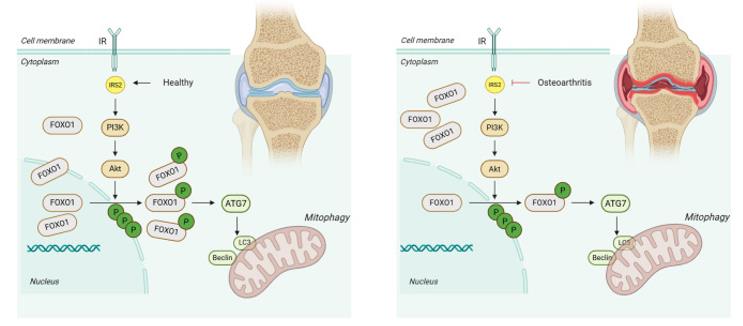 Fig. 1 The role of IRS2/FOXO1 signaling in chondrocyte autophagy and osteoarthritis progression.1
Key structural properties of IRS2:
- Modular signal protein structure
- Amino end of PH and the structure of PTB domain responsible for identifying and membrane receptor
- The carboxyl end contains a large number of tyrosine and serine phosphorylation site signal transduction platform
Functions of IRS2
The core function of the IRS2 gene is to act as a key intracellular signal transducer in the insulin and insulin-like growth factor signaling pathways. It integrates and transmits receptor signals, playing a central role in systemic metabolic regulation, cell growth, and survival.
| Function | Description |
| Metabolic Signal Transduction | IRS2 is the core substrate downstream of the insulin receptor. After its tyrosine phosphorylation, it recruits and activates effect molecules such as PI3K, initiating metabolic processes such as glycogen synthesis and glucose uptake. |
| Survival and Proliferation of Pancreatic β Cells | In the pancreas, the IRS2 signaling pathway is crucial for maintaining the function of β cells, promoting their proliferation, and resisting apoptosis, directly influencing the body's ability to maintain normal blood sugar levels. |
| Regulation of Liver Glycogen Metabolism | The insulin signaling mediated by IRS2 in the liver can effectively inhibit gluconeogenesis and promote glycogen synthesis, which is a crucial step in maintaining glucose homeostasis in the liver. |
| Central Energy Balance Regulation | In the hypothalamus, IRS2 plays a role in regulating food intake and energy expenditure, influencing the balance of body weight and overall energy metabolism. |
| Cell Growth and Survival | By activating downstream pathways such as Akt/PKB, IRS2 can promote cell growth and inhibit cell apoptosis, especially in long-lived cells like neurons, where its effect is particularly significant. |
The signal transduction of IRS2 is tissue-specific, and its signal intensity and effect are precisely regulated by its phosphorylation status (especially the negative feedback phosphorylation at serine/threonine sites). The disruption of this regulatory network is an important molecular basis for the occurrence of insulin resistance and type 2 diabetes.
Applications of IRS2 and IRS2 Antibody in Literature
1. Qin, Chaoren, et al. "IRS2/FOXO1 mitigates osteoarthritis by regulating chondrocyte autophagy and mitochondrial function." Molecular Medicine 31.1 (2025): 293. https://doi.org/10.1186/s10020-025-01346-8
This study employed quantitative proteomics to comprehensively map the tyrosine phosphorylation interaction network of key proteins in the insulin pathway. 52 phosphorylation-dependent interaction sites were identified at 109 locations, revealing the redundancy and differential interaction networks of IRS-1/2, and providing new clues for the identification mechanism of non-typical phosphorylation.
2. Jo, Minjeong, et al. "Fluorescent tagging of endogenous IRS2 with an auxin-dependent degron to assess dynamic intracellular localization and function." Journal of Biological Chemistry 300.11 (2024). https://doi.org/10.1016/j.jbc.2024.107796
In this study, an endogenous IRS2 model with internal markers was constructed using CRISPR/Cas9 technology. It was revealed that IRS2 shuttles between the cytoplasm and the nucleus in response to the PI3K signal and is regulated by the nuclear export mechanism. Acute degradation of IRS2 can inhibit tumor cell invasion, suggesting its potential as a therapeutic target.
3. Greenberg, Inbal, et al. "IRS2 as a driver of brain metastasis in colorectal cancer: a potential target for novel therapeutic strategies." Neuro-Oncology (2025): noaf028. https://doi.org/10.1093/neuonc/noaf028
This study reveals that insulin receptor substrate 2 regulates the β-catenin and oxidative phosphorylation pathways, thereby driving brain metastasis of colorectal cancer. The animal model confirmed that the IRS2 inhibitor NT219 combined with 5-FU can significantly inhibit brain metastasis and prolong survival.
4. Xu, Xiangming, et al. "YAP‐TEAD up‐regulates IRS2 expression to induce and deteriorate oesophageal cancer." Journal of Cellular and Molecular Medicine 25.5 (2021): 2584-2595. https://doi.org/10.1111/jcmm.16266
This study has confirmed that the YAP-TEAD complex can activate the JNK/c-Jun pathway, upregulate the expression of IRS2, thereby promoting the proliferation, invasion and spheroid formation of esophageal cancer cells, and accelerating tumor progression. Targeting YAP-TEAD may be a potential therapeutic strategy.
5. Zhang, Wenzhen, et al. "miR-33a inhibits the differentiation of bovine preadipocytes through the IRS2–akt pathway." Genes 14.2 (2023): 529. https://doi.org/10.3390/genes14020529
This study has confirmed that miR-33a inhibits the differentiation and lipid accumulation of bovine precursor adipocytes by targeting IRS2 and suppressing Akt phosphorylation. This finding provides a potential regulatory target for improving the quality of beef.
Creative Biolabs: IRS2 Antibodies for Research
Creative Biolabs specializes in the production of high-quality IRS2 antibodies for research and industrial applications. Our portfolio includes monoclonal antibodies tailored for ELISA, Flow Cytometry, Western blot, immunohistochemistry, and other diagnostic methodologies.
- Custom IRS2 Antibody Development: Tailor-made solutions to meet specific research requirements.
- Bulk Production: Large-scale antibody manufacturing for industry partners.
- Technical Support: Expert consultation for protocol optimization and troubleshooting.
- Aliquoting Services: Conveniently sized aliquots for long-term storage and consistent experimental outcomes.
For more details on our IRS2 antibodies, custom preparations, or technical support, contact us at email.
Reference
- Qin, Chaoren, et al. "IRS2/FOXO1 mitigates osteoarthritis by regulating chondrocyte autophagy and mitochondrial function." Molecular Medicine 31.1 (2025): 293. https://doi.org/10.1186/s10020-025-01346-8
Anti-IRS2 antibodies
 Loading...
 Compare




Hot products 
-
Mouse Anti-GOLGA2 Recombinant Antibody (2C10) (CBMAB-G0602-LY)

-
Mouse Anti-DISP2 Monoclonal Antibody (F66A4B1) (CBMAB-1112CQ)

-
Mouse Anti-FOXA3 Recombinant Antibody (2A9) (CBMAB-0377-YC)

-
Mouse Anti-H1-0 Recombinant Antibody (CBFYH-0565) (CBMAB-H1451-FY)

-
Mouse Anti-BRCA2 Recombinant Antibody (CBYY-1728) (CBMAB-2077-YY)

-
Mouse Anti-AK4 Recombinant Antibody (V2-180419) (CBMAB-A1891-YC)

-
Mouse Anti-CECR2 Recombinant Antibody (CBWJC-2465) (CBMAB-C3533WJ)

-
Mouse Anti-Gro Monoclonal Antibody (1) (CBMAB-0482-LY)

-
Mouse Anti-ASTN1 Recombinant Antibody (H-9) (CBMAB-1154-CN)

-
Mouse Anti-ADAM12 Recombinant Antibody (V2-179752) (CBMAB-A1114-YC)

-
Mouse Anti-AMACR Recombinant Antibody (CB34A) (CBMAB-CA034LY)

-
Mouse Anti-ASB9 Recombinant Antibody (1D8) (CBMAB-A0529-LY)

-
Mouse Anti-AQP2 Recombinant Antibody (E-2) (CBMAB-A3358-YC)

-
Mouse Anti-ACKR3 Recombinant Antibody (V2-261265) (CBMAB-C1023-LY)

-
Mouse Anti-F11R Recombinant Antibody (402) (CBMAB-0026-WJ)

-
Mouse Anti-ADV Recombinant Antibody (V2-503423) (CBMAB-V208-1364-FY)

-
Armenian hamster Anti-CD40 Recombinant Antibody (HM40-3) (CBMAB-C10365-LY)

-
Mouse Anti-AKT1 Recombinant Antibody (V2-180546) (CBMAB-A2070-YC)

-
Mouse Anti-DLL4 Recombinant Antibody (D1090) (CBMAB-D1090-YC)

-
Mouse Anti-ACTB Recombinant Antibody (V2-179553) (CBMAB-A0870-YC)

- AActivation
- AGAgonist
- APApoptosis
- BBlocking
- BABioassay
- BIBioimaging
- CImmunohistochemistry-Frozen Sections
- CIChromatin Immunoprecipitation
- CTCytotoxicity
- CSCostimulation
- DDepletion
- DBDot Blot
- EELISA
- ECELISA(Cap)
- EDELISA(Det)
- ESELISpot
- EMElectron Microscopy
- FFlow Cytometry
- FNFunction Assay
- GSGel Supershift
- IInhibition
- IAEnzyme Immunoassay
- ICImmunocytochemistry
- IDImmunodiffusion
- IEImmunoelectrophoresis
- IFImmunofluorescence
- IGImmunochromatography
- IHImmunohistochemistry
- IMImmunomicroscopy
- IOImmunoassay
- IPImmunoprecipitation
- ISIntracellular Staining for Flow Cytometry
- LALuminex Assay
- LFLateral Flow Immunoassay
- MMicroarray
- MCMass Cytometry/CyTOF
- MDMeDIP
- MSElectrophoretic Mobility Shift Assay
- NNeutralization
- PImmunohistologyp-Paraffin Sections
- PAPeptide Array
- PEPeptide ELISA
- PLProximity Ligation Assay
- RRadioimmunoassay
- SStimulation
- SESandwich ELISA
- SHIn situ hybridization
- TCTissue Culture
- WBWestern Blot
