
QKI Antibodies
Background
The QKI gene encodes a RNA-binding protein, which mainly functions as a key regulator for selective splicing and mRNA stability. This protein plays a significant role in the development of the nervous system and the formation of myelin sheaths, and is also involved in processes such as angiogenesis and cell signal transduction. Initially identified in 1996 as a homologous gene in mammals, the QKI gene has been extensively studied due to its expression pattern in glial cells. Its functional deficiency is associated with various neurological diseases. The gene binds to specific RNA sequences through its KH domain and regulates the post-transcriptional expression of target genes, providing an important model for understanding the molecular mechanisms of RNA metabolism and cell differentiation.
Structure of QKI
The protein encoded by the QKI gene has a molecular weight of approximately 38 kDa, and its exact size varies among different splicing isoforms. The common main isoforms such as QKI-5, QKI-6, and QKI-7 have slightly different molecular weights, mainly due to variations in their C-terminal sequences. The core structure of this protein includes a highly conserved KH domain, which is responsible for recognizing and binding to specific RNA sequences (such as the ACUAAY element). Through this domain, the QKI protein can regulate the stability, localization, and selective splicing of downstream target mRNA, thereby playing a crucial post-transcriptional regulatory role in physiological processes such as nerve myelin formation and vascular development.
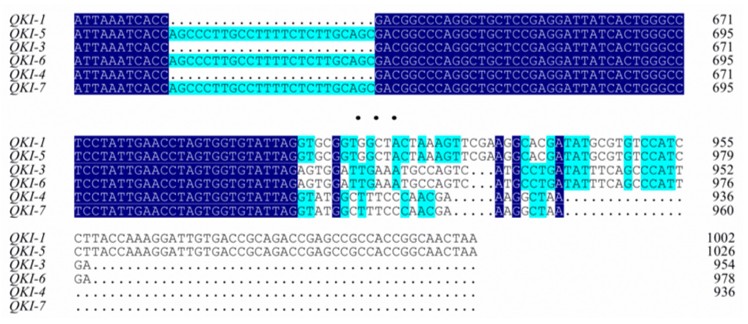 Fig. 1 Alignment of the amino-acid sequences on the different parts of the QKI isoforms.1
Key structural properties of QKI:
- Containing a highly conserved KH (hnRNP K homology) domain
- KH domains mediate binding to specific RNA sequences (ACUAAY elements)
- Enhance its post-transcriptional regulatory function through dimerization.
- Nuclear localization signals regulate its shuttle between the nucleus and the cytoplasm
Functions of QKI
The RNA-binding protein encoded by the QKI gene mainly functions to regulate the post-transcriptional expression of genes. Its core functions and mechanisms are as follows:
| Function | Description |
| RNA Splicing Regulation | By binding to specific pre-mRNA sequences, it regulates the selective splicing process, thereby influencing the generation of different protein subtypes. |
| Regulation of mRNA stability | By binding to the 3'UTR region of the target mRNA, it affects the stability and degradation rate of the mRNA, thereby precisely regulating the protein expression level. |
| mRNA Localization and Transport | It is involved in transporting specific mRNAs to specific regions within the cell (such as axons or glial cell protrusions), enabling localized translation. |
| Neuronal Myelin Formation | This is of crucial importance in oligodendrocytes, regulating the metabolism of myelin-related protein mRNA and ensuring normal myelination of the central nervous system. |
| Cell Differentiation and Development | It is involved in multiple crucial biological processes such as embryonic development, angiogenesis, and differentiation of astrocytes. |
Unlike many single-function guardian genes, QKI binds to target RNAs through its KH domain, forming a broad post-transcriptional regulatory network. Its functional deficiency is closely related to various neurological diseases such as schizophrenia and white matter lesions.
Applications of QKI and QKI Antibody in Literature
1. Chen, Sijia, et al. "Overexpression of the QKI Gene Promotes Differentiation of Goat Myoblasts into Myotubes." Animals 13.4 (2023): 725. https://doi.org/10.3390/ani13040725
This study has confirmed that the QKI gene, especially the QKI-5 subtype, can significantly promote the differentiation of goat myoblasts and the formation of myotubes, providing a theoretical basis for enhancing the meat production performance of goats through genetic improvement.
2. Zhou, Xin, et al. "Qki regulates myelinogenesis through Srebp2-dependent cholesterol biosynthesis." Elife 10 (2021): e60467. https://doi.org/10.7554/eLife.60467
The article indicates that QKI-5, as a co-activator of Srebp2, regulates cholesterol biosynthesis within oligodendrocytes and is crucial for the normal formation of myelin in the central nervous system.
3. Shi, Fei, et al. "QKI‐6 inhibits bladder cancer malignant behaviours through down‐regulating E2F3 and NF‐κB signalling." Journal of cellular and molecular medicine 23.10 (2019): 6578-6594. https://doi.org/10.1111/jcmm.14481
The study found that the down-regulation of QKI-6 expression in bladder cancer is associated with advanced tumor stage and shorter survival period. It inhibits expression by binding to the 3'UTR of the E2F3 gene, and is also negatively regulated by E2F3 feedback, forming a regulatory network to inhibit tumor growth and invasion.
4. Zhang, Haihua, et al. "QKI-6 suppresses cell proliferation, migration, and emt in non-small cell lung cancer." Frontiers in Oncology 12 (2022): 897553. https://doi.org/10.3389/fonc.2022.897553
The study found that decreased expression of QKI-6 in non-small cell lung cancer predicts a poor prognosis. Its overexpression inhibits the EGFR/SRC/STAT3 pathway by upregulating AGR2, thereby blocking the EMT process and inhibiting the proliferation and migration of cancer cells.
5. Shin, Seula, et al. "Qki activates Srebp2-mediated cholesterol biosynthesis for maintenance of eye lens transparency." Nature communications 12.1 (2021): 3005. https://doi.org/10.1038/s41467-021-22782-0
The research reveals that the QKI protein acts as a transcriptional co-activator, and by interacting with Srebp2, it regulates the expression of genes involved in cholesterol biosynthesis in lens cells. This is crucial for maintaining the transparency of the lens and preventing cataracts.
Creative Biolabs: QKI Antibodies for Research
Creative Biolabs specializes in the production of high-quality QKI antibodies for research and industrial applications. Our portfolio includes monoclonal antibodies tailored for ELISA, Flow Cytometry, Western blot, immunohistochemistry, and other diagnostic methodologies.
- Custom QKI Antibody Development: Tailor-made solutions to meet specific research requirements.
- Bulk Production: Large-scale antibody manufacturing for industry partners.
- Technical Support: Expert consultation for protocol optimization and troubleshooting.
- Aliquoting Services: Conveniently sized aliquots for long-term storage and consistent experimental outcomes.
For more details on our QKI antibodies, custom preparations, or technical support, contact us at email.
Reference
- Chen, Sijia, et al. "Overexpression of the QKI Gene Promotes Differentiation of Goat Myoblasts into Myotubes." Animals 13.4 (2023): 725. Distributed under the same Creative Commons license CC BY 4.0 as the original. Cropped from the original figure. https://doi.org/10.3390/ani13040725
Anti-QKI antibodies
 Loading...
 Compare




Hot products 
-
Mouse Anti-FPR2 Recombinant Antibody (1D6) (CBMAB-F2628-CQ)

-
Mouse Anti-FLI1 Recombinant Antibody (CBXF-0733) (CBMAB-F0435-CQ)

-
Mouse Anti-Gram Positive Bacteria LTA Recombinant Antibody (CBMC-C0664) (CBMAB-V208-1410-CQ)

-
Mouse Anti-CECR2 Recombinant Antibody (CBWJC-2465) (CBMAB-C3533WJ)

-
Mouse Anti-ARHGDIA Recombinant Antibody (CBCNA-009) (CBMAB-R0415-CN)

-
Mouse Anti-CGAS Recombinant Antibody (CBFYM-0995) (CBMAB-M1146-FY)

-
Mouse Anti-APOE Recombinant Antibody (A1) (CBMAB-0078CQ)

-
Mouse Anti-CD8 Recombinant Antibody (C1083) (CBMAB-C1083-LY)

-
Mouse Anti-ADAM12 Recombinant Antibody (V2-179752) (CBMAB-A1114-YC)

-
Mouse Anti-GFAP Recombinant Antibody (5) (CBMAB-G0346-LY)

-
Mouse Anti-BSN Recombinant Antibody (219E1) (CBMAB-1228-CN)

-
Mouse Anti-APP Recombinant Antibody (DE2B4) (CBMAB-1122-CN)

-
Mouse Anti-ABCA3 Recombinant Antibody (V2-178911) (CBMAB-A0145-YC)

-
Mouse Anti-ARID1B Recombinant Antibody (KMN1) (CBMAB-A3546-YC)

-
Mouse Anti-ALX1 Recombinant Antibody (96k) (CBMAB-C0616-FY)

-
Mouse Anti-GST Recombinant Antibody (CBLG1-1938) (CBMAB-G5371-LY)

-
Mouse Anti-FN1 Monoclonal Antibody (D6) (CBMAB-1240CQ)

-
Mouse Anti-14-3-3 Pan Recombinant Antibody (V2-9272) (CBMAB-1181-LY)

-
Mouse Anti-EGR1 Recombinant Antibody (CBWJZ-100) (CBMAB-Z0289-WJ)

-
Mouse Anti-Gro Monoclonal Antibody (1) (CBMAB-0482-LY)

- AActivation
- AGAgonist
- APApoptosis
- BBlocking
- BABioassay
- BIBioimaging
- CImmunohistochemistry-Frozen Sections
- CIChromatin Immunoprecipitation
- CTCytotoxicity
- CSCostimulation
- DDepletion
- DBDot Blot
- EELISA
- ECELISA(Cap)
- EDELISA(Det)
- ESELISpot
- EMElectron Microscopy
- FFlow Cytometry
- FNFunction Assay
- GSGel Supershift
- IInhibition
- IAEnzyme Immunoassay
- ICImmunocytochemistry
- IDImmunodiffusion
- IEImmunoelectrophoresis
- IFImmunofluorescence
- IGImmunochromatography
- IHImmunohistochemistry
- IMImmunomicroscopy
- IOImmunoassay
- IPImmunoprecipitation
- ISIntracellular Staining for Flow Cytometry
- LALuminex Assay
- LFLateral Flow Immunoassay
- MMicroarray
- MCMass Cytometry/CyTOF
- MDMeDIP
- MSElectrophoretic Mobility Shift Assay
- NNeutralization
- PImmunohistologyp-Paraffin Sections
- PAPeptide Array
- PEPeptide ELISA
- PLProximity Ligation Assay
- RRadioimmunoassay
- SStimulation
- SESandwich ELISA
- SHIn situ hybridization
- TCTissue Culture
- WBWestern Blot
