
ALDH1A1 Antibodies
Background
ALDH1A1 is a key metabolic enzyme belonging to the aldehyde dehydrogenase family, mainly distributed in various tissues of mammals such as the liver, retina and stem cells. This enzyme is responsible for catalyzing the oxidation of fatty aldehydes to the corresponding carboxylic acids, thereby participating in the key step of the conversion of retinaldehyde to retinoic acid, and plays an important regulatory role in retinal development and cell differentiation. It also plays a core role in stem cell maintenance, oxidative stress defense and drug metabolism, and its abnormal expression is closely related to chemotherapy resistance in many cancers. This gene was first identified in the 1980s. Its three-dimensional structure and catalytic mechanism have been resolved through methods such as X-ray crystallography, providing an important model for the study of enzyme kinetics, metabolic diseases, and targeted tumor therapy, and continuously promoting a deeper understanding of the association between cellular metabolic networks and diseases.
Structure of ALDH1A1
ALDH1A1 is a protein of the aldehyde dehydrogenase family with a molecular weight of approximately 55 kDa. Its exact molecular weight varies slightly among different species and tissues due to transcript variations and post-translational modifications such as phosphorylation.
| Species | Human | Mouse | Rat | Bovine |
| Molecular Weight (kDa) | ~55 | ~55 | ~55 | ~55 |
| Primary Structural Differences | Catalyzing the generation of retinoic acid from retinaldehyde is associated with stem cell markers and drug resistance | Features highly conservative, often used in the study of disease model | Common in the study of the liver metabolism | Sequences are highly homologous, but functional studies are relatively scarce |
This protein is composed of approximately 500 amino acids, forming a typical aldehyde dehydrogenase conserved domain. Its tertiary structure contains a catalytic domain, with the core being a conserved glutamic acid active site and NAD+ binding pocket, which are crucial for catalyzing the oxidation of aldehydes. A key cysteine residue acts as a nucleophile to participate in substrate binding, while adjacent histidine and aspartic acid work together to stabilize the transition state, jointly determining the specificity and efficient catalytic activity of the enzyme for aldehyde substrates.
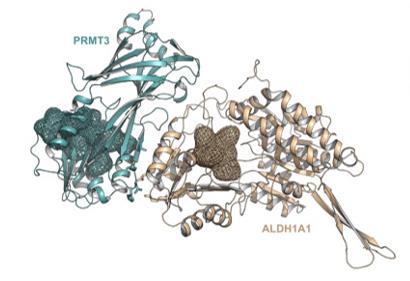 Fig. 1 Crystal structure of human PRMT3 (cyan) in complex with human ALDH1A1 (brown).1
Key structural properties of ALDH1A1:
- Conservative three-dimensional aldehyde dehydrogenase folding structure
- Contains NAD+ binding domain and catalytic domain
- Active center contains key cysteine residues (Cys302) as nucleophilic reagent
- Hydrophobic pockets are responsible for identifying and binding to aldehyde substrates
Functions of ALDH1A1
The main function of the ALDH1A1 gene is to catalyze the oxidative metabolism of aldehydes, especially retinaldehyde. However, it is also widely involved in various physiological and pathological processes such as cell differentiation, oxidative stress defense, and tumor drug resistance.
| Function | Description |
| Retinoic acid is produced | Catalyze the irreversible oxidation of retinaldehyde to retinoic acid (RA), which is a key step in the retinoic acid signaling pathway and regulates embryonic development and cell differentiation. |
| Stem cell maintenance | As a biomarker and functional regulator of various stem cells (such as tumor stem cells and hematopoietic stem cells), it maintains their self-renewal and undifferentiated state. |
| Defense against oxidative stress | Metabolize toxic lipid peroxidation end products (such as 4-hydroxynonenal) to protect cells from oxidative damage. |
| Drug resistance | In a variety of high expression of (such as breast, lung cancer, through metabolic chemotherapy drugs (such as cyclophosphamide) and remove toxic aldehyde, mediated tumor drug resistance. |
| Ethanol metabolism | Participate in acetaldehyde oxidation, is one of the secondary enzyme in alcohol metabolism pathways. |
Unlike single-function metabolic enzymes, the catalytic efficiency of ALDH1A1 is precisely regulated by its oligomerization state and intracellular localization, which enables it to integrate metabolic and signal transduction functions and play a core role in developmental homeostasis and disease progression.
Applications of ALDH1A1 and ALDH1A1 Antibody in Literature
- Gorodetska, Ielizaveta, et al. "ALDH1A1 drives prostate cancer metastases and radioresistance by interplay with AR-and RAR-dependent transcription." Theranostics 14.2 (2024): 714. https://doi.org/10.7150/thno.88057
Studies have shown that ALDH1A1 and ALDH1A3 have opposite effects in bone metastasis of prostate cancer. ALDH1A1 promotes tumor metastasis and radiotherapy resistance by regulating PLK3 and is a potential prognostic marker and therapeutic target.
- Wang, Mingyuan, et al. "ALDH1A1 promotes immune escape of tumor cells through ZBTB7B-glycolysis pathway." Cell Death & Disease 15.8 (2024): 568. https://doi.org/10.1038/s41419-024-06943-9
Research has found that ALDH1A1 regulates glycolysis through ZBTB7B, promoting tumor immune escape. Inhibiting ALDH1A1 can enhance the effect of immunotherapy, and its combination with PD-1/PD-L1 inhibitors has the potential for clinical transformation.
- Carmichael, Kathleen, et al. "Function and regulation of ALDH1A1-positive nigrostriatal dopaminergic neurons in motor control and Parkinson's disease." Frontiers in Neural Circuits 15 (2021): 644776. https://doi.org/10.3389/fncir.2021.644776
Research has found that ALDH1A1-positive dopamine neurons are the first specific group of brain cells to be lost in Parkinson's disease, accounting for 70% of substantia nigra neurons. They are crucial for regulating motor activity, and the study of their circuits provides a new perspective for the treatment of Parkinson's disease.
- Omran, Ziad. "Novel disulfiram derivatives as ALDH1A1-selective inhibitors." Molecules 27.2 (2022): 480. https://doi.org/10.3390/molecules27020480
In this study, a novel selective inhibitor of ALDH1A1 was developed based on disulfiram. By introducing (heterologous) aromatic rings to increase the molecular structure, the new compound maintains its inhibitory activity on ALDH1A1 while completely avoiding the inhibition of the key metabolic enzyme ALDH2.
- Liu, Ying, et al. "ALDH1A1 expression correlates with clinicopathologic features and poor prognosis of breast cancer patients: a systematic review and meta-analysis." BMC cancer 14.1 (2014): 444. https://doi.org/10.1186/1471-2407-14-444
The article indicates that high expression of ALDH1A1 is associated with the tumor size, grade, lymph node metastasis and HER2 status of breast cancer, and can suggest ER/PR negative. Comprehensive analysis confirmed that ALDH1A1 is an effective biomarker for predicting the progression and poor prognosis of breast cancer.
Creative Biolabs: ALDH1A1 Antibodies for Research
Creative Biolabs specializes in the production of high-quality ALDH1A1 antibodies for research and industrial applications. Our portfolio includes monoclonal antibodies tailored for ELISA, Flow Cytometry, Western blot, immunohistochemistry, and other diagnostic methodologies.
- Custom ALDH1A1 Antibody Development: Tailor-made solutions to meet specific research requirements.
- Bulk Production: Large-scale antibody manufacturing for industry partners.
- Technical Support: Expert consultation for protocol optimization and troubleshooting.
- Aliquoting Services: Conveniently sized aliquots for long-term storage and consistent experimental outcomes.
For more details on our ALDH1A1 antibodies, custom preparations, or technical support, contact us at email.
Reference
- Verma, Mamta, et al. "PRMT3 interacts with ALDH1A1 and regulates gene-expression by inhibiting retinoic acid signaling." Communications biology 4.1 (2021): 109. https://doi.org/10.1038/s42003-020-01644-3
Anti-ALDH1A1 antibodies
 Loading...
 Compare




Hot products 
-
Human Anti-SARS-CoV-2 Spike Recombinant Antibody (CBC05) (CBMAB-CR005LY)

-
Mouse Anti-ACKR3 Recombinant Antibody (V2-261265) (CBMAB-C1023-LY)

-
Mouse Anti-CTCF Recombinant Antibody (CBFYC-2371) (CBMAB-C2443-FY)

-
Mouse Anti-CD33 Recombinant Antibody (6C5/2) (CBMAB-C8126-LY)

-
Rabbit Anti-ENO2 Recombinant Antibody (BA0013) (CBMAB-0272CQ)

-
Mouse Anti-ADIPOR1 Recombinant Antibody (V2-179982) (CBMAB-A1368-YC)

-
Mouse Anti-GZMA Recombinant Antibody (CBLG1-2197) (CBMAB-G5901-LY)

-
Rabbit Anti-CCL5 Recombinant Antibody (R0437) (CBMAB-R0437-CN)

-
Mouse Anti-H1-0 Recombinant Antibody (CBFYH-0565) (CBMAB-H1451-FY)

-
Rabbit Anti-ALOX5AP Recombinant Antibody (CBXF-1219) (CBMAB-F0750-CQ)

-
Rabbit Anti-AKT3 Recombinant Antibody (V2-12567) (CBMAB-1057-CN)

-
Mouse Anti-APOE Recombinant Antibody (A1) (CBMAB-0078CQ)

-
Rat Anti-4-1BB Recombinant Antibody (V2-1558) (CBMAB-0953-LY)

-
Mouse Anti-CARTPT Recombinant Antibody (113612) (CBMAB-C2450-LY)

-
Mouse Anti-AKT1/AKT2/AKT3 (Phosphorylated T308, T309, T305) Recombinant Antibody (V2-443454) (PTM-CBMAB-0030YC)

-
Mouse Anti-ADRB2 Recombinant Antibody (V2-180026) (CBMAB-A1420-YC)

-
Mouse Anti-GluRIIA Monoclonal Antibody (8B4D2) (CBMAB-0305-CN)

-
Mouse Anti-FLT1 Recombinant Antibody (11) (CBMAB-V0154-LY)

-
Mouse Anti-FOSB Recombinant Antibody (CBXF-3593) (CBMAB-F2522-CQ)

-
Mouse Anti-AQP2 Recombinant Antibody (E-2) (CBMAB-A3358-YC)

- AActivation
- AGAgonist
- APApoptosis
- BBlocking
- BABioassay
- BIBioimaging
- CImmunohistochemistry-Frozen Sections
- CIChromatin Immunoprecipitation
- CTCytotoxicity
- CSCostimulation
- DDepletion
- DBDot Blot
- EELISA
- ECELISA(Cap)
- EDELISA(Det)
- ESELISpot
- EMElectron Microscopy
- FFlow Cytometry
- FNFunction Assay
- GSGel Supershift
- IInhibition
- IAEnzyme Immunoassay
- ICImmunocytochemistry
- IDImmunodiffusion
- IEImmunoelectrophoresis
- IFImmunofluorescence
- IGImmunochromatography
- IHImmunohistochemistry
- IMImmunomicroscopy
- IOImmunoassay
- IPImmunoprecipitation
- ISIntracellular Staining for Flow Cytometry
- LALuminex Assay
- LFLateral Flow Immunoassay
- MMicroarray
- MCMass Cytometry/CyTOF
- MDMeDIP
- MSElectrophoretic Mobility Shift Assay
- NNeutralization
- PImmunohistologyp-Paraffin Sections
- PAPeptide Array
- PEPeptide ELISA
- PLProximity Ligation Assay
- RRadioimmunoassay
- SStimulation
- SESandwich ELISA
- SHIn situ hybridization
- TCTissue Culture
- WBWestern Blot
