
ADAM2 Antibodies
Background
ADAM2 is a transmembrane glycoprotein belonging to the family of unintegrin metalloproteinases, mainly expressed in the testicular tissue of mammals. This protein plays a key role in spermatogenesis, participates in the molecular regulation of sperm and egg cell recognition and fusion, and is of great significance for the establishment of male reproductive function. Since its first identification in 1994, ADAM2 has served as a typical model for the study of fertilization-related basic proteins. Its structural features and functional mechanisms have been deeply analyzed, promoting the understanding of the mechanism of membrane interactions mediated by cell surface proteins in the field of reproductive biology. This type of research not only reveals the molecular basis of the collaborative work of protein domains, but also provides an important theoretical basis for the development of reproductive medicine.
Structure of ADAM2
ADAM2 is a transmembrane glycoprotein with a molecular weight of approximately 80-100 kDa. Its molecular weight may vary among different species, mainly due to the degree of glycosylation modification or subtle changes in the domain.
| Species | Human | Mouse | Rat |
| Molecular Weight (kDa) | About 80-100 | About 100 | About 90 |
| Primary Structural Differences | The N-terminal predomain sequence shows species specificity | The research on structure and function is the most in-depth | Highly homologous to mice |
The primary structure of this protein contains multiple characteristic domains, such as the pre-domain, the unintegrin-like domain, and the cysteine-rich domain. Its core functional structure is the integrin-like domain, which is responsible for mediating the interaction with integrins on the surface of the egg and is crucial for the combination of sperm and egg. The overall spatial conformation of this protein enables it to function as a key adhesion molecule on the surface of sperm.
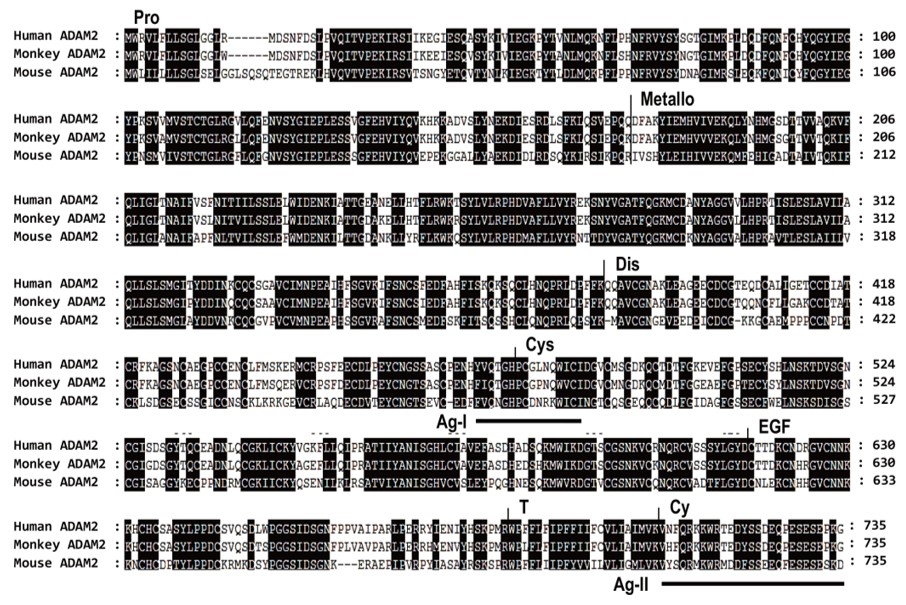 Fig. 1 Comparison of amino acid sequences of mammalian ADAM2.1
Key structural properties of ADAM:
- Multi-domain transmembrane proteins
- Contains a disintegrin-like and cysteine-rich domain
- Sample solution of integrin structure domain is responsible for sperm egg recognition
Functions of ADAM2
The main function of the ADAM2 protein is to mediate the recognition and combination of sperm and egg, ensuring the completion of the fertilization process. Its functions also involve cell signal transduction and developmental regulation within the testicles.
| Function | Description |
| Sperm and egg recognition and adhesion | Sample solution integrin structure domain specificity combined with egg transparent belt or the integrin receptor on the egg membrane, is the key step in the sperm egg first contact. |
| Membrane fusion promotion | As part of the sperm surface protein complex (such as fertilin), it creates the necessary conditions for the fusion of the sperm and egg plasma membranes. |
| Regulation of testicular development | Express in the process of spermatogenesis, the signal may affect germ cell differentiation and mature. |
| Species-specific barrier | Interspecific differences in protein structure may be involved in the formation of reproductive isolation and prevent interspecies fertilization. |
| Markers of male infertility | Mutations or abnormal expression of the ADAM2 gene are associated with specific types of male infertility and can serve as potential diagnostic indicators. |
Unlike most ADAM family members with catalytic activity, ADAM2 lacks typical metalloproteinase activity. Its core function lies in protein-protein interactions, which determines that it specifically plays the role of a "molecular bridge" between cells.
Applications of ADAM2 and ADAM2 Antibody in Literature
1. Dervovic, Dzana, et al. "In vivo CRISPR screens reveal Serpinb9 and Adam2 as regulators of immune therapy response in lung cancer." nature communications 14.1 (2023): 3150. https://doi.org/10.1038/s41467-023-38841-7
To explore the response mechanism of tumor immunotherapy, this study found through in vivo CRISPR/Cas9 screening that the cancer testicular antigen ADAM2 is highly expressed in KRAS-mutated lung cancer. It reduces antigen presentation by inhibiting the interferon and TNF signaling pathways, while reducing the expression of immune checkpoints such as PD-L1 and enhancing the efficacy of adopted T cells.
2. Choi, Heejin, et al. "Characterization of mammalian ADAM2 and its absence from human sperm." PLoS One 11.6 (2016): e0158321. https://doi.org/10.1371/journal.pone.0158321
The article indicates that the ADAM2 protein plays a crucial role in mammalian reproduction. Studies have confirmed that it is indispensable in the sperm function of mice and exists in the testicles and sperm of monkeys. However, ADAM2 was not detected in human sperm, suggesting that there are species differences in their reproductive functions.
3. Al-Shabebi, Abdulkarem, Thnaian Althnaian, and Khalid Alkhodair. "Localization and expression of ADAM2 in the dromedary camel testis, epididymis and sperm during rutting season." Animal Reproduction 18 (2021): e20200241. https://doi.org/10.1590/1984-3143-AR2020-0241
This study was the first to discover the ADAM2 protein in the testicles, epididymis and sperm of dromedary camels. It is expressed at all stages of spermatogenesis and in the epididymal epithelium, and is also located in the acrosome cap of mature sperm. The expression of mRNA in the testicles was significantly higher than that in the epididymis, suggesting that ADAM2 plays an important role in the fertility of male dromedary camels.
4. Maheswaran, Emeaga, et al. "Lack of ADAM2, CALR3 and SAGE1 cancer/testis antigen expression in lung and breast cancer." PLoS One 10.8 (2015): e0134967. https://doi.org/10.1371/journal.pone.0134967
This study evaluated the immunotherapeutic potential of cancer-testicular antigens ADAM2, CALR3 and SAGE1 in lung cancer and breast cancer. The results indicated that these antigens were specifically expressed only in the testicles in normal tissues, and no significant expression was found in the tumor samples tested and the cell lines after demethylation induction. Therefore, they are not suitable as immunotherapy targets for these two types of cancer.
5. Desiderio, Ulyana V., Xiaoling Zhu, and Janice P. Evans. "ADAM2 interactions with mouse eggs and cell lines expressing α4/α9 (ITGA4/ITGA9) integrins: implications for integrin-based adhesion and fertilization." PLoS One 5.10 (2010): e013744. https://doi.org/10.1371/journal.pone.0013744
This study reveals that integrin α9β7 can serve as a novel binding partner for ADAM2. Experiments have confirmed that RPMI 8866 cells lacking the β1 subunit form heterodimers with the α9 and β7 subunits, mediating specific adhesion to ADAM2. This is of great significance for understanding mammalian fertilization and the regulation of integrin function.
Creative Biolabs: ADAM2 Antibodies for Research
Creative Biolabs specializes in the production of high-quality ADAM2 antibodies for research and industrial applications. Our portfolio includes monoclonal antibodies tailored for ELISA, Flow Cytometry, Western blot, immunohistochemistry, and other diagnostic methodologies.
- Custom ADAM2 Antibody Development: Tailor-made solutions to meet specific research requirements.
- Bulk Production: Large-scale antibody manufacturing for industry partners.
- Technical Support: Expert consultation for protocol optimization and troubleshooting.
- Aliquoting Services: Conveniently sized aliquots for long-term storage and consistent experimental outcomes.
For more details on our ADAM2 antibodies, custom preparations, or technical support, contact us at email.
Reference
- Choi, Heejin, et al. "Characterization of mammalian ADAM2 and its absence from human sperm." PLoS One 11.6 (2016): e0158321. https://doi.org/10.1371/journal.pone.0158321
Anti-ADAM2 antibodies
 Loading...
 Compare




Hot products 
-
Mouse Anti-EGR1 Recombinant Antibody (CBWJZ-100) (CBMAB-Z0289-WJ)

-
Mouse Anti-CRYAB Recombinant Antibody (A4345) (CBMAB-A4345-YC)

-
Mouse Anti-AMOT Recombinant Antibody (CBYC-A564) (CBMAB-A2552-YC)

-
Mouse Anti-14-3-3 Pan Recombinant Antibody (V2-9272) (CBMAB-1181-LY)

-
Mouse Anti-BIRC3 Recombinant Antibody (16E63) (CBMAB-C3367-LY)

-
Mouse Anti-GZMA Recombinant Antibody (CBLG1-2197) (CBMAB-G5901-LY)

-
Mouse Anti-A2M Recombinant Antibody (V2-178822) (CBMAB-A0036-YC)

-
Rat Anti-AChR Recombinant Antibody (V2-12500) (CBMAB-0990-CN)

-
Mouse Anti-CD24 Recombinant Antibody (ALB9) (CBMAB-0176CQ)

-
Mouse Anti-CD19 Recombinant Antibody (CBXC-1224) (CBMAB-C1491-CQ)

-
Mouse Anti-ABL2 Recombinant Antibody (V2-179121) (CBMAB-A0364-YC)

-
Rabbit Anti-CCL5 Recombinant Antibody (R0437) (CBMAB-R0437-CN)

-
Mouse Anti-GST Recombinant Antibody (CBLG1-1938) (CBMAB-G5371-LY)

-
Mouse Anti-FAS2 Monoclonal Antibody (1D4) (CBMAB-0071-CN)

-
Mouse Anti-EMP3 Recombinant Antibody (CBFYE-0100) (CBMAB-E0207-FY)

-
Mouse Anti-ACTB Recombinant Antibody (V2-179553) (CBMAB-A0870-YC)

-
Mouse Anti-GDF5 Recombinant Antibody (1F4) (CBMAB-G2740-LY)

-
Mouse Anti-C1QC Recombinant Antibody (CBFYC-0600) (CBMAB-C0654-FY)

-
Mouse Anti-C5b-9 Recombinant Antibody (aE11) (CBMAB-AO138LY)

-
Rat Anti-ADGRE4 Recombinant Antibody (V2-160163) (CBMAB-F0011-CQ)

- AActivation
- AGAgonist
- APApoptosis
- BBlocking
- BABioassay
- BIBioimaging
- CImmunohistochemistry-Frozen Sections
- CIChromatin Immunoprecipitation
- CTCytotoxicity
- CSCostimulation
- DDepletion
- DBDot Blot
- EELISA
- ECELISA(Cap)
- EDELISA(Det)
- ESELISpot
- EMElectron Microscopy
- FFlow Cytometry
- FNFunction Assay
- GSGel Supershift
- IInhibition
- IAEnzyme Immunoassay
- ICImmunocytochemistry
- IDImmunodiffusion
- IEImmunoelectrophoresis
- IFImmunofluorescence
- IGImmunochromatography
- IHImmunohistochemistry
- IMImmunomicroscopy
- IOImmunoassay
- IPImmunoprecipitation
- ISIntracellular Staining for Flow Cytometry
- LALuminex Assay
- LFLateral Flow Immunoassay
- MMicroarray
- MCMass Cytometry/CyTOF
- MDMeDIP
- MSElectrophoretic Mobility Shift Assay
- NNeutralization
- PImmunohistologyp-Paraffin Sections
- PAPeptide Array
- PEPeptide ELISA
- PLProximity Ligation Assay
- RRadioimmunoassay
- SStimulation
- SESandwich ELISA
- SHIn situ hybridization
- TCTissue Culture
- WBWestern Blot
