
CHD8 Antibodies
Background
The CHD8 gene is highly expressed in embryonic brain nerve cells and mainly regulates chromatin structure and the expression of related genes, thereby influencing the connections and development of neurons. This gene precisely controls the activation or deactivation of genes related to neural development through its ATPase activity and interactions with other proteins. CHD8 was initially drawn attention due to its strong association with autism spectrum disorders and is currently one of the most important single-gene risk factors for autism. Studying CHD8 helps understand the pathogenesis of neurodevelopmental diseases and provides important clues for developing targeted treatment strategies.
Structure of CHD8
The protein encoded by the CHD8 gene has a molecular weight of approximately 290 kDa. This protein is highly conserved among different species, with its molecular weight generally remaining within the range of 290 - 295 kDa.
| Species | Human | Mouse | Rat | Macaque |
| Molecular Weight (kDa) | 290.5 | 290.2 | 290.4 | 290.3 |
| Primary Structural Differences | Typical structure, containing ATPase domain | Homology with humans reaches 98% | Minor variations exist at the C-terminus | Highly similar to humans |
This protein is composed of approximately 2500 amino acids and forms a complex spatial conformation with multiple functional domains. The protein structure includes a chromatin domain at the N-terminus, an ATPase domain in the center, and a SANT domain at the C-terminus. These domains together constitute a molecular complex capable of binding and remodeling chromatin. The protein recognizes specific histone modifications through its SANT domain and uses the ATPase domain to hydrolyze energy to change the position of nucleosomes, thereby regulating the transcriptional activity of target genes. The SNF2-related domains in the protein form a conserved catalytic core, and two functional nuclear localization signals ensure that the protein accurately enters the cell nucleus to exert its function.
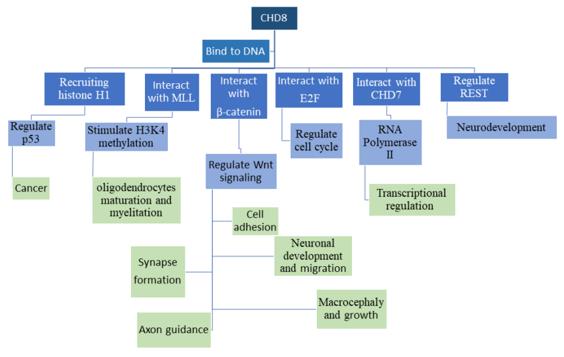 Fig. 1 Functions of the CHD8 protein.1
Key structural and functional characteristics of the CHD8 gene:
- Chromatin remodeling domain with ATPase activity
- Multiple functional domains (chromatin domain, ATPase domain, SANT domain) working together
- DNA binding ability, recognizing and regulating specific genes
- Interacting with histone-modifying enzymes, regulating chromatin state and gene expression
Functions of CHD8
The main function of the CHD8 gene is to regulate gene expression through chromatin remodeling, playing a central role in neural development and cell differentiation. However, its functions are not limited to transcriptional regulation; it also participates in various biological processes such as cell cycle regulation and DNA damage repair.
| Function | Description |
| Chromatin remodeling | CHD8 uses ATPase activity to alter the position of nucleosomes, regulate the open state of chromatin, and affect the transcription of target genes. |
| Neural Development Regulation | Regulates the expression of genes related to neuronal proliferation, differentiation, and synapse formation, maintaining the normal process of neural development. |
| Wnt signaling pathway regulation | By interacting with β-catenin, it inhibits the activity of the Wnt signaling pathway, thereby controlling the balance between cell proliferation and differentiation. |
| Transcriptional Inhibition and Activation | Depending on the protein complexes it binds to, CHD8 can either inhibit or activate the transcription of downstream genes. |
| Cell Cycle Regulation | Participates in regulating the expression of p53 and other genes related to the cell cycle, influencing the processes of cell proliferation and apoptosis. |
The regulation of target genes by CHD8 is bidirectional and environment-dependent. Its dysfunction is closely related to neurodevelopmental disorders such as autism spectrum disorders, which is consistent with its status as a central transcriptional regulator.
Applications of CHD8 and CHD8 Antibody in Literature
1. Weissberg, Orly, and Evan Elliott. "The mechanisms of CHD8 in neurodevelopment and autism spectrum disorders." Genes 12.8 (2021): 1133. https://doi.org/10.3390/genes12081133
The article indicates that CHD8 is a gene strongly associated with autism and plays a crucial role in various cellular processes. Through the study of the CHD8 mutant mouse model, it helps to understand the development mechanism of the autistic phenotype and provides important clues for exploring potential therapeutic targets.
2. Basson, M. Albert. "Neurodevelopmental functions of CHD8: new insights and questions." Biochemical Society Transactions 52.1 (2024): 15-27. https://doi.org/10.1042/BST20220926
The article indicates that heterozygous functional loss mutations of the CHD8 gene are highly prevalent in autism, affecting various brain cells and the process of neural development. Its phenotype is regulated by the type of mutation, gender and genetic background, and the elucidation of the related mechanisms remains a key focus of future research.
3. Hoffmann, Anke, and Dietmar Spengler. "Chromatin remodeler CHD8 in autism and brain development." Journal of Clinical Medicine 10.2 (2021): 366. https://doi.org/10.3390/jcm10020366
The article indicates that CHD8 is a high-risk factor for autism, and its mutations lead to abnormal neural development. Studies using animal models have revealed its role in aspects such as synaptic plasticity. In the future, attention should be paid to gender differences, brain organoid models, and therapeutic interventions.
4. Sorrentino, Ugo, et al. "CHD8-related disorders redefined: an expanding spectrum of dystonic phenotypes." Journal of Neurology 271.5 (2024): 2859-2865. https://doi.org/10.1007/s00415-024-12271-x
The study found that mutations in the CHD8 gene can cause dystonia, especially in females. This symptom may occur independently of autism, suggesting that dystonia should be included in the clinical phenotype of CHD8-related neurodevelopmental disorders.
5. Chatterjee, Ipsita, et al. "CHD8 regulates gut epithelial cell function and affects autism-related behaviors through the gut-brain axis." Translational Psychiatry 13.1 (2023): 305. https://doi.org/10.1038/s41398-023-02611-2
The research has found that a deficiency in the single copy of the CHD8 gene can lead to abnormal intestinal barrier function and changes in the microbiota. Such intestinal defects may exacerbate the autistic-related behaviors. Antibiotic treatment can improve social impairments.
Creative Biolabs: CHD8 Antibodies for Research
Creative Biolabs specializes in the production of high-quality CHD8 antibodies for research and industrial applications. Our portfolio includes monoclonal and polyclonal antibodies tailored for ELISA, Flow Cytometry, Western blot, immunohistochemistry, and other diagnostic methodologies.
- Custom CHD8 Antibody Development: Tailor-made solutions to meet specific research requirements.
- Bulk Production: Large-scale antibody manufacturing for industry partners.
- Technical Support: Expert consultation for protocol optimization and troubleshooting.
- Aliquoting Services: Conveniently sized aliquots for long-term storage and consistent experimental outcomes.
For more details on our CHD8 antibodies, custom preparations, or technical support, contact us at email.
Reference
- Weissberg, Orly, and Evan Elliott. "The mechanisms of CHD8 in neurodevelopment and autism spectrum disorders." Genes 12.8 (2021): 1133. Distributed under Open Access license CC BY 4.0, without modification. https://doi.org/10.3390/genes12081133
Anti-CHD8 antibodies
 Loading...
 Compare




Hot products 
- AActivation
- AGAgonist
- APApoptosis
- BBlocking
- BABioassay
- BIBioimaging
- CImmunohistochemistry-Frozen Sections
- CIChromatin Immunoprecipitation
- CTCytotoxicity
- CSCostimulation
- DDepletion
- DBDot Blot
- EELISA
- ECELISA(Cap)
- EDELISA(Det)
- ESELISpot
- EMElectron Microscopy
- FFlow Cytometry
- FNFunction Assay
- GSGel Supershift
- IInhibition
- IAEnzyme Immunoassay
- ICImmunocytochemistry
- IDImmunodiffusion
- IEImmunoelectrophoresis
- IFImmunofluorescence
- IGImmunochromatography
- IHImmunohistochemistry
- IMImmunomicroscopy
- IOImmunoassay
- IPImmunoprecipitation
- ISIntracellular Staining for Flow Cytometry
- LALuminex Assay
- LFLateral Flow Immunoassay
- MMicroarray
- MCMass Cytometry/CyTOF
- MDMeDIP
- MSElectrophoretic Mobility Shift Assay
- NNeutralization
- PImmunohistologyp-Paraffin Sections
- PAPeptide Array
- PEPeptide ELISA
- PLProximity Ligation Assay
- RRadioimmunoassay
- SStimulation
- SESandwich ELISA
- SHIn situ hybridization
- TCTissue Culture
- WBWestern Blot
