
LILRB4 Antibodies
Background
LILRB4, as a transmembrane protein mainly expressed on the surface of myeloid cells, belongs to the leukocyte immunoglobulin-like receptor family. This protein transmits negative regulatory signals through the intracellular immunoreceptor tyrosine inhibitory motif and plays a crucial role in maintaining immune tolerance and preventing autoimmune responses. In the tumor microenvironment, LILRB4 can induce T cell dysfunction and promote the differentiation of regulatory T cells, thereby helping tumor cells achieve immune evasion. Since it was first identified as an immunosuppressive receptor in 1999, the structure and function of LILRB4 have been deeply analyzed, and its potential application value as a new immune checkpoint in autoimmune diseases, transplant rejection, and cancer immunotherapy is increasingly prominent.
Structure of LILRB4
LILRB4 is a type I transmembrane glycoprotein. The mature form has a molecular weight of approximately 65 kDa, and its size varies slightly depending on the cell source and the degree of post-translational modification.
| Type of Cell | Monocytes/Macrophages | Dendritic Cells | Tumor Cells (e.g. MM) |
| Molecular weight range (kDa) | 60-70 | 60-75 | 55-80 |
| Modification differences | Basic glycosylation | Highly glycosylated | Abnormal glycosylation or truncation |
The extracellular region of the LILRB4 protein contains two tandem C2-type immunoglobulin-like domains, which are responsible for recognizing various ligands including ApoE. The long tail region of its cytoplasmic domain contains three immunoreceptor tyrosine inhibitory motifs (ITIMs), which recruit and activate the phosphatases SHP-1 or SHP-2, thereby conducting inhibitory signals. This protein is mainly expressed on the surface of myeloid immune cells and plays a core role in maintaining peripheral immune tolerance by inhibiting the production of pro-inflammatory factors and the antigen-presenting function.
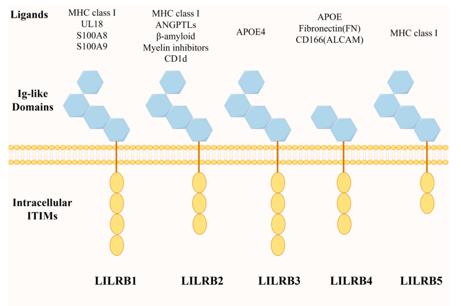 Fig. 1 LILRB family member structures and their ligand molecules.1
The key structural characteristics of LILRB4:
- Extracellular Ig-like domain: Two C2-type domains recognize ligands
- Intracellular ITIM motif: Conveys immunosuppressive signals
- Transmembrane region: α-helix anchors to the cell membrane
- Glycosylation site: Maintains protein stability and function
Functions of LILRB4
The main function of LILRB4 is to act as an immune suppressor receptor to regulate the activation of immune cells. However, it is also involved in various pathological and physiological processes, including the maintenance of immune tolerance and the immune escape of tumors.
| Function | Description |
| Immune suppression signal transduction | Recruiting phosphatases through intracellular ITIM motifs to inhibit activation signals of immune cells. |
| Regulating T cell function | Inducing dysfunction of effector T cells and promoting differentiation of regulatory T cells. |
| Maintaining immune tolerance | Suppressing excessive immune responses at sites such as the maternal-fetal interface to prevent tissue damage. |
| Promoting tumor progression | Inhibiting anti-tumor immune responses in the tumor microenvironment and helping tumor cells evade immune surveillance. |
| Regulating osteoclast differentiation | Influencing bone metabolism by secreting factors such as RELT, participating in bone destruction in multiple myeloma. |
The immunosuppressive function of LILRB4 mainly relies on the phosphorylation of the ITIM motif. After ligand binding, it triggers a cascade reaction of downstream signaling pathways, which is different from the oxygenation curve of hemoglobin, demonstrating the specificity of receptor-ligand interaction.
Applications of LILRB4 and LILRB4 Antibody in Literature
1. Xiang, Zhiqing, et al. "LILRB4 checkpoint for immunotherapy: structure, mechanism and disease targets." Biomolecules 14.2 (2024): 187. https://doi.org/10.3390/biom14020187
The article indicates that LILRB4 is an immune checkpoint molecule that transmits inhibitory signals through the ITIM motif. It plays a significant regulatory role in autoimmune diseases, transplant tolerance, and cancer treatment, and is expected to become a new target for immunotherapy.
2. Xie, Li, et al. "LILRB4 regulates multiple myeloma development through STAT3-PFKFB1 pathway." Cell Death & Disease 15.7 (2024): 515. https://doi.org/10.1038/s41419-024-06883-4
The research has found that LILRB4 is highly expressed in multiple myeloma and is associated with poor prognosis for patients. This molecule promotes tumor growth through the IKZF1-STAT3 pathway. Antibody therapy targeting LILRB4 can effectively inhibit tumor progression and is a potential new immunotherapy strategy.
3. Wang, Hongying, et al. "LILRB4 on multiple myeloma cells promotes bone lesion by p-SHP2/NF-κB/RELT signal pathway." Journal of Experimental & Clinical Cancer Research 43.1 (2024): 183. https://doi.org/10.1186/s13046-024-03110-y
The study found that LILRB4 is highly expressed in multiple myeloma. It promotes osteoclast differentiation by upregulating the RELT factor, thereby exacerbating bone destruction. Blocking the LILRB4 signaling pathway can effectively inhibit the progression of bone damage, providing a new target for treatment.
4. Li, Yuantao, et al. "LILRB4 regulates the function of decidual MDSCs via the SHP-2/STAT6 pathway during Toxoplasma gondii infection." Parasites & Vectors 16.1 (2023): 237. https://doi.org/10.1186/s13071-023-05856-4
The study found that Toxoplasma gondii infection down-regulates the expression of LILRB4 on dMDSCs through the STAT3 pathway, inhibits Arg-1 and IL-10 via the SHP-2/STAT6 pathway, leading to cellular dysfunction and possibly contributing to adverse pregnancy outcomes.
5. Sharma, Naveen, et al. "LILRB4 suppresses immunity in solid tumors and is a potential target for immunotherapy." Journal of Experimental Medicine 218.7 (2021): e20201811. https://doi.org/10.1084/jem.20201811
The study found that LILRB4 is highly expressed on tumor-associated macrophages and has an immunosuppressive effect. Knockout or antibody blockade of LILRB4 can reduce tumor burden, increase immune infiltration, regulate the phenotype of TAMs, and enhance the anti-tumor immune effect.
Creative Biolabs: LILRB4 Antibodies for Research
Creative Biolabs specializes in the production of high-quality LILRB4 antibodies for research and industrial applications. Our portfolio includes monoclonal and polyclonal antibodies tailored for ELISA, Flow Cytometry, Western blot, immunohistochemistry, and other diagnostic methodologies.
- Custom LILRB4 Antibody Development: Tailor-made solutions to meet specific research requirements.
- Bulk Production: Large-scale antibody manufacturing for industry partners.
- Technical Support: Expert consultation for protocol optimization and troubleshooting.
- Aliquoting Services: Conveniently sized aliquots for long-term storage and consistent experimental outcomes.
For more details on our LILRB4 antibodies, custom preparations, or technical support, contact us at email.
Reference
- Xiang, Zhiqing, et al. "LILRB4 checkpoint for immunotherapy: structure, mechanism and disease targets." Biomolecules 14.2 (2024): 187. Distributed under Open Access license CC BY 4.0, without modification. https://doi.org/10.3390/biom14020187
Anti-LILRB4 antibodies
 Loading...
 Compare




Hot products 
-
Mouse Anti-CRYAB Recombinant Antibody (A4345) (CBMAB-A4345-YC)

-
Mouse Anti-C5AR1 Recombinant Antibody (R63) (CBMAB-C9553-LY)

-
Rat Anti-ADGRE4 Recombinant Antibody (V2-160163) (CBMAB-F0011-CQ)

-
Mouse Anti-FLI1 Recombinant Antibody (CBXF-0733) (CBMAB-F0435-CQ)

-
Mouse Anti-ENO1 Recombinant Antibody (CBYC-A950) (CBMAB-A4388-YC)

-
Mouse Anti-ELAVL4 Recombinant Antibody (6B9) (CBMAB-1132-YC)

-
Mouse Anti-CTNND1 Recombinant Antibody (CBFYC-2414) (CBMAB-C2487-FY)

-
Mouse Anti-DLG1 Monolconal Antibody (4F3) (CBMAB-0225-CN)

-
Mouse Anti-CARTPT Recombinant Antibody (113612) (CBMAB-C2450-LY)

-
Mouse Anti-ASB9 Recombinant Antibody (1D8) (CBMAB-A0529-LY)

-
Mouse Anti-GOLGA2 Recombinant Antibody (2C10) (CBMAB-G0602-LY)

-
Mouse Anti-APCS Recombinant Antibody (CBYC-A663) (CBMAB-A3054-YC)

-
Mouse Anti-ATP1B1 Recombinant Antibody (E4) (CBMAB-0463-LY)

-
Mouse Anti-ATM Recombinant Antibody (2C1) (CBMAB-A3970-YC)

-
Mouse Anti-ABIN2 Recombinant Antibody (V2-179106) (CBMAB-A0349-YC)

-
Mouse Anti-GPRC5C Recombinant Antibody (CBFYH-0464) (CBMAB-H0521-FY)

-
Mouse Anti-ARHGDIA Recombinant Antibody (CBCNA-009) (CBMAB-R0415-CN)

-
Mouse Anti-FYN Recombinant Antibody (10) (CBMAB-S6332-CQ)

-
Rabbit Anti-BRCA2 Recombinant Antibody (D9S6V) (CBMAB-CP0017-LY)

-
Mouse Anti-APOE Recombinant Antibody (A1) (CBMAB-0078CQ)

- AActivation
- AGAgonist
- APApoptosis
- BBlocking
- BABioassay
- BIBioimaging
- CImmunohistochemistry-Frozen Sections
- CIChromatin Immunoprecipitation
- CTCytotoxicity
- CSCostimulation
- DDepletion
- DBDot Blot
- EELISA
- ECELISA(Cap)
- EDELISA(Det)
- ESELISpot
- EMElectron Microscopy
- FFlow Cytometry
- FNFunction Assay
- GSGel Supershift
- IInhibition
- IAEnzyme Immunoassay
- ICImmunocytochemistry
- IDImmunodiffusion
- IEImmunoelectrophoresis
- IFImmunofluorescence
- IGImmunochromatography
- IHImmunohistochemistry
- IMImmunomicroscopy
- IOImmunoassay
- IPImmunoprecipitation
- ISIntracellular Staining for Flow Cytometry
- LALuminex Assay
- LFLateral Flow Immunoassay
- MMicroarray
- MCMass Cytometry/CyTOF
- MDMeDIP
- MSElectrophoretic Mobility Shift Assay
- NNeutralization
- PImmunohistologyp-Paraffin Sections
- PAPeptide Array
- PEPeptide ELISA
- PLProximity Ligation Assay
- RRadioimmunoassay
- SStimulation
- SESandwich ELISA
- SHIn situ hybridization
- TCTissue Culture
- WBWestern Blot
