
MS4A1 Antibodies
Background
MS4A1 is a tetrameric transmembrane domain protein, mainly expressed on the surface of mature B lymphocytes. The CD20 protein encoded by this gene participates in the activation and proliferation of B cells by regulating calcium ion channels and is a key regulatory factor in the humoral immune response. It was first identified in the study of B-cell lymphoma in 1980 and, due to its unique B-cell-specific expression pattern, has become an important target for the treatment of multiple sclerosis and B-cell malignancies. The development of related monoclonal antibody drugs (such as rituximab) has significantly promoted the development of immune-targeted therapy. Its highly conserved tetrameric transmembrane structure and calcium ion flux regulatory mechanism provide a classic model for the study of immune receptor functions and tumor immunotherapy strategies.
Structure of MS4A1
Myoglobin is a relatively small protein with a molecular weight of approximately 16.7 kDa. This weight may slightly vary between species due to minor differences in amino acid sequence.
| Species | Human | Mouse | Rhesus monkey |
| Molecular Weight (kDa) | 35 | 34 | 35 |
| Primary Structural Differences | Extracellular ring contains specific antigenic epitopes | Different extracellular loop sequences affect the binding of some antibodies | Highly homologous sequences, similar to the human response to treatment |
This protein consists of 297 amino acids and exhibits a typical four-transmembrane topology, forming a hydrophobic core composed of four transmembrane α-helices. Its three-dimensional structure is assembled into homologous or heterologous tetramers on the cell membrane, forming a functional calcium ion channel. A large extracellular loop (connecting the second and third transmembrane regions) is exposed on the cell surface, constituting a key antigenic epitope region. The amino acid residues in the near-membrane region are responsible for stabilizing the channel structure and regulating calcium ion flow. Specific non-sulfated antigenic epitopes on this extracellular loop (such as those composed of Ala170 and Pro172) are the structural basis for precise recognition and binding by various therapeutic monoclonal antibodies (such as rituximab), and this specific binding is cleared by mechanisms such as antibody-dependent cell cytotoxicity to eliminate B cells.
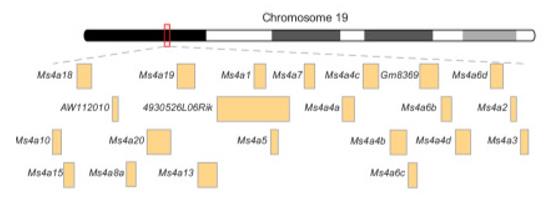 Fig. 1 Schematic of the Ms4a Gene Cluster on Chromosome 19.1
Key structural properties of MS4A1:
- Four-time transmembrane α -helical transmembrane structure
- Hydrophobic core of transmembrane domain, forming an ion channel tunnel
- Specific antigenic epitopes on the extracellular loop (such as 170-AAANP-174)
- Intracellular N end and C end are shorter, involved in signal transduction
Functions of MS4A1
The CD20 protein encoded by the MS4A1 gene is a surface marker of B lymphocytes. Its main function is to regulate the activation and proliferation of B cells, and it plays a core role in adaptive immunity.
| Function | Description |
| Calcium Ion Channel | As a transmembrane tetramer, it forms a calcium ion channel, regulates intracellular calcium concentration, and mediates B cell activation signals. |
| Regulation of B Cell Proliferation | The activity of this channel is crucial for the cell cycle progression of B cells, which moves them from the G1 phase to the S phase. |
| Immune Therapy Target | As a B-cell specific antigen, it is the target for monoclonal antibody drugs, and is used to eliminate abnormal B cells. |
| Cell Membrane Microstructure | Its tetramer structure helps maintain the stability of the lipid raft region of the B-cell receptor signaling complex. |
The CD20 protein influences the B-cell receptor signaling pathway by regulating calcium homeostasis. Its function does not directly involve ligand binding, but rather it initiates downstream signal cascades by altering membrane potential and ion flow. This characteristic makes it a highly specific target for the treatment of B-cell lymphomas and autoimmune diseases.
Applications of MS4A1 and MS4A1 Antibody in Literature
1. Jiang, Hao-Ching, et al. "CD20/MS4A1 is a mammalian olfactory receptor expressed in a subset of olfactory sensory neurons that mediates innate avoidance of predators." Nature Communications 15.1 (2024): 3360. https://doi.org/10.1038/s41467-024-47698-3
The article indicates that in the olfactory epithelium of mice, the MS4A1 (CD20) protein acts as a novel odor receptor, capable of specifically recognizing chemical substances released by predators. The absence of this receptor causes mice to lose their instinctive avoidance response to the odors of predators, revealing a new mechanism of olfaction that drives essential innate behaviors for survival.
2. Song, Ye, et al. "CD8+ T cell-associated genes MS4A1 and TNFRSF17 are prognostic markers and inhibit the progression of colon cancer." Frontiers in Oncology 12 (2022): 941208. https://doi.org/10.7150/ijms.99659
This study, through bioinformatics and experimental verification, found that when MS4A1 and TNFRSF17 are highly expressed in colon cancer, the overall survival period of patients is longer and they are more sensitive to immunotherapy. This dual-gene combination can predict the immunotherapy efficacy and has potential therapeutic value in inhibiting tumor progression.
3. Wright, Casey M., et al. "MS4A1 dysregulation in asbestos-related lung squamous cell carcinoma is due to CD20 stromal lymphocyte expression." PLoS One 7.4 (2012): e34943. https://doi.org/10.1371/journal.pone.0034943
This study compared asbestos-related and non-asbestos-related lung squamous cell carcinomas. It was found that MS4A1 was highly expressed in asbestos-related lung squamous cell carcinomas. Its protein was mainly located in the interstitial lymphocytes of the tumor rather than the cancer cells, suggesting that this difference might be related to the tumor microenvironment rather than a direct tumor marker.
4. Jiang, Duanfeng, et al. "Pyruvate dehydrogenase kinase 4‐mediated metabolic reprogramming is involved in rituximab resistance in diffuse large B‐cell lymphoma by affecting the expression of MS4A1/CD20." Cancer Science 112.9 (2021): 3585-3597. https://doi.org/10.1111/cas.15055
This study reveals that in diffuse large B-cell lymphoma, the upregulation of PDK4 expression promotes the metabolic shift of tumor cells towards glycolysis and negatively regulates the expression of MS4A1 (CD20), thereby inducing resistance to rituximab. Targeted inhibition of PDK4 can restore drug sensitivity.
5. Zuccolo, Jonathan, et al. "Phylogenetic analysis of the MS4A and TMEM176 gene families." PloS one 5.2 (2010): e9369. https://doi.org/10.1371/journal.pone.0009369
This study reveals that in diffuse large B-cell lymphoma, the upregulation of PDK4 expression promotes the metabolic shift of tumor cells towards glycolysis and negatively regulates the expression of MS4A1 (CD20), thereby inducing resistance to rituximab. Targeted inhibition of PDK4 can restore drug sensitivity.
Creative Biolabs: MS4A1 Antibodies for Research
Creative Biolabs specializes in the production of high-quality MS4A1 antibodies for research and industrial applications. Our portfolio includes monoclonal antibodies tailored for ELISA, Flow Cytometry, Western blot, immunohistochemistry, and other diagnostic methodologies.
- Custom MS4A1 Antibody Development: Tailor-made solutions to meet specific research requirements.
- Bulk Production: Large-scale antibody manufacturing for industry partners.
- Technical Support: Expert consultation for protocol optimization and troubleshooting.
- Aliquoting Services: Conveniently sized aliquots for long-term storage and consistent experimental outcomes.
For more details on our MS4A1 antibodies, custom preparations, or technical support, contact us at email.
Reference
- Jiang, Hao-Ching, et al. "CD20/MS4A1 is a mammalian olfactory receptor expressed in a subset of olfactory sensory neurons that mediates innate avoidance of predators." Nature Communications 15.1 (2024): 3360. https://doi.org/10.1038/s41467-024-47698-3
Anti-MS4A1 antibodies
 Loading...
 Compare




Hot products 
-
Mouse Anti-BLNK Recombinant Antibody (CBYY-0623) (CBMAB-0626-YY)

-
Mouse Anti-EIF4G1 Recombinant Antibody (2A9) (CBMAB-A2544-LY)

-
Rabbit Anti-CBL Recombinant Antibody (D4E10) (CBMAB-CP0149-LY)

-
Mouse Anti-DMD Recombinant Antibody (D1190) (CBMAB-D1190-YC)

-
Mouse Anti-ENO1 Recombinant Antibody (8G8) (CBMAB-E1329-FY)

-
Mouse Anti-BSN Recombinant Antibody (219E1) (CBMAB-1228-CN)

-
Mouse Anti-ATP1B1 Recombinant Antibody (E4) (CBMAB-0463-LY)

-
Rat Anti-ADAM10 Recombinant Antibody (V2-179741) (CBMAB-A1103-YC)

-
Rabbit Anti-AKT2 (Phosphorylated S474) Recombinant Antibody (V2-556130) (PTM-CBMAB-0605LY)

-
Mouse Anti-DISP2 Monoclonal Antibody (F66A4B1) (CBMAB-1112CQ)

-
Mouse Anti-F11R Recombinant Antibody (402) (CBMAB-0026-WJ)

-
Mouse Anti-ACVR1C Recombinant Antibody (V2-179685) (CBMAB-A1041-YC)

-
Rabbit Anti-CCN1 Recombinant Antibody (CBWJC-3580) (CBMAB-C4816WJ)

-
Mouse Anti-FeLV g27 Recombinant Antibody (1) (CBMAB-V208-1714-FY)

-
Rabbit Anti-B2M Recombinant Antibody (CBYY-0059) (CBMAB-0059-YY)

-
Mouse Anti-FAS2 Monoclonal Antibody (1D4) (CBMAB-0071-CN)

-
Mouse Anti-NSUN6 Recombinant Antibody (D-5) (CBMAB-N3674-WJ)

-
Mouse Anti-A2M Recombinant Antibody (V2-178822) (CBMAB-A0036-YC)

-
Mouse Anti-CD24 Recombinant Antibody (HIS50) (CBMAB-C10123-LY)

-
Mouse Anti-ALB Recombinant Antibody (V2-363290) (CBMAB-S0173-CQ)

- AActivation
- AGAgonist
- APApoptosis
- BBlocking
- BABioassay
- BIBioimaging
- CImmunohistochemistry-Frozen Sections
- CIChromatin Immunoprecipitation
- CTCytotoxicity
- CSCostimulation
- DDepletion
- DBDot Blot
- EELISA
- ECELISA(Cap)
- EDELISA(Det)
- ESELISpot
- EMElectron Microscopy
- FFlow Cytometry
- FNFunction Assay
- GSGel Supershift
- IInhibition
- IAEnzyme Immunoassay
- ICImmunocytochemistry
- IDImmunodiffusion
- IEImmunoelectrophoresis
- IFImmunofluorescence
- IGImmunochromatography
- IHImmunohistochemistry
- IMImmunomicroscopy
- IOImmunoassay
- IPImmunoprecipitation
- ISIntracellular Staining for Flow Cytometry
- LALuminex Assay
- LFLateral Flow Immunoassay
- MMicroarray
- MCMass Cytometry/CyTOF
- MDMeDIP
- MSElectrophoretic Mobility Shift Assay
- NNeutralization
- PImmunohistologyp-Paraffin Sections
- PAPeptide Array
- PEPeptide ELISA
- PLProximity Ligation Assay
- RRadioimmunoassay
- SStimulation
- SESandwich ELISA
- SHIn situ hybridization
- TCTissue Culture
- WBWestern Blot
