
POLM Antibodies
Background
The POLM gene encodes proteins belonging to the DNA polymerase μ family, which are mainly present in vertebrate lymphoid tissues and during neuronal development. This enzyme is involved in the non-homologous terminal join repair pathway of DNA double-strand breaks and maintains genomic stability in antibody diversity generation and synaptic formation through its unique terminal transferase activity. During the V(D)J recombination of B cells and T cells, POLM promotes the rearrangement of immune receptor genes by filling short sequence gaps, which is crucial for the establishment of an adaptive immune system. As a special DNA polymerase first identified by the Bertocci team in 2000, it has been listed as a key factor for specific DNA repair of the immune system due to its ability to add nucleotides independently of templates and its characteristics of synthesis across gaps. Its unique bridging helix domain and nucleotide selection mechanism continuously provide models for DNA repair research, promoting breakthroughs in fields related to genomic stability, immune deficiency diseases, and neurodevelopmental disorders.
Structure of POLM
The DNA polymerase μ encoded by the POLM gene is a nucleic acid synthase with a molecular weight of approximately 67 kDa. Its precise molecular weight may vary slightly due to differences in amino acid sequences among species.
| Species | Human | Mouse | Bovine | Zebrafish |
| Molecular Weight (kDa) | 67.2 | 66.8 | 67.5 | 68.1 |
| Primary Structural Differences | As the typical BRCT domains, polymerase domain, and a signal of check and ratify | Species-specific variants exist in the C-terminal sequence | The active center of the polymerase is highly conserved | With an additional C-terminal extension fragment |
This protein is composed of approximately 541 amino acids, and its three-dimensional structure contains a unique "bridging helical" motif, which lies between the BRCT domain at the N-terminal and the polymerase core domain at the C-terminal. The core domain of this polymerase adopts a classic right-hand conformation, but its unique circular insertion structure determines its prominent terminal transferase activity, enabling it to add nucleotides without a template. The active center is composed of highly conserved aspartic acid residue clusters, which work in coordination with divalent metal ions to catalyze the doping of nucleotides. Its specialized nucleotide selection pocket endows it with low-precision binding ability to dNTPs, which is closely related to its physiological function in unconventional DNA repair.
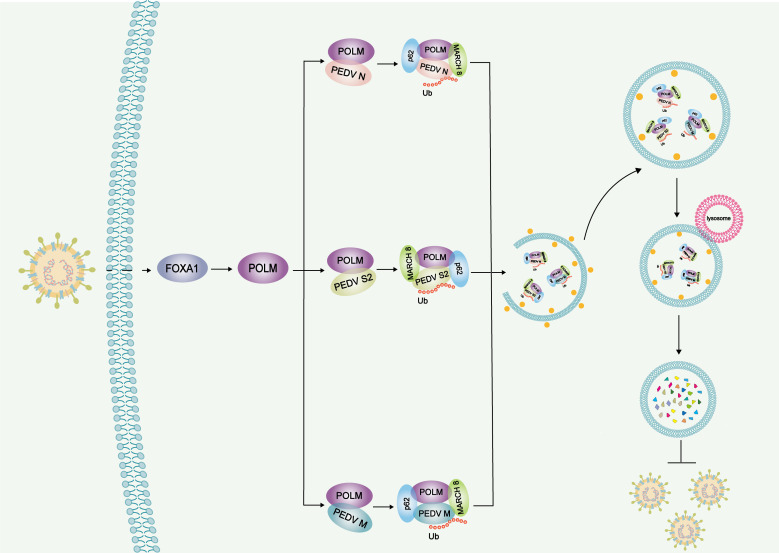 Fig. 1 Anti-viral mechanisms of POLM.1
Key structural properties of POLM:
- The unique "bridge-helix" domain connects the BRCT region to the polymerase active center
- Nucleotide selection pockets have loose substrate recognition characteristics
- Special ring insert structure to determine the terminal transferase activity
- Clusters of conserved aspartic acid residues cooperate with divalent metal ions to catalyze nucleotide polymerization
Functions of POLM
The core function of the POLM gene is to participate in the repair of DNA double-strand breaks, especially playing a key role in non-homologous end junction pathways. In addition, it is also widely involved in various cellular physiological processes, including the generation of immune diversity and neural development.
| Function | Description |
| DNA terminal connection | Catalyze the addition of nucleotides at the double-strand breaks of DNA to fill the short sequence gap and connect the ends of the breaks. |
| Immune diversity generation | In lymphocyte V(D)J recombination, nucleotide variations are introduced through its non-template-dependent synthetic ability, enriching the antibody library. |
| Damage tolerance synthesis | Synthesis can be carried out at sites where the DNA template is incomplete or has minor damage, ensuring that the repair process can continue. |
| Microhomology-mediated repair | The alignment and connection of the broken ends are assisted by using short micro-homologous sequences to improve the accuracy of repair. |
| Neurogenomic stability | Maintain genomic stability within developing neurons and prevent cell dysfunction caused by the accumulation of DNA damage. |
Unlike the strict substrate selection characteristics demonstrated by high-fidelity DNA polymerases, POLM has a broad affinity for nucleotides and is prone to binding to incorrect bases, which directly reflects its biological role as a "quick patch" rather than an "exact replication" in emergency repairs.
Applications of POLM and POLM Antibody in Literature
1. Cao X, Liu Y, et al. "POLM inhibits porcine epidemic diarrhea virus replication by degrading multiple viral structural proteins." Journal of Virology 99.3 (2025): e02278-24. https://doi.org/10.1128/jvi.02278-24
This study reveals that the host factor POLM is upregulated by FOXA1 regulation in PEDV infection and mediates the degradation of viral N, S2 and M proteins through autophagic pathways by recruiting E3 ubiquitin ligase MARCH8 and vector protein p62, thereby inhibiting the proliferation of PEDV and providing a new target for antiviral treatment.
2. Abdul Basit, Muhammad, et al. "Effects of inclusion of different doses of Persicaria odorata leaf meal (POLM) in broiler chicken feed on biochemical and haematological blood indicators and liver histomorphological changes." Animals 10.7 (2020): 1209. https://doi.org/10.3390/ani10071209
The article indicates that POLM is an alternative to antibiotics. This study evaluated the effect of POLM on broilers. The results show that the addition of POLM can safely promote growth, improve blood and biochemical indicators, and has no adverse effects on organs at the maximum dose of 8g/kg.
3. Childs, John D., et al. "Predictors of web-based follow-up response in the Prevention of Low Back Pain in the Military Trial (POLM)." BMC Musculoskeletal Disorders 12.1 (2011): 132. https://doi.org/10.1186/1471-2474-12-132
This study explores the factors influencing the network response rate in the POLM experiment. The results showed that the first-year response rate was 18.9% and was significantly correlated with soldier demographics and whether individualized attention was received.
4. George, Steven Z., et al. "Brief psychosocial education, not core stabilization, reduced incidence of low back pain: results from the Prevention of Low Back Pain in the Military (POLM) cluster randomized trial." BMC medicine 9.1 (2011): 128. https://doi.org/10.1186/1741-7015-9-128
The article indicates that the POLM study shows that core stability training is not superior to traditional training in preventing lower back pain. Brief psychological education can effectively reduce the incidence of seeking medical treatment, with remarkable results.
5. George, Steven Z., et al. "Rationale, design, and protocol for the prevention of low back pain in the military (POLM) trial (NCT00373009)." BMC musculoskeletal disorders 8.1 (2007): 92. https://doi.org/10.1186/1471-2474-8-92
The article indicates that the POLM trial aims to compare the preventive effects of four programs, including core training and psychological education, on soldiers' low back pain. The study evaluated its effectiveness in preventing the first attack and reducing the severity through a two-year follow-up.
Creative Biolabs: POLM Antibodies for Research
Creative Biolabs specializes in the production of high-quality POLM antibodies for research and industrial applications. Our portfolio includes monoclonal antibodies tailored for ELISA, Flow Cytometry, Western blot, immunohistochemistry, and other diagnostic methodologies.
- Custom POLM Antibody Development: Tailor-made solutions to meet specific research requirements.
- Bulk Production: Large-scale antibody manufacturing for industry partners.
- Technical Support: Expert consultation for protocol optimization and troubleshooting.
- Aliquoting Services: Conveniently sized aliquots for long-term storage and consistent experimental outcomes.
For more details on our POLM antibodies, custom preparations, or technical support, contact us at email.
Reference
- Cao X, Liu Y, et al. "POLM inhibits porcine epidemic diarrhea virus replication by degrading multiple viral structural proteins." Journal of Virology 99.3 (2025): e02278-24. https://doi.org/10.1128/jvi.02278-24
Anti-POLM antibodies
 Loading...
 Compare



Hot products 
-
Rabbit Anti-ABL1 (Phosphorylated Y245) Recombinant Antibody (V2-505716) (PTM-CBMAB-0465LY)

-
Mouse Anti-CECR2 Recombinant Antibody (CBWJC-2465) (CBMAB-C3533WJ)

-
Mouse Anti-DMPK Recombinant Antibody (CBYCD-324) (CBMAB-D1200-YC)

-
Mouse Anti-GZMA Recombinant Antibody (CBLG1-2197) (CBMAB-G5901-LY)

-
Mouse Anti-BIRC3 Recombinant Antibody (315304) (CBMAB-1214-CN)

-
Mouse Anti-ALB Recombinant Antibody (V2-55272) (CBMAB-H0819-FY)

-
Mouse Anti-ASTN1 Recombinant Antibody (H-9) (CBMAB-1154-CN)

-
Mouse Anti-DLC1 Recombinant Antibody (D1009) (CBMAB-D1009-YC)

-
Mouse Anti-GPRC5C Recombinant Antibody (CBFYH-0464) (CBMAB-H0521-FY)

-
Mouse Anti-ATM Recombinant Antibody (2C1) (CBMAB-A3970-YC)

-
Mouse Anti-AMIGO2 Recombinant Antibody (CBYY-C0756) (CBMAB-C2192-YY)

-
Mouse Anti-AGO2 Recombinant Antibody (V2-634169) (CBMAB-AP203LY)

-
Mouse Anti-AKT1/AKT2/AKT3 (Phosphorylated T308, T309, T305) Recombinant Antibody (V2-443454) (PTM-CBMAB-0030YC)

-
Mouse Anti-FN1 Monoclonal Antibody (D6) (CBMAB-1240CQ)

-
Mouse Anti-ACE2 Recombinant Antibody (V2-179293) (CBMAB-A0566-YC)

-
Mouse Anti-BLNK Recombinant Antibody (CBYY-0623) (CBMAB-0626-YY)

-
Mouse Anti-GluRIIA Monoclonal Antibody (8B4D2) (CBMAB-0305-CN)

-
Mouse Anti-ENO1 Recombinant Antibody (CBYC-A950) (CBMAB-A4388-YC)

-
Mouse Anti-ALDOA Recombinant Antibody (A2) (CBMAB-A2316-YC)

-
Mouse Anti-BMI1 Recombinant Antibody (CBYC-P026) (CBMAB-P0108-YC)

- AActivation
- AGAgonist
- APApoptosis
- BBlocking
- BABioassay
- BIBioimaging
- CImmunohistochemistry-Frozen Sections
- CIChromatin Immunoprecipitation
- CTCytotoxicity
- CSCostimulation
- DDepletion
- DBDot Blot
- EELISA
- ECELISA(Cap)
- EDELISA(Det)
- ESELISpot
- EMElectron Microscopy
- FFlow Cytometry
- FNFunction Assay
- GSGel Supershift
- IInhibition
- IAEnzyme Immunoassay
- ICImmunocytochemistry
- IDImmunodiffusion
- IEImmunoelectrophoresis
- IFImmunofluorescence
- IGImmunochromatography
- IHImmunohistochemistry
- IMImmunomicroscopy
- IOImmunoassay
- IPImmunoprecipitation
- ISIntracellular Staining for Flow Cytometry
- LALuminex Assay
- LFLateral Flow Immunoassay
- MMicroarray
- MCMass Cytometry/CyTOF
- MDMeDIP
- MSElectrophoretic Mobility Shift Assay
- NNeutralization
- PImmunohistologyp-Paraffin Sections
- PAPeptide Array
- PEPeptide ELISA
- PLProximity Ligation Assay
- RRadioimmunoassay
- SStimulation
- SESandwich ELISA
- SHIn situ hybridization
- TCTissue Culture
- WBWestern Blot
