
FOSB Antibodies
Background
FOSB gene encoding a belongs to FOS protein family of transcription factors, usually as part of the AP - 1 transcription complex work. This protein participates in key biological processes such as cell proliferation, differentiation and stress response by regulating the expression of target genes, and plays a particularly important role in neural plasticity and addiction mechanisms. The ΔFosB isomers produced by its alternative splicing have abnormal stability and can continuously accumulate in neurons under chronic stimulation, and are regarded as the key molecular mediator of neural adaptive changes related to drug addiction. This gene was first discovered by Curran's team in 1988 when identifying genes related to cell transformation. Its unique long-term mechanism of action provides an important molecular model for understanding the gene regulatory network in chronic diseases and significantly advances the research progress of the mechanism of action of transcription factors in long-term adaptive changes in organisms.
Structure of FOSB
FOSB is a protein with a molecular weight of approximately 33-37 kDa, and its specific value varies depending on different isomers. This protein belongs to the FOS family, and its molecular weight fluctuations mainly result from post-transcriptional alternative splicing and translation modifications.
| Species | Human | Mouse | Rat | Rhesus monkey | Dog |
| Molecular Weight (kDa) | 33-37 | 33-36 | 34-37 | 33-37 | 34-36 |
| Primary Structural Differences | There exist key isomers such as full-length FosB and truncated ΔFosB | High homology with human, there are similar splice variants | Core highly conserved DNA binding domain | Amino acid sequence is similar to human height | Leucine zipper domain is highly conserved |
This protein is composed of 338 amino acids, and its primary structure contains a highly conserved basic leucine zipper domain, which mediates its formation of a dimer and binding to DNA. Its truncated isomer ΔFosB exhibits significantly enhanced stability due to C-terminal truncation and can accumulate in neurons for a long time. The secondary structure of proteins is dominated by α-helices, which are arranged through flexible junction regions to jointly form a functional domain that can precisely bind to the AP-1 site.
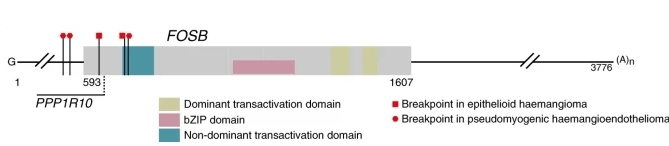 Fig. 1 Wild-type FOSB transcript schematic with vascular tumour breakpoints (PHE, EH).1
Key structural properties of FosB:
- Leucine zipper dimerization domain
- Alkaline region DNA-binding motif
- Transcriptionally activate functional regions
Functions of FOSB
The main function of the FOSB gene is to regulate gene expression as a transcription factor. However, it is also widely involved in various pathophysiological processes, including addiction mechanisms, stress responses, and the development of mental disorders.
| Function | Description |
| Transcriptional regulation | As a component of the AP-1 complex, it activates or inhibits the transcription of target genes by binding to specific DNA sequences. |
| Regulation of neural plasticity | Long-term expression in brain regions such as nucleus accumbens regulates dendritic spine morphology and synaptic function, and mediates long-lasting behavioral adaptation. |
| Addiction mechanism mediator | ΔFosB isomers accumulate under chronic drug exposure, driving persistent changes in the reward circuit and are the core molecules of addiction. |
| Participation in stress response | The expression is upregulated in chronic stress models and is involved in the regulation of adaptive changes in the hypothalamic-pituitary-adrenal axis. |
| Association with mental illness | Abnormal expression is related to the pathogenesis and treatment response of various mental disorders such as depression and schizophrenia. |
Unlike the transient expression of most immediate early genes, ΔFosB exhibits abnormal stability and can remain in neurons for several weeks, making it a key molecular switch connecting short-term stimuli with long-term neural adaptive changes.
Applications of FOSB and FOSB Antibody in Literature
1. Qi, Min, et al. "Expression and potential role of FOSB in glioma." Frontiers in Molecular Neuroscience 15 (2022): 972615. https://doi.org/10.3389/fnmol.2022.972615
This study confirmed that FOSB is highly expressed in glioma. Knockdown of FOSB can inhibit the proliferation and migration of glioma cells, promote cell apoptosis, and slow down tumor growth in mice, indicating that FOSB has a promoting effect on the development of glioma.
2. Cates, Hannah M., et al. "Fosb induction in nucleus accumbens by cocaine is regulated by E2F3a." Eneuro 6.2 (2019). https://doi.org/10.1523/ENEURO.0325-18.2019
This study reveals that the transcription factor E2F3a is a novel upstream regulatory factor for the addiction key protein ΔFosB. Under the action of cocaine, E2F3a can specifically bind to the Fosb gene and regulate its expression, thereby mediating the long-term effect of the drug in the nucleus accumbens.
3. Ting, Chen-Hung, et al. "FOSB–PCDHB13 axis disrupts the microtubule network in non-small cell lung cancer." Cancers 11.1 (2019): 107. https://doi.org/10.3390/cancers11010107
This study found that in non-small cell lung cancer, FOSB can inhibit tumor growth by activating the expression of PCDHB13. Both FOSB and PCDHB13 were lowly expressed in the patient's body, indicating that the FOSB-PCDHB13 axis is a novel tumor suppressor pathway.
4. Zhang, Hongchao, et al. "Two-polarized roles of transcription factor FOSB in lung cancer progression and prognosis: dependent on p53 status." Journal of Experimental & Clinical Cancer Research 43.1 (2024): 237. https://doi.org/10.1186/s13046-024-03161-1
This study reveals that the role of FOSB in non-small cell lung cancer is regulated by the status of the TP53 gene. In the wild type of TP53, FOSB inhibits tumors, while in the mutant type, it promotes progression. This bidirectional effect stems from the activation of different target genes by FOSB interacting with various Pp53.
5. Wang, Yansu, et al. "LINC00963-FOSB-mediated transcription activation of UBE3C enhances radioresistance of breast cancer cells by inducing ubiquitination-dependent protein degradation of TP73." Journal of translational medicine 21.1 (2023): 321. https://doi.org/10.1186/s12967-023-04153-z
This study reveals that in breast cancer, LINC00963 enhances the radioresistance of cancer cells by promoting the nuclear entry of FOSB to activate the transcription of UBE3C, which ubiquitinates and degrades TP73. Targeting this pathway is expected to improve the radiotherapy effect.
Creative Biolabs: FOSB Antibodies for Research
Creative Biolabs specializes in the production of high-quality FOSB antibodies for research and industrial applications. Our portfolio includes monoclonal antibodies tailored for ELISA, Flow Cytometry, Western blot, immunohistochemistry, and other diagnostic methodologies.
- Custom FOSB Antibody Development: Tailor-made solutions to meet specific research requirements.
- Bulk Production: Large-scale antibody manufacturing for industry partners.
- Technical Support: Expert consultation for protocol optimization and troubleshooting.
- Aliquoting Services: Conveniently sized aliquots for long-term storage and consistent experimental outcomes.
For more details on our FOSB antibodies, custom preparations, or technical support, contact us at email.
Reference
- Fittall, Matthew W., et al. "Recurrent rearrangements of FOS and FOSB define osteoblastoma." Nature communications 9.1 (2018): 2150. https://doi.org/10.1038/s41467-018-04530-z
Anti-FOSB antibodies
 Loading...
 Compare



Hot products 
-
Mouse Anti-BCL6 Recombinant Antibody (CBYY-0442) (CBMAB-0445-YY)

-
Mouse Anti-C1QC Recombinant Antibody (CBFYC-0600) (CBMAB-C0654-FY)

-
Mouse Anti-GGT1 Recombinant Antibody (1F9) (CBMAB-G3273-LY)

-
Mouse Anti-ENO1 Recombinant Antibody (CBYC-A950) (CBMAB-A4388-YC)

-
Mouse Anti-BHMT Recombinant Antibody (CBYY-0547) (CBMAB-0550-YY)

-
Rat Anti-CCR2 Recombinant Antibody (475301) (CBMAB-C1338-LY)

-
Mouse Anti-BIRC7 Recombinant Antibody (88C570) (CBMAB-L0261-YJ)

-
Mouse Anti-GNA12 Recombinant Antibody (CBFYH-0402) (CBMAB-H1272-FY)

-
Mouse Anti-GST Recombinant Antibody (CBLG1-1938) (CBMAB-G5371-LY)

-
Mouse Anti-ARHGDIA Recombinant Antibody (CBCNA-009) (CBMAB-R0415-CN)

-
Mouse Anti-GFAP Recombinant Antibody (5) (CBMAB-G0346-LY)

-
Mouse Anti-AMACR Recombinant Antibody (CB34A) (CBMAB-CA034LY)

-
Mouse Anti-ALOX5 Recombinant Antibody (33) (CBMAB-1890CQ)

-
Mouse Anti-ACO2 Recombinant Antibody (V2-179329) (CBMAB-A0627-YC)

-
Mouse Anti-APP Recombinant Antibody (DE2B4) (CBMAB-1122-CN)

-
Mouse Anti-ACTG1 Recombinant Antibody (V2-179597) (CBMAB-A0916-YC)

-
Mouse Anti-B2M Recombinant Antibody (CBYY-0050) (CBMAB-0050-YY)

-
Mouse Anti-ADGRE2 Recombinant Antibody (V2-261270) (CBMAB-C0813-LY)

-
Mouse Anti-ABCA3 Recombinant Antibody (V2-178911) (CBMAB-A0145-YC)

-
Mouse Anti-ALB Recombinant Antibody (V2-180650) (CBMAB-A2186-YC)

- AActivation
- AGAgonist
- APApoptosis
- BBlocking
- BABioassay
- BIBioimaging
- CImmunohistochemistry-Frozen Sections
- CIChromatin Immunoprecipitation
- CTCytotoxicity
- CSCostimulation
- DDepletion
- DBDot Blot
- EELISA
- ECELISA(Cap)
- EDELISA(Det)
- ESELISpot
- EMElectron Microscopy
- FFlow Cytometry
- FNFunction Assay
- GSGel Supershift
- IInhibition
- IAEnzyme Immunoassay
- ICImmunocytochemistry
- IDImmunodiffusion
- IEImmunoelectrophoresis
- IFImmunofluorescence
- IGImmunochromatography
- IHImmunohistochemistry
- IMImmunomicroscopy
- IOImmunoassay
- IPImmunoprecipitation
- ISIntracellular Staining for Flow Cytometry
- LALuminex Assay
- LFLateral Flow Immunoassay
- MMicroarray
- MCMass Cytometry/CyTOF
- MDMeDIP
- MSElectrophoretic Mobility Shift Assay
- NNeutralization
- PImmunohistologyp-Paraffin Sections
- PAPeptide Array
- PEPeptide ELISA
- PLProximity Ligation Assay
- RRadioimmunoassay
- SStimulation
- SESandwich ELISA
- SHIn situ hybridization
- TCTissue Culture
- WBWestern Blot
