
Nestin Antibodies
Background
Nestin, as a type of intermediate filament protein of Class VI, mainly exists in the neural progenitor cells and various progenitor cells of vertebrates. This protein participates in the maintenance of cell structure by forming the cytoskeletal network and plays a key regulatory role in the process of cell differentiation, supporting neural development and tissue regeneration. Stem cells rely on nestin to maintain their self-renewal ability because their expression levels change dynamically with the state of cell differentiation. This gene was first identified by the Lendahl team in 1990 and is a typical representative of neural stem cell markers. Its unique gene structure and expression pattern have become an important model for stem cell biology research. Nestin's continuous research in the fields of developmental biology and regenerative medicine has significantly advanced people's understanding of cell fate determination, tissue repair mechanisms, and the pathogenesis of diseases.
Structure of Nestin
Nestin is a type of intermediate filament protein of Class VI with a relatively large molecular weight, approximately 177 to 220 kDa. The specific value may vary slightly depending on the species and post-translational modifications.
| Species | Human | Mouse | Rat | Chicken |
| Molecular Weight (kDa) | ~220 | ~200 | ~177 | ~190 |
| Primary Structural Differences | Contains about 1616 amino acids with a long C terminus | Highly homologous to humans, the core helical region is conserved | The core rod-shaped domains are similar | Has a form of alternative splicing unique to birds |
This protein is composed of over 1,600 amino acids, and its primary structure contains a highly conserved α -helical rod-shaped core domain, as well as species-specific N-terminal and C-terminal non-helical tails. Nestin assembles into cytoskeletal networks by forming heterodimers (usually paired with Vimentin), and this assembly ability mainly depends on its conserved helical rod-shaped regions. Its C-terminal tail contains multiple phosphorylation sites, which can dynamically regulate the assembly and dissociation of filamentous structures, thereby affecting the mechanical stability and migration ability of the cell.
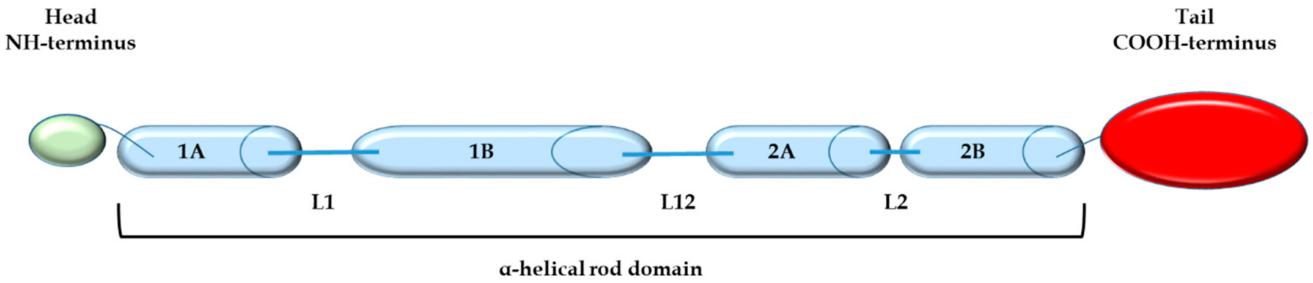 Fig. 1 Nestin's structure consists of a central α-helical rod domain (blue) flanked by globular NH (green) and COOH (red) domains.1
Key structural properties of Nestin:
- Characteristic class VI intermediate filament protein α-helical rod domain
- Highly conserved helical regions mediate protein dimerization and filamentous assembly
- The non-helical tail contains multiple phosphorylation sites that regulate the dynamic remodeling of the wire mesh
Functions of Nestin
The protein encoded by the Nestin gene mainly functions as a key component of the cytoskeleton, participating in maintaining cell morphology and supporting cell division. In addition, it is also widely involved in a variety of important physiological and developmental processes, including cell differentiation regulation and tissue regeneration.
| Function | Description |
| Structural support | Intermediate filament networks are formed in stem cells and precursor cells to maintain the mechanical stability and spatial structure of the cells. |
| Regulation of cell differentiation | Highly expressed in undifferentiated cells, down-regulated expression is accompanied by directed cell differentiation, marking the pluripotent state of cells. |
| Participation in tissue regeneration | In the process of nerve damage, muscle repair was reactivated, promote progenitor cell proliferation and migration. |
| Cell cycle association | Dynamic recombination during cell division, involved in mitotic spindle organization and cytokinesis. |
| Disease markers | High expression of nestin in various tumors is associated with the characteristics, invasiveness and poor prognosis of tumor stem cells. |
The expression of Nestin is highly specific to cell type and developmental stage. Its regulation depends on enhancer-promoter interaction and the activation of signaling pathways (such as Notch and TGF-β), playing an important role in tissue homeostasis and regeneration.
Applications of Nestin and Nestin Antibody in Literature
1. Yao, Senyu, et al. "Nestin-dependent mitochondria-ER contacts define stem Leydig cell differentiation to attenuate male reproductive ageing." Nature communications 13.1 (2022): 4020. https://doi.org/10.1038/s41467-022-31755-w
This article finds that with the increase of age, the differentiation ability of stem cell Lylae's cells (SLC) declines, and the mechanism is related to the reduction of mitochondrial-endoplasmic reticulum contact (MERCs) caused by the absence of the intermediate filament protein Nestin. Melatonin can delay the aging of the male reproductive system by restoring Nestin-dependent MERCs, improving the differentiation potential of SLCS.
2. Jaramillo-Rangel, Gilberto, et al. "Nestin-expressing cells in the lung: the bad and the good parts." Cells 10.12 (2021): 3413. https://doi.org/10.3390/cells10123413
This article indicates that Nestin, as an intermediate filament protein, is highly expressed in lung cancer and is associated with cell proliferation, angiogenesis and metastasis, leading to invasive phenotypes and treatment resistance. Its role in non-cancerous lung diseases and its value as a prognostic marker or therapeutic target still require in-depth research.
3. Bernal, Aurora, and Lorena Arranz. "Nestin-expressing progenitor cells: function, identity and therapeutic implications." Cellular and Molecular Life Sciences 75.12 (2018): 2177-2195. https://doi.org/10.1007/s00018-018-2794-z
This article indicates that Nestin is an intermediate filament protein of the cytoskeleton, widely expressed in stem cells of tissues such as nerves and bone marrow, and participates in regulating their self-renewal, differentiation and migration. Its potential as therapeutic targets and molecular mechanisms in disease models still need to be further explored.
4. Lu, Chunjuan, and Wei. "[Retracted] Nestin Regulates Keap1‐Nrf2‐HO‐1‐Mediated Antioxidant Responses during Stress and Malignant Hematopoiesis." BioMed Research International 2022.1 (2022): 1706585. https://doi.org/10.1155/2022/1706585
This study found that in leukemia patients, Nestin regulates the upregulation of the Keap1-Nrf2-HO-1 signaling pathway, promotes antioxidant responses, and is closely related to the occurrence and development of leukemia, suggesting that Nestin may become a tumor marker.
5. Han, Shunshun, et al. "Nestin Regulates Autophagy‐Dependent Ferroptosis Mediated Skeletal Muscle Atrophy by Ubiquitinating MAP 1LC3B." Journal of Cachexia, Sarcopenia and Muscle 16.2 (2025): e13779. https://doi.org/10.1002/jcsm.13779
Research has found that Nestin alleviates skeletal muscle atrophy by catalyzing the polyubiquitination of the K51 site of the LC3B protein, inhibiting autophagic flux and ferroptosis. The absence of Nestin can exacerbate atrophy. As a key regulatory factor of ferroptosis - autophagy interaction, it provides a new target for the treatment of muscle atrophy.
Creative Biolabs: Nestin Antibodies for Research
Creative Biolabs specializes in the production of high-quality Nestin antibodies for research and industrial applications. Our portfolio includes monoclonal antibodies tailored for ELISA, Flow Cytometry, Western blot, immunohistochemistry, and other diagnostic methodologies.
- Custom Nestin Antibody Development: Tailor-made solutions to meet specific research requirements.
- Bulk Production: Large-scale antibody manufacturing for industry partners.
- Technical Support: Expert consultation for protocol optimization and troubleshooting.
- Aliquoting Services: Conveniently sized aliquots for long-term storage and consistent experimental outcomes.
For more details on our Nestin antibodies, custom preparations, or technical support, contact us at email.
Reference
- Jaramillo-Rangel, Gilberto, et al. "Nestin-expressing cells in the lung: the bad and the good parts." Cells 10.12 (2021): 3413. https://doi.org/10.3390/cells10123413
Anti-Nestin antibodies




Hot products 
-
Mouse Anti-ATG5 Recombinant Antibody (9H197) (CBMAB-A3945-YC)

-
Mouse Anti-AQP2 Recombinant Antibody (G-3) (CBMAB-A3359-YC)

-
Mouse Anti-BIRC3 Recombinant Antibody (315304) (CBMAB-1214-CN)

-
Mouse Anti-AAV-5 Recombinant Antibody (V2-503417) (CBMAB-V208-1369-FY)

-
Rabbit Anti-ATF4 Recombinant Antibody (D4B8) (CBMAB-A3872-YC)

-
Rabbit Anti-ENO2 Recombinant Antibody (BA0013) (CBMAB-0272CQ)

-
Mouse Anti-ALB Recombinant Antibody (V2-363290) (CBMAB-S0173-CQ)

-
Mouse Anti-GNA12 Recombinant Antibody (CBFYH-0402) (CBMAB-H1272-FY)

-
Mouse Anti-Gram Positive Bacteria LTA Recombinant Antibody (CBMC-C0664) (CBMAB-V208-1410-CQ)

-
Rabbit Anti-ABL1 (Phosphorylated Y245) Recombinant Antibody (V2-505716) (PTM-CBMAB-0465LY)

-
Mouse Anti-BIRC3 Recombinant Antibody (16E63) (CBMAB-C3367-LY)

-
Rabbit Anti-Acetyl-Histone H4 (Lys16) Recombinant Antibody (V2-623415) (CBMAB-CP1021-LY)

-
Rabbit Anti-DLK1 Recombinant Antibody (9D8) (CBMAB-D1061-YC)

-
Mouse Anti-DMPK Recombinant Antibody (CBYCD-324) (CBMAB-D1200-YC)

-
Mouse Anti-DLC1 Recombinant Antibody (D1009) (CBMAB-D1009-YC)

-
Mouse Anti-ACTB Recombinant Antibody (V2-179553) (CBMAB-A0870-YC)

-
Mouse Anti-CCN2 Recombinant Antibody (CBFYC-2383) (CBMAB-C2456-FY)

-
Mouse Anti-CSPG4 Recombinant Antibody (CBFYM-1050) (CBMAB-M1203-FY)

-
Mouse Anti-CAPZB Recombinant Antibody (CBYY-C0944) (CBMAB-C2381-YY)

-
Mouse Anti-ENPP1 Recombinant Antibody (CBFYE-0159) (CBMAB-E0375-FY)

- AActivation
- AGAgonist
- APApoptosis
- BBlocking
- BABioassay
- BIBioimaging
- CImmunohistochemistry-Frozen Sections
- CIChromatin Immunoprecipitation
- CTCytotoxicity
- CSCostimulation
- DDepletion
- DBDot Blot
- EELISA
- ECELISA(Cap)
- EDELISA(Det)
- ESELISpot
- EMElectron Microscopy
- FFlow Cytometry
- FNFunction Assay
- GSGel Supershift
- IInhibition
- IAEnzyme Immunoassay
- ICImmunocytochemistry
- IDImmunodiffusion
- IEImmunoelectrophoresis
- IFImmunofluorescence
- IGImmunochromatography
- IHImmunohistochemistry
- IMImmunomicroscopy
- IOImmunoassay
- IPImmunoprecipitation
- ISIntracellular Staining for Flow Cytometry
- LALuminex Assay
- LFLateral Flow Immunoassay
- MMicroarray
- MCMass Cytometry/CyTOF
- MDMeDIP
- MSElectrophoretic Mobility Shift Assay
- NNeutralization
- PImmunohistologyp-Paraffin Sections
- PAPeptide Array
- PEPeptide ELISA
- PLProximity Ligation Assay
- RRadioimmunoassay
- SStimulation
- SESandwich ELISA
- SHIn situ hybridization
- TCTissue Culture
- WBWestern Blot
