
IL32 Antibodies
Background
IL-32 is a pro-inflammatory cytokine mainly present in immune cells and epithelial cells, playing a crucial role in inflammation regulation. This protein was initially named NK4 in 1992 and was renamed IL-32 in 2005 due to its pro-inflammatory properties. There are various splicing variants of this protein, including α, β, and γ, among which the γ variant has the strongest biological activity. IL-32 induces the production of various inflammatory factors by activating signaling pathways such as p38 MAPK and NF-κB. Apart from rodents, the IL-32 gene exists in most mammals. Recent studies have found that IL-32 not only participates in autoimmune diseases such as rheumatoid arthritis and inflammatory bowel disease, but also has antiviral activity and can affect various viral infections such as influenza virus and HIV, becoming a research hotspot in the fields of inflammation and infection.
Structure of IL32
IL-32 is a pro-inflammatory cytokine with a molecular weight of approximately 22-29 kDa. Different splicing variants have slight differences. This protein consists of multiple exons and encodes about 131-234 amino acids. Its secondary structure is mainly composed of α helices, and its tertiary structure forms a compact spherical conformation. IL-32 lacks a typical signal peptide and is mainly located in the cytoplasm, secreted through non-classical pathways. Its structure contains multiple potential phosphorylation sites, which participate in regulating intracellular signal transduction. The structural differences of different splicing variants mainly concentrate in their N-terminal and C-terminal regions, which directly affect its biological activity and functional diversity. IL-32 interacts with integrins, proteases, etc. through its specific domains, activating downstream p38 MAPK, NF-κB, etc. signaling pathways.
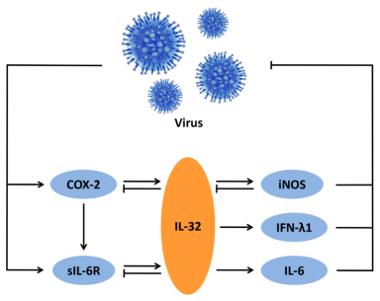 Fig. 1 The IL-32-mediated inflammatory network against viral infection.1
The key structural characteristics of IL-32:
- There are various splicing variants such as α, β, and γ, among which the γ variant has the strongest activity.
- Lacks signal peptides and is secreted through non-classical pathways
- Contains multiple phosphorylation sites, involved in signal regulation
- There is an integrin binding domain
- Dominated by α helices, it forms a globular conformation
- The differences in the N-terminal and C-terminal determine the function of the variant.
Functions of IL32
The main function of IL-32 is to regulate inflammatory responses and immune responses. However, it is also involved in various pathological physiological processes, including antiviral defense and regulation of cell apoptosis.
| Function | Description |
| Inflammation regulation | IL-32 induces the production of various pro-inflammatory factors such as TNF-α and IL-6, playing a central role in the inflammatory network. |
| Antiviral activity | Inhibits the replication of various viruses including influenza virus and HIV, enhancing the host's antiviral defense by activating the interferon pathway. |
| Immune regulation | Promotes the differentiation and activation of immune cells, regulating the Th1/Th2 immune balance. |
| Apoptosis | Influences cell survival and death by regulating caspase and Bcl-2 family proteins. |
| Signal transduction | Activates signal pathways such as p38 MAPK and NF-κB, mediating the expression of downstream inflammatory genes. |
The different splicing variants of IL-32 exhibit functional differences. Among them, the γ variant has the strongest biological activity, while the β variant mainly participates in the regulation of cell adhesion.
Applications of IL32 and IL32 Antibody in Literature
1. Zhou, Yaqin, and Ying Zhu. "Important role of the IL-32 inflammatory network in the host response against viral infection." Viruses 7.6 (2015): 3116-3129. https://doi.org/10.3390/v7062762
The article clarifies that interleukin-32 (IL-32) is a pro-inflammatory cytokine that plays a crucial role in the inflammatory network. Recent studies have shown that it has antiviral activity, can induce antiviral effects and regulate related mechanisms, and is expected to become a potential therapeutic target.
2. Sasidharan, Kavitha, et al. "IL32 downregulation lowers triglycerides and type I collagen in di-lineage human primary liver organoids." Cell Reports Medicine 5.1 (2024). https://doi.org/10.1016/j.xcrm.2023.101352
The study found that IL-32β promotes the synthesis of triglycerides in liver cells, and downregulation of IL-32 can reduce its synthesis and secretion as well as decrease the level of type I collagen. The genetic variation rs76580947 is associated with the reduction of circulating IL-32 and the protection against fatty liver.
3. Huang, Cheng, et al. "Pericytes Modulate Third‐Generation Tyrosine Kinase Inhibitor Sensitivity in EGFR‐Mutated Lung Cancer Cells Through IL32‐β5‐Integrin Paracrine Signaling." Advanced Science 11.46 (2024): 2405130. https://doi.org/10.1002/advs.202405130
The study found that pericytes secrete IL32, which activates the β5 integrin pathway in cancer cells and reduces the sensitivity of EGFR-mutated lung cancer to targeted drugs. Inhibiting this signal can restore efficacy and provide a new strategy for treatment.
4. Han, Feng, and Jianxin Ma. "Pan-cancer analysis reveals IL32 is a potential prognostic and immunotherapeutic biomarker in cancer." Scientific reports 14.1 (2024): 8129. https://doi.org/10.1038/s41598-024-58550-5
The study found that IL32 is highly expressed in various tumors and is associated with poor prognosis and immune infiltration. Its expression affects the stemness of tumors, TMB, and immune checkpoint genes, and can serve as a cancer prognosis marker and potential therapeutic target.
5. Meyer, Braydon, et al. "DNA methylation at IL32 in juvenile idiopathic arthritis." Scientific reports 5.1 (2015): 11063. https://doi.org/10.1038/srep11063
The study found that the methylation levels of the IL32 gene in CD4+ and CD8+ T cells of children with juvenile idiopathic arthritis were decreased, and there was an interaction with specific SNPs. This further confirmed that the methylation changes of the IL32 gene were associated with the disease.
Creative Biolabs: IL32 Antibodies for Research
Creative Biolabs specializes in the production of high-quality IL32 antibodies for research and industrial applications. Our portfolio includes monoclonal and polyclonal antibodies tailored for ELISA, Flow Cytometry, Western blot, immunohistochemistry, and other diagnostic methodologies.
- Custom IL32 Antibody Development: Tailor-made solutions to meet specific research requirements.
- Bulk Production: Large-scale antibody manufacturing for industry partners.
- Technical Support: Expert consultation for protocol optimization and troubleshooting.
- Aliquoting Services: Conveniently sized aliquots for long-term storage and consistent experimental outcomes.
For more details on our IL32 antibodies, custom preparations, or technical support, contact us at email.
Reference
- Han, Jun, et al. "Effect of changes in the structure of IL32 on the color of meat products." Food Materials Research 4.1 (2024). Distributed under Open Access license CC BY 4.0, without modification. https://doi.org/10.48130/fmr-0024-0003
Anti-IL32 antibodies
 Loading...
 Compare




Hot products 
- AActivation
- AGAgonist
- APApoptosis
- BBlocking
- BABioassay
- BIBioimaging
- CImmunohistochemistry-Frozen Sections
- CIChromatin Immunoprecipitation
- CTCytotoxicity
- CSCostimulation
- DDepletion
- DBDot Blot
- EELISA
- ECELISA(Cap)
- EDELISA(Det)
- ESELISpot
- EMElectron Microscopy
- FFlow Cytometry
- FNFunction Assay
- GSGel Supershift
- IInhibition
- IAEnzyme Immunoassay
- ICImmunocytochemistry
- IDImmunodiffusion
- IEImmunoelectrophoresis
- IFImmunofluorescence
- IGImmunochromatography
- IHImmunohistochemistry
- IMImmunomicroscopy
- IOImmunoassay
- IPImmunoprecipitation
- ISIntracellular Staining for Flow Cytometry
- LALuminex Assay
- LFLateral Flow Immunoassay
- MMicroarray
- MCMass Cytometry/CyTOF
- MDMeDIP
- MSElectrophoretic Mobility Shift Assay
- NNeutralization
- PImmunohistologyp-Paraffin Sections
- PAPeptide Array
- PEPeptide ELISA
- PLProximity Ligation Assay
- RRadioimmunoassay
- SStimulation
- SESandwich ELISA
- SHIn situ hybridization
- TCTissue Culture
- WBWestern Blot
