
TNFRSF9 Antibodies
Background
TNFRSF9 is a transmembrane glycoprotein mainly expressed on the surface of immune cells and participates in the activation regulation of T cells and natural killer cells as a costimulatory molecule. This protein transmits cell activation signals by binding to the ligand CD137L, enhances immune responses and promotes the secretion of cytokines. In tumor immunity and autoimmune diseases, TNFRSF9 plays a crucial role in maintaining immune balance by regulating the proliferation and survival of immune cells. This molecule was first identified in activated T cells in the 1990s. Its unique signal transduction mechanism makes it an important target for tumor immunotherapy. Agonist antibodies targeting this target have shown therapeutic potential in clinical studies of various cancers. Its relatively clear mechanism of action and controllable characteristics provide an important model for the research of immune checkpoints and the development of tumor immunotherapy.
Structure of TNFRSF9
TNFRSF9 is a type I transmembrane glycoprotein with a molecular weight of approximately 30-40 kDa. The molecular weight of this protein varies among species, mainly due to the different degrees of glycosylation modification.
| Species | Human | Mouse | Rat | Crab-eating macaque | Dogs |
| Molecular Weight (kDa) | 38-42 | 30-35 | 32-37 | 36-40 | 34-38 |
| Primary Structural Differences | Contains four cysteine-rich domains | The sequence similarity in the extracellular region is approximately 65% | The transmembrane region is highly conserved | The glycosylation pattern is similar to that of humans | The intracellular segment signal domain shows species specificity |
The protein encoded by this gene is composed of 255 amino acids and has a typical type I membrane protein topological structure. Its extracellular region contains four characteristic cysteine-rich domains (CRD1-4), forming a stable spatial conformation. The protein structure contains a transmembrane helical region and an intracellular segment signal transduction domain. The secondary structure is mainly composed of β -folding and stabilizes the CRD domain through disulfide bonds. The intracellular segment contains TrAF2-binding motifs, which can mediate the activation of the downstream NF-κB signaling pathway. This protein, as a co-stimulatory molecule, undergoes trimerization after binding to its ligand CD137L, thereby initiating T cell activation signals.
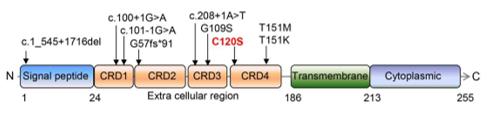 Fig. 1 Distribution of TNFRSF9 variants and protein domain structure.1
Key structural properties of TNFRSF9:
- Extracellular domains rich in cysteine
- Transmembrane helical regions that mediate trimerization
- The intracellular segment contains TRAF-binding motifs that are responsible for signal transduction
- Conservative disulfide bonds maintain structural stability and ligand binding ability
Functions of TNFRSF9
The main function of TNFRSF9 is to act as a costimulatory molecule to regulate the activation and response of immune cells. In addition, it is also involved in a variety of immune-related pathological processes, including tumor immune surveillance and the occurrence of autoimmune diseases.
| Function | Description |
| T-cell co-stimulation | After T cell receptor activation, it provides a second signal to promote T cell proliferation, cytokine secretion and survival. |
| Enhanced immune response | By recruiting TRAF adaptor proteins to activate the NF-κB and MAPK signaling pathways, the intensity of the immune response is enhanced. |
| Tumor immune regulation | Regulating the anti-tumor activity of T cells and NK cells in the tumor microenvironment is an important target for immune checkpoint therapy. |
| Immune memory formation | Participate in effect to memory T cells, T cell differentiation process, affect long-term immune protection. |
| Autoimmune regulation | The imbalance of its signal strength can lead to excessive immune activation, which is related to the pathogenesis of various autoimmune diseases. |
The signal activation of TNFRSF9 depends on ligand-induced trimerization and subsequent receptor clustering, which is similar to most members of the TNF receptor superfamily. However, its expression kinetics and signal duration jointly determine the ultimate direction of the immune effect - whether it promotes an immune response or induces cell exhaustion.
Applications of TNFRSF9 and TNFRSF9 Antibody in Literature
1. Liu, Xiaorong, et al. "TNFRSF9 suppressed the progression of breast cancer via the p38MAPK/PAX6 signaling pathway." Journal of oncology 2022.1 (2022): 8549781. https://doi.org/10.1155/2022/8549781
This study reveals that TNFRSF9 inhibits the proliferation and invasion of breast cancer and promotes apoptosis by suppressing the phosphorylation of p38 and down-regulating PAX6. TNFRSF9 is lowly expressed in cancer tissues, and its absence promotes tumor development, suggesting that this pathway can serve as a potential target for immunotherapy.
2. Cho, Jae-Won, et al. "Systems biology analysis identifies TNFRSF9 as a functional marker of tumor-infiltrating regulatory T-cell enabling clinical outcome prediction in lung cancer." Computational and structural biotechnology journal 19 (2021): 860-868. https://doi.org/10.1016/j.csbj.2021.01.025
This study, through systems biology methods, discovered that TNFRSF9 is a key functional surface marker for tumor-infiltrating Treg cells. In non-small cell lung cancer, the low expression of TNFRSF9 in Treg cells predicts a better prognosis and response to immunotherapy, indicating its involvement in immunosuppression.
3. Zhao, Peiwei, et al. "Clinical and functional characterization of a novel TNFRSF9 variant causing immune dysregulation with predisposition to EBV-driven lymphomagenesis." Frontiers in Immunology 16 (2025): 1605221. https://doi.org/10.3389/fimmu.2025.1605221
This study identified a novel TNFRSF9 gene variation in a pair of siblings with EBV infection and lymphoma. Functional experiments have confirmed that this variation inhibits protein expression and weakens the AKT and NF-κB signaling pathways, leading to functional defects in immune cells and thereby triggering primary immunodeficiency diseases.
4. Suchanski, Jaroslaw, et al. "Galactosylceramide upregulates the expression of the BCL2 gene and downregulates the expression of TNFRSF1B and TNFRSF9 genes, acting as an anti-apoptotic molecule in breast cancer cells." Cancers 16.2 (2024): 389. https://doi.org/10.3390/cancers16020389
This study reveals that galactoceramide enhances the chemotherapy resistance of breast cancer cells by down-regulating p53 expression, thereby inhibiting the pro-apoptotic genes TNFRSF9 and TNFRSF1B, and up-regulating the anti-apoptotic gene BCL-2.
Creative Biolabs: TNFRSF9 Antibodies for Research
Creative Biolabs specializes in the production of high-quality TNFRSF9 antibodies for research and industrial applications. Our portfolio includes monoclonal antibodies tailored for ELISA, Flow Cytometry, Western blot, immunohistochemistry, and other diagnostic methodologies.
- Custom TNFRSF9 Antibody Development: Tailor-made solutions to meet specific research requirements.
- Bulk Production: Large-scale antibody manufacturing for industry partners.
- Technical Support: Expert consultation for protocol optimization and troubleshooting.
- Aliquoting Services: Conveniently sized aliquots for long-term storage and consistent experimental outcomes.
For more details on our TNFRSF9 antibodies, custom preparations, or technical support, contact us at email.
Reference
- Zhao, Peiwei, et al. "Clinical and functional characterization of a novel TNFRSF9 variant causing immune dysregulation with predisposition to EBV-driven lymphomagenesis." Frontiers in Immunology 16 (2025): 1605221. https://doi.org/10.3389/fimmu.2025.1605221
Anti-TNFRSF9 antibodies
 Loading...

 Compare




Hot products 
- AActivation
- AGAgonist
- APApoptosis
- BBlocking
- BABioassay
- BIBioimaging
- CImmunohistochemistry-Frozen Sections
- CIChromatin Immunoprecipitation
- CTCytotoxicity
- CSCostimulation
- DDepletion
- DBDot Blot
- EELISA
- ECELISA(Cap)
- EDELISA(Det)
- ESELISpot
- EMElectron Microscopy
- FFlow Cytometry
- FNFunction Assay
- GSGel Supershift
- IInhibition
- IAEnzyme Immunoassay
- ICImmunocytochemistry
- IDImmunodiffusion
- IEImmunoelectrophoresis
- IFImmunofluorescence
- IGImmunochromatography
- IHImmunohistochemistry
- IMImmunomicroscopy
- IOImmunoassay
- IPImmunoprecipitation
- ISIntracellular Staining for Flow Cytometry
- LALuminex Assay
- LFLateral Flow Immunoassay
- MMicroarray
- MCMass Cytometry/CyTOF
- MDMeDIP
- MSElectrophoretic Mobility Shift Assay
- NNeutralization
- PImmunohistologyp-Paraffin Sections
- PAPeptide Array
- PEPeptide ELISA
- PLProximity Ligation Assay
- RRadioimmunoassay
- SStimulation
- SESandwich ELISA
- SHIn situ hybridization
- TCTissue Culture
- WBWestern Blot
