
HLA-B Antibodies
Background
The HLA-B gene is a major histocompatibility complex (MHC) class I gene located on human chromosome 6, and the protein it encodes plays a core role in immune recognition and response. This gene product initiates immune clearance against virus-infected cells or tumor cells by presenting endogenous antigen peptides to the cell surface for recognition by CD8+ T cells. As one of the most polymorphic genes in the human leukocyte antigen system, HLA-B has discovered thousands of allelic genotypes, and its diversity directly affects an individual's susceptibility to specific diseases, the risk of organ transplant rejection, and drug allergic reactions. The discovery and research of this gene began in the middle of the 20th century with the exploration of transplant immunity. Its typing technology is now widely used in clinical matching, autoimmune disease research and epidemiological association analysis, providing a key molecular basis for immunology, genetic medicine and precision medicine.
Structure of HLA-B
The molecular weight of the protein encoded by the HLA-B gene is approximately 45 kDa, and its size is basically stable among different alleles. It is mainly composed of heavy chains non-covalently bound to β2 microglobulin to form heterodimers.
| Species | B*07:02 | B*27:05 | B*51:01 | B*08:01 |
| Molecular Weight (kDa) | About 45 | About 45 | About 45 | About 45 |
| Primary Structural Differences | The amino acid sequences of the α1 and α2 domains of the antigen-binding slot are highly polymorphic, which determines the binding specificity of different peptide segments | Associated with the risk of ankylosing spondylitis | Associated with the risk of Behcet's disease | Related to allergies to specific drugs |
This protein contains approximately 360 amino acids, and its three-dimensional structure features typical MHC Class I molecular characteristics: the α1 and α2 domains jointly form highly polymorphic antigenic peptide binding slots, while the α3 domain is relatively conserved. Polymorphic residues located in the binding slot (such as amino acids at positions 45, 62, and 67, etc.) directly affect the anchoring of peptides and the recognition of T-cell receptors, serving as the structural basis for the specificity of immune responses.
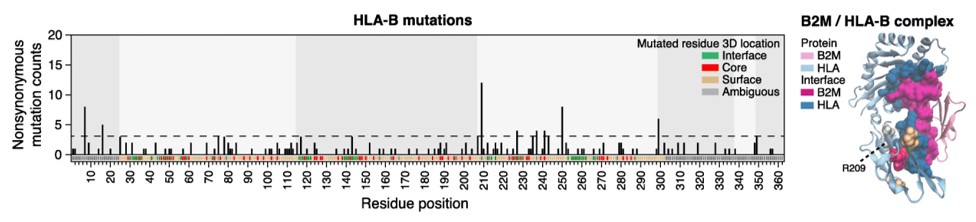 Fig. 1 Distribution of Nonsynonymous HLA-B Mutations Across Functional Domains.1
Key structural properties of HLA-B:
- Polymorphic antigenic peptide binding slots (composed of α1 and α2 domains)
- Conserved immunoglobulin-like α3 domain
- Non-covalently binding to β2 microglobulin forms a stable complex
Functions of HLA-B
The main function of the HLA-B gene is to activate cellular immune responses by presenting endogenous antigen peptides. Its specific functions are as follows:
| Function | Description |
| Antigen presentation | Bind the endogenous peptide segments (such as viral or tumor antigens) produced by degradation in the cytoplasm and present them to the cell surface for recognition by CD8⁺ T cells. |
| Immune surveillance | By presenting abnormal peptides, it initiates cytotoxic T lymphocyte (CTL) responses, eliminating virus-infected cells and cancerous cells. |
| Transplant rejection | Its high polymorphism determines the histocompatibility differences between individuals, is the main target of the immune rejection in organ transplantation. |
| Susceptibility to diseases | Specific alleles (such as B27:05) are closely related to the risk of diseases like ankylosing spondylitis and B57:01 is associated with abacavir allergy. |
| Immune memory | Participate in the establishment of adaptive immune memory, enabling the body to generate a rapid and specific clearance response to reinfected pathogens. |
The antigen-binding slots of HLA-B molecules are highly selective, and their polymorphisms directly determine the sequence characteristics (anchoring residues) of the bound peptides, thereby influencing the intensity of an individual's immune response to specific pathogens and disease outcomes.
Applications of HLA-B and HLA-B Antibody in Literature
1. Yarzabek, Brogan, et al. "Variations in HLA-B cell surface expression, half-life and extracellular antigen receptivity." Elife 7 (2018): e34961. https://doi.org/10.7554/eLife.34961
The article indicates that there are allelic and cell type differences in the expression and stability of human leukocyte antigen class B molecules. Studies have found that the surface expression levels, half-lives and exogenous antigen binding capabilities of specific HLA-B subtypes in lymphocytes and monocytes are differentially regulated by antigen acquisition pathways.
2. Sahin, Ziver, et al. "Takayasu's arteritis is associated with HLA-B* 52, but not with HLA-B* 51, in Turkey." Arthritis research & therapy 14.1 (2012): R27. https://doi.org/10.1186/ar3730
This study confirmed that in patients with Takayasu arteritis in Turkey, HLA-B*52 (rather than HLA-B*51) was significantly associated with the disease, and its carrier rate was reduced in patients with late-onset and localized vascular involvement.
3. Castro, Andrea, et al. "Elevated neoantigen levels in tumors with somatic mutations in the HLA-A, HLA-B, HLA-C and B2M genes." BMC medical genomics 12.Suppl 6 (2019): 107. https://doi.org/10.1186/s12920-019-0544-1
Studies have found that somatic mutations in the HLA-B gene can lead to changes in the MHC-I antigen presentation function of tumor cells, which is associated with a higher neoantigen load and stronger immune cell infiltration, and is one of the key mechanisms of tumor immune escape.
4. Kennedy, Philippa R., et al. "HLA-B and HLA-C differ in their nanoscale organization at cell surfaces." Frontiers in immunology 10 (2019): 61. https://doi.org/10.3389/fimmu.2019.00061
Studies have found that there are differences in the nanoscale tissue distribution of HLA-B and HLA-C on the cell membrane. HLA-C tends to form larger and more clusters, and the degree of its clustering is regulated by the expression level and cell type, which may affect its immunological function.
5. Owen, Michael J., Anna-Maija Kissonerghis, and H. F. Lodish. "Biosynthesis of HLA-A and HLA-B antigens in vivo." Journal of Biological Chemistry 255.20 (1980): 9678-9684. https://doi.org/10.1016/S0021-9258(18)43446-1
Research has found that in B lymphoblasts, the heavy chain synthesis of HLA-B antigen rapidly binds to β2 microglobulin, and its glycosylation matinates and is expressed on the cell surface within approximately 30 to 40 minutes. The binding with β 2-microglobulin is crucial for its subsequent processing and transportation.
Creative Biolabs: HLA-B Antibodies for Research
Creative Biolabs specializes in the production of high-quality HLA-B antibodies for research and industrial applications. Our portfolio includes monoclonal antibodies tailored for ELISA, Flow Cytometry, Western blot, immunohistochemistry, and other diagnostic methodologies.
- Custom HLA-B Antibody Development: Tailor-made solutions to meet specific research requirements.
- Bulk Production: Large-scale antibody manufacturing for industry partners.
- Technical Support: Expert consultation for protocol optimization and troubleshooting.
- Aliquoting Services: Conveniently sized aliquots for long-term storage and consistent experimental outcomes.
For more details on our HLA-B antibodies, custom preparations, or technical support, contact us at email.
Reference
- Castro, Andrea, et al. "Elevated neoantigen levels in tumors with somatic mutations in the HLA-A, HLA-B, HLA-C and B2M genes." BMC medical genomics 12.Suppl 6 (2019): 107. https://doi.org/10.1186/s12920-019-0544-1
Anti-HLA-B antibodies
 Loading...
 Compare




Hot products 
- AActivation
- AGAgonist
- APApoptosis
- BBlocking
- BABioassay
- BIBioimaging
- CImmunohistochemistry-Frozen Sections
- CIChromatin Immunoprecipitation
- CTCytotoxicity
- CSCostimulation
- DDepletion
- DBDot Blot
- EELISA
- ECELISA(Cap)
- EDELISA(Det)
- ESELISpot
- EMElectron Microscopy
- FFlow Cytometry
- FNFunction Assay
- GSGel Supershift
- IInhibition
- IAEnzyme Immunoassay
- ICImmunocytochemistry
- IDImmunodiffusion
- IEImmunoelectrophoresis
- IFImmunofluorescence
- IGImmunochromatography
- IHImmunohistochemistry
- IMImmunomicroscopy
- IOImmunoassay
- IPImmunoprecipitation
- ISIntracellular Staining for Flow Cytometry
- LALuminex Assay
- LFLateral Flow Immunoassay
- MMicroarray
- MCMass Cytometry/CyTOF
- MDMeDIP
- MSElectrophoretic Mobility Shift Assay
- NNeutralization
- PImmunohistologyp-Paraffin Sections
- PAPeptide Array
- PEPeptide ELISA
- PLProximity Ligation Assay
- RRadioimmunoassay
- SStimulation
- SESandwich ELISA
- SHIn situ hybridization
- TCTissue Culture
- WBWestern Blot
