
IKZF1 Antibodies
Background
The IKZF1 gene encodes a zinc finger protein called Ikaros, which is mainly expressed in the hematopoietic system and participates in the differentiation and development of lymphocytes as a transcriptional regulatory factor. This protein can activate or inhibit the expression of target genes by binding to specific DNA sequences, thereby regulating the maturation and functional homeostasis of immune cells. Under pathological conditions, mutations in IKZF1 are closely related to hematological malignancies such as acute lymphoblastic leukemia, and its abnormal expression can lead to lymphocyte development disorders. This gene was first identified by Georgopoulos' team in 1991. Subsequent studies gradually revealed its core role in immune regulation and tumorigenesis. In-depth analysis of the IKZF1 structure not only promotes the development of targeted drugs but also provides an important paradigm for understanding the dynamic regulatory mechanism of transcription factors in the immune microenvironment.
Structure of IKZF1
IKZF1 is a zinc finger transcription factor protein with a molecular weight of approximately 57-60 kDa. Its precise molecular weight may fluctuate slightly due to alternative splicing of different isomers.
| Species | Human | Mouse | Rat |
| Molecular Weight (kDa) | 58.5 | 57.8 | 58.2 |
| Primary Structural Differences | Contains six zinc finger domain structure, with functions of transcriptional activation and DNA binding | Highly homologous to humans, with a highly conserved functional domain | The structure of the core zinc finger is basically the same as that of humans |
This protein is encoded by multiple exons. Its N-terminal is the transcriptional activation domain, and the C-terminal contains a continuous zinc finger structure (where the 1st to 4th fingers are responsible for recognizing specific DNA sequences, and the 5th to 6th fingers mediate dimerization). Proteins bind to gene regulatory regions through their zinc finger structures to form homologous or heterodimers to regulate the transcription of target genes, playing a core role in lymphocyte development.
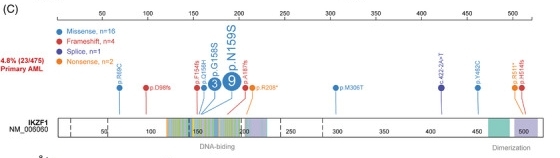 Fig. 1 Structure and mutation spectrum of IKZF1 in AML.1
Key structural properties of IKZF1:
- Contains multiple C2H2 type zinc finger domains in series
- DNA sequence recognition and binding are carried out using specific zinc fingers
- Protein dimerization is mediated by the C-terminal zinc finger
- Independently of n-terminal domain transcription activation/inhibition function
Functions of IKZF1
The main function of IKZF1 is to regulate lymphocyte development as a transcription factor. In addition, it is also involved in various physiological and pathological processes such as tumor suppression and cell cycle regulation.
| Function | Description |
| Lymphocyte differentiation | Regulate the differentiation and maturation process of B cells and T cells from hematopoietic stem cells to specific lineages. |
| Maintenance of immune homeostasis | By activating or inhibiting target genes, it controls the balance between the proliferation and apoptosis of immune cells. |
| Tumor suppression | Normal functioning IKZF1 can inhibit abnormal proliferation, and its absence or mutation is a key cause of various types of leukemia. |
| Epigenetic regulatory interaction | Synergistic with other transcription factors and epigenetic modification complexes to precisely regulate chromatin state and gene expression. |
| Therapeutic target | Drug research targeting the abnormal function of IKZF1 has become an important direction in the treatment of hematological malignancies. |
Unlike general-purpose transcription factors with wide-ranging effects, IKZF1 precisely regulates immune-related genes by recognizing specific DNA sequences and forming dimers, which demonstrates its high specificity in the hematopoietic system.
Applications of IKZF1 and IKZF1 Antibody in Literature
1. Eckardt, Jan-Niklas, et al. "Mutated IKZF1 is an independent marker of adverse risk in acute myeloid leukemia." Leukemia 37.12 (2023): 2395-2403. https://doi.org/10.1038/s41375-023-02061-1
The article indicates that in a study of 1,606 patients with acute myeloid leukemia (AML), mutations in the IKZF1 gene (especially the N159S hotspot) coexisted with abnormalities such as RUNX1 and GATA2, leading to anemia and thrombocytopenia. Multivariate analysis confirmed that IKZF1 mutation is an independent adverse prognostic factor, significantly reducing the response rate and survival rate, and affecting the transplantation efficacy, suggesting that it should be included in the AML risk stratification model.
2. Paolino, Jonathan, et al. "IKZF1 alterations and therapeutic targeting in B-cell acute lymphoblastic leukemia." Biomedicines 12.1 (2024): 89. https://doi.org/10.3390/biomedicines12010089
The article indicates that the IKAROS protein encoded by the IKZF1 gene is a key factor in lymphocyte development. Its absence in B-cell acute lymphocytic leukemia can lead to functional loss, endowing cancer cells with the ability to self-renew, and is significantly associated with treatment resistance and poor prognosis. Identifying this mutation is helpful for intensifying treatment and improving the therapeutic effect of high-risk patients.
3. Feng, Lin, Hang Zhang, and Ting Liu. "Multifaceted roles of IKZF1 gene, perspectives from bench to bedside." Frontiers in Oncology 14 (2024): 1383419. https://doi.org/10.3389/fonc.2024.1383419
The article indicates that the IKAROS protein encoded by the IKZF1 gene is a key transcription factor regulating lymphocyte generation and immunity. Its dysfunction is not only related to immunodeficiency diseases, but also plays an important role in the transformation of leukemia. IKZF1 mutation is an independent adverse prognostic marker for B-cell acute lymphocytic leukemia and has been used for clinical risk stratification to guide treatment.
4. Garcia-Solorio, Joaquin, et al. "IKZF1plus is a frequent biomarker of adverse prognosis in Mexican pediatric patients with B-acute lymphoblastic leukemia." Frontiers in Oncology 14 (2024): 1337954. https://doi.org/10.3389/fonc.2024.1337954
Studies have found that among children with B-ALL in Mexico, the mutation rate of the IKZF1 gene is as high as 35.9%. The IKZF1plus feature formed by its coexistence with PAX5, CDKN2A/2B, etc. accounts for 21.8%, which is significantly higher than previous reports. This feature is associated with advanced age, high-risk stratification and a decline in overall survival rate, highlighting the importance of incorporating it into routine genomic testing for improving prognosis.
5. Wang, Yang, et al. "Identification of IKZF1 genetic mutations as new molecular subtypes in acute myeloid leukaemia." Clinical and Translational Medicine 13.6 (2023): e1309. https://doi.org/10.1002/ctm2.1309
This study focuses on the rare IKZF1 mutation in acute myeloid leukemia. Research has found that IKZF1 N159S is a hotspot mutation in AML. By reshaping the transcription factor binding spectrum, it leads to high expression of HOXA/B and unique immune characteristics, thereby defining a novel molecular subpopulation with a unique pathogenic mechanism in AML.
Creative Biolabs: IKZF1 Antibodies for Research
Creative Biolabs specializes in the production of high-quality IKZF1 antibodies for research and industrial applications. Our portfolio includes monoclonal antibodies tailored for ELISA, Flow Cytometry, Western blot, immunohistochemistry, and other diagnostic methodologies.
- Custom IKZF1 Antibody Development: Tailor-made solutions to meet specific research requirements.
- Bulk Production: Large-scale antibody manufacturing for industry partners.
- Technical Support: Expert consultation for protocol optimization and troubleshooting.
- Aliquoting Services: Conveniently sized aliquots for long-term storage and consistent experimental outcomes.
For more details on our IKZF1 antibodies, custom preparations, or technical support, contact us at email.
Reference
- Wang, Yang, et al. "Identification of IKZF1 genetic mutations as new molecular subtypes in acute myeloid leukaemia." Clinical and Translational Medicine 13.6 (2023): e1309. https://doi.org/10.1002/ctm2.1309
Anti-IKZF1 antibodies
 Loading...
 Compare




Hot products 
- AActivation
- AGAgonist
- APApoptosis
- BBlocking
- BABioassay
- BIBioimaging
- CImmunohistochemistry-Frozen Sections
- CIChromatin Immunoprecipitation
- CTCytotoxicity
- CSCostimulation
- DDepletion
- DBDot Blot
- EELISA
- ECELISA(Cap)
- EDELISA(Det)
- ESELISpot
- EMElectron Microscopy
- FFlow Cytometry
- FNFunction Assay
- GSGel Supershift
- IInhibition
- IAEnzyme Immunoassay
- ICImmunocytochemistry
- IDImmunodiffusion
- IEImmunoelectrophoresis
- IFImmunofluorescence
- IGImmunochromatography
- IHImmunohistochemistry
- IMImmunomicroscopy
- IOImmunoassay
- IPImmunoprecipitation
- ISIntracellular Staining for Flow Cytometry
- LALuminex Assay
- LFLateral Flow Immunoassay
- MMicroarray
- MCMass Cytometry/CyTOF
- MDMeDIP
- MSElectrophoretic Mobility Shift Assay
- NNeutralization
- PImmunohistologyp-Paraffin Sections
- PAPeptide Array
- PEPeptide ELISA
- PLProximity Ligation Assay
- RRadioimmunoassay
- SStimulation
- SESandwich ELISA
- SHIn situ hybridization
- TCTissue Culture
- WBWestern Blot
