
POLN Antibodies
Background
The POLN gene encodes a DNA polymerase that mainly participates in the DNA damage repair pathway, especially playing a key role in the cross-damage synthesis process. This gene plays a significant role in maintaining genomic stability. The protein it encodes can bypass damage sites during DNA replication, helping cells cope with replication pressure. Abnormal function of the POLN gene is associated with a variety of genetic diseases and cancer risks, making it an important subject of molecular biology and medical research. In recent years, research on its structure and function has been continuously deepened, providing a new perspective for understanding the DNA repair mechanism, cell cycle regulation and the treatment of related diseases.
Structure of POLN
The protein encoded by the POLN gene is a DNA polymerase with a molecular weight of approximately 108 kDa. This enzyme is relatively conserved in evolution, but there are differences in its sequence and functional details among different species.
| Species | Human | Mouse | African clawed toad | Fruit fly |
| Molecular Weight (kDa) | Approximately 108 | Approximately 107 | Approximately 106 | Approximately 105 |
| Primary Structural Differences | Participate in DNA cross-damage synthesis and homologous recombination repair | Similar functions are crucial for the stability of the genome of germ cells | Expressed during early embryonic development | Participate in DNA damage response |
The POLN protein contains approximately 983 amino acids and its structure belongs to group A DNA polymerase. Its core domains include the palmar domain, finger domain and thumb domain, which together form a typical right-handed conformation to catalyze DNA synthesis. The most notable feature of this enzyme is its unique active site, which can accommodate damaged bases, thereby enabling replication across DNA damage sites. In addition, it contains a polymerase-associated domain (PAD), which is crucial for its unique damage tolerance function.
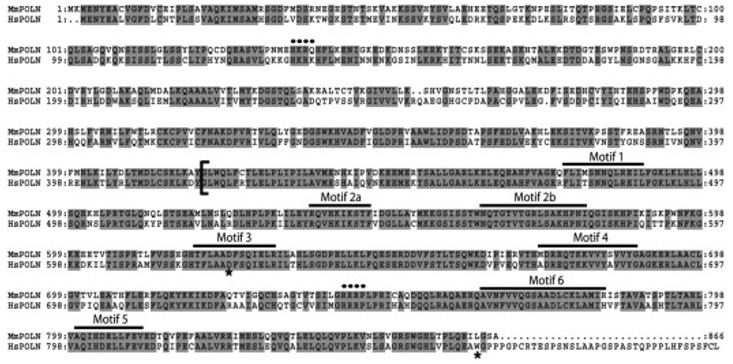 Fig. 1 Sequence alignment of human and mouse POLN.1
Key structural properties of POLN:
- Classical right-handed structure of DNA polymerase (palm domain, finger domain, thumb domain)
- Extended active site cavities that can accommodate damaged bases
- Characteristic of the related domain polymerase (PAD), gives its cross damage synthetic ability
Functions of POLN
The core function of the protein encoded by the POLN gene is to perform cross-damage synthesis in DNA damage repair, and it also plays a significant role in maintaining genomic stability.
| Function | Description |
| Cross-damage synthesis | As a Y-family DNA polymerase, it can bypass certain specific types of damage sites (such as thymine dimers) during DNA replication, allowing replication to continue and preventing the collapse of the replication fork. |
| Support for homologous recombination | Through its polymerase activity, it assists in synthesizing dependent homologous recombination repair pathways such as strand annealing, fills DNA strand gaps, and promotes accurate damage repair. |
| Maintenance of genomic stability | In reproductive cells, and is especially important in the process of embryonic development, loss of its function will lead to genomic instability increases, associated with certain genetic diseases and cancer susceptibility. |
| Replication Stress Coping | When normal replication is blocked, the stagnant replication forks are recruited to work as a backup replication enzyme, helping cells cope with replication pressure. |
| Double-chain break repair | Participate in some DNA double-strand break repair pathways and prepare for subsequent recombination or ligation steps by extending the DNA ends. |
The catalytic activity of POLN is less efficient and less faithful compared to other high-fidelity replication polymerases, which reflects its special role in prioritizing bypasses damage in the "speed versus accuracy" trade-off to maintain genomic integrity. Its expression level within cells is usually low, but it can be induced and activated under DNA damage signals.
Applications of POLN and POLN Antibody in Literature
1. Marini, Federica, et al. "POLN, a nuclear PolA family DNA polymerase homologous to the DNA cross-link sensitivity protein Mus308." Journal of Biological Chemistry 278.34 (2003): 32014-32019. https://doi.org/10.1074/jbc.m305646200
The article indicates that POLN is a novel mammalian DNA polymerase associated with Drosophila Mus308, highly expressed in the testis, located in the nucleus, and possesses DNA polymerase activity, which may be involved in DNA damage repair.
2. Takata, Kei-ichi, et al. "Conserved overlapping gene arrangement, restricted expression, and biochemical activities of DNA polymerase ν (POLN)." Journal of Biological Chemistry 290.40 (2015): 24278-24293. https://doi.org/10.1074/jbc.M115.677419
The article indicates that POLN (DNA polymerase ν) is mainly expressed in the testicles of vertebrates and shares exons with the HAUS3 gene. It possesses thymine diol damage crossing and chain replacement activities, and interacts with homologous recombination repair factors, but its physiological functions remain to be clarified.
3. Takata, Kei-ichi, et al. "Human DNA polymerase N (POLN) is a low fidelity enzyme capable of error-free bypass of 5S-thymine glycol." Journal of Biological Chemistry 281.33 (2006): 23445-23455. https://doi.org/10.1074/jbc.M604317200
The article indicates that POLN is A human A-family DNA polymerase with unique low fidelity, especially prone to misassigning T to template G. It can effectively carry out cross-damage synthesis across thymine diol damage, and its biochemical characteristics are significantly different from those of POLQ in the same family.
4. Takata, Kei-ichi, et al. "Analysis of DNA polymerase ν function in meiotic recombination, immunoglobulin class-switching, and DNA damage tolerance." PLoS genetics 13.6 (2017): e1006818. https://doi.org/10.1371/journal.pgen.1006818
The article indicates that PolN-deficient mice and human cells do not show obvious developmental abnormalities or increased sensitivity to DNA crosslinkers. Research has found that POLN is mainly expressed in the testicles and may play a special role in processing specific DNA substrates during meiosis homologous recombination.
5. Dos Santos, Wellington, et al. "Whole-exome sequencing identifies pathogenic germline variants in patients with lynch-like syndrome." Cancers 14.17 (2022): 4233. https://doi.org/10.3390/cancers14174233
This study found a rare and potentially pathogenic variation of the DNA repair gene POLN in patients with Lynch-like syndrome, providing new genetic clues for explaining their high risk of colorectal cancer and helping to improve screening strategies for high-risk families.
Creative Biolabs: POLN Antibodies for Research
Creative Biolabs specializes in the production of high-quality POLN antibodies for research and industrial applications. Our portfolio includes monoclonal antibodies tailored for ELISA, Flow Cytometry, Western blot, immunohistochemistry, and other diagnostic methodologies.
- Custom POLN Antibody Development: Tailor-made solutions to meet specific research requirements.
- Bulk Production: Large-scale antibody manufacturing for industry partners.
- Technical Support: Expert consultation for protocol optimization and troubleshooting.
- Aliquoting Services: Conveniently sized aliquots for long-term storage and consistent experimental outcomes.
For more details on our POLN antibodies, custom preparations, or technical support, contact us at email.
Reference
- Marini, Federica, et al. "POLN, a nuclear PolA family DNA polymerase homologous to the DNA cross-link sensitivity protein Mus308." Journal of Biological Chemistry 278.34 (2003): 32014-32019. https://doi.org/10.1074/jbc.m305646200
Anti-POLN antibodies
 Loading...
 Compare



Hot products 
- AActivation
- AGAgonist
- APApoptosis
- BBlocking
- BABioassay
- BIBioimaging
- CImmunohistochemistry-Frozen Sections
- CIChromatin Immunoprecipitation
- CTCytotoxicity
- CSCostimulation
- DDepletion
- DBDot Blot
- EELISA
- ECELISA(Cap)
- EDELISA(Det)
- ESELISpot
- EMElectron Microscopy
- FFlow Cytometry
- FNFunction Assay
- GSGel Supershift
- IInhibition
- IAEnzyme Immunoassay
- ICImmunocytochemistry
- IDImmunodiffusion
- IEImmunoelectrophoresis
- IFImmunofluorescence
- IGImmunochromatography
- IHImmunohistochemistry
- IMImmunomicroscopy
- IOImmunoassay
- IPImmunoprecipitation
- ISIntracellular Staining for Flow Cytometry
- LALuminex Assay
- LFLateral Flow Immunoassay
- MMicroarray
- MCMass Cytometry/CyTOF
- MDMeDIP
- MSElectrophoretic Mobility Shift Assay
- NNeutralization
- PImmunohistologyp-Paraffin Sections
- PAPeptide Array
- PEPeptide ELISA
- PLProximity Ligation Assay
- RRadioimmunoassay
- SStimulation
- SESandwich ELISA
- SHIn situ hybridization
- TCTissue Culture
- WBWestern Blot
