
4-1BB Antibodies
Background
4-1BB is an important co-stimulatory protein on the cell membrane surface, mainly expressed on the surface of activated T lymphocytes. This protein, by binding to its ligand 4-1BBL, can enhance the proliferation, survival and cytokine secretion of T cells, thereby significantly strengthening the anti-tumor immune response. Since its first identification by a scientific research team in 1993, the functional research on 4-1BB as an immune checkpoint molecule has been continuously deepened, and its agonist antibodies have demonstrated significant efficacy in preclinical studies of various tumor models. The protein encoded by this gene activates downstream signaling pathways by forming a ligand-induced trimer structure. Its unique signal transduction mechanism provides an important target for tumor immunotherapy. The development of related drugs has promoted the understanding of the immune regulatory network and laid a molecular foundation for the design of combination treatment strategies.
Structure of 4-1BB
4-1BB (CD137) is a type I transmembrane glycoprotein of approximately 19.0 kDa, and its molecular weight varies among different species due to the degree of glycosylation modification.
| Species | Human | Mouse | Crab-eating macaque | Rat |
| Molecular Weight (kDa) | 19.0 | 18.5 | 19.2 | 18.7 |
| Primary Structural Differences | Contains four cysteine rich domain structure | Extracellular area about 60% homology with humans | Highly similar to the human protein structure | Conservative intracellular signal structure domain |
This protein is composed of 255 amino acids, and its extracellular region forms a characteristic cysteine-enriched domain (CRD), which constructs a stable spatial conformation through reverse parallel β -folded lamelles. The secondary structure of 4-1BB is mainly composed of β chains, which enclose ligand-binding grooves. A single α -helix in the transmembrane region is responsible for anchoring the receptor to the cell membrane, while the TRAF-binding motif contained in the intracellular segment initiates the NF-κB and MAPK signaling pathways by recruiting downstream signaling molecules, ultimately mediating the co-stimulatory effect of T cells.
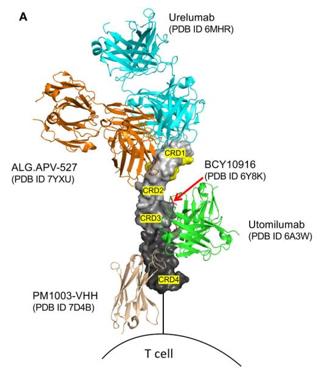 Fig. 1 Outer view of 4-1BB.1
Key structural properties of 4-1BB:
- Cysteine-rich extracellular domains form specific ligand binding interfaces
- Conservative transmembrane area keep stable anchor receptors on the cell surface
- Intracellular TRAF-binding motifs mediate downstream signal transduction
- Ligand-induced trimerization is necessary for activation of signaling pathways
Functions of 4-1BB
The main function of 4-1BB (CD137) is to serve as a co-stimulatory signaling molecule for T cells. However, it is also involved in a variety of immune regulatory processes, including T-cell survival, metabolic reprogramming, and anti-tumor immune responses.
| Function | Description |
| T-cell co-stimulation | By binding to its ligand 4-1BBL, it provides a second signal for T cell activation, enhancing T cell proliferation and effector functions. |
| Promote T cell survival | Up-regulate the expression of the anti-apoptotic protein Bcl-xL and prolong the survival time of effector T cells and memory T cells. |
| Enhance anti-tumor immunity | The activated 4-1BB signal promotes the infiltration of cytotoxic T cells into the tumor microenvironment and enhances their tumor-killing ability. |
| Metabolic reprogramming | Induce the transformation of T cell metabolism from oxidative phosphorylation to glycolysis to meet the rapid energy demands of effector T cells. |
| Regulate autoimmunity | "By regulating the intensity of T-cell responses, it participates in preventing autoimmune pathological damage caused by excessive immune reactions." |
The signal transduction of 4-1BB depends on the binding of its intracellular segment to TRAF-adapter proteins, thereby activating the NF-κB and MAPK pathways. This characteristic of signal cascade amplification enables it to effectively enhance the persistence and function of T cells, providing a key molecular basis for tumor immunotherapy.
Applications of 4-1BB and 4-1BB Antibody in Literature
1. Singh, Rohit, et al. "4-1BB immunotherapy: advances and hurdles." Experimental & Molecular Medicine 56.1 (2024): 32-39. https://doi.org/10.1038/s12276-023-01136-4
The article indicates that 4-1BB is a key receptor for T-cell immunity and plays a significant role in anti-tumor and anti-infection. Although its agonist antibodies have significant therapeutic effects, they are limited due to side effects such as hepatotoxicity. Currently, researchers are committed to developing a new generation of 4-1BB targeted therapies with higher safety to promote their clinical application.
2. Kim, Alyssa Min Jung, Macy Rose Nemeth, and Seung-Oe Lim. "4-1BB: A promising target for cancer immunotherapy." Frontiers in Oncology 12 (2022): 968360. https://doi.org/10.3389/fonc.2022.968360
The article indicates that as an important co-stimulatory receptor, 4-1BB can enhance the anti-tumor immune response and has become a potential target for cancer immunotherapy. Although the development of its agonist drugs started later than that of co-inhibitory receptors, significant progress has been made in related research. This article aims to summarize the latest achievements and development prospects of 4-1BB targeted therapy.
3. Wang, Ya-Tao, et al. "Targeting 4-1BB for tumor immunotherapy from bench to bedside." Frontiers in Immunology 13 (2022): 975926. https://doi.org/10.3389/fimmu.2022.975926
The article indicates that 4-1BB is an important target for tumor immunotherapy. Its expression is upregulated in the tumor microenvironment and can significantly enhance anti-tumor immunity. This review will summarize its structure, function and the progress of targeted drug research and development, and look forward to its clinical application prospects.
4. Salek-Ardakani, Shahram, Dirk M. Zajonc, and Michael Croft. "Agonism of 4-1BB for immune therapy: a perspective on possibilities and complications." Frontiers in Immunology 14 (2023): 1228486. https://doi.org/10.3389/fimmu.2023.1228486
The article indicates that 4-1BB is a key target for enhancing anti-tumor and anti-viral immunity. To overcome the limitations of the first-generation agonists, a new generation of bispecific/multispecific antibodies is being developed, aiming to precisely activate 4-1BB to achieve enhanced efficacy and reduced toxicity. This article reviews the progress and challenges in this field.
Creative Biolabs: 4-1BB Antibodies for Research
Creative Biolabs specializes in the production of high-quality 4-1BB antibodies for research and industrial applications. Our portfolio includes monoclonal antibodies tailored for ELISA, Flow Cytometry, Western blot, immunohistochemistry, and other diagnostic methodologies.
- Custom 4-1BB Antibody Development : Tailor-made solutions to meet specific research requirements.
- Bulk Production : Large-scale antibody manufacturing for industry partners.
- Technical Support : Expert consultation for protocol optimization and troubleshooting.
- Aliquoting Services : Conveniently sized aliquots for long-term storage and consistent experimental outcomes.
For more details on our 4-1BB antibodies, custom preparations, or technical support, contact us at email.
Reference
- Wang, Ya-Tao, et al. "Targeting 4-1BB for tumor immunotherapy from bench to bedside." Frontiers in Immunology 13 (2022): 975926. https://doi.org/10.3389/fimmu.2022.975926
Anti-4-1BB antibodies
 Loading...
 Compare




Hot products 
-
Mouse Anti-CD164 Recombinant Antibody (CBFYC-0077) (CBMAB-C0086-FY)

-
Rat Anti-FABP3 Recombinant Antibody (CBXF-2299) (CBMAB-F1612-CQ)

-
Mouse Anti-8-oxoguanine Recombinant Antibody (V2-7719) (CBMAB-1898CQ)

-
Mouse Anti-BAD (Phospho-Ser136) Recombinant Antibody (CBYY-0138) (CBMAB-0139-YY)

-
Mouse Anti-AMH Recombinant Antibody (5/6) (CBMAB-A2527-YC)

-
Human Anti-SARS-CoV-2 Spike Recombinant Antibody (CBC05) (CBMAB-CR005LY)

-
Mouse Anti-ATM Recombinant Antibody (2C1) (CBMAB-A3970-YC)

-
Mouse Anti-GSDMA Recombinant Antibody (CBLG1-2983) (CBMAB-G5128-LY)

-
Mouse Anti-FTH1 Recombinant Antibody (CBXF-1896) (CBMAB-F3426-CQ)

-
Mouse Anti-FOSB Recombinant Antibody (CBXF-3593) (CBMAB-F2522-CQ)

-
Mouse Anti-APP Recombinant Antibody (5C2A1) (CBMAB-A3314-YC)

-
Mouse Anti-FLI1 Recombinant Antibody (CBXF-0733) (CBMAB-F0435-CQ)

-
Mouse Anti-BRD3 Recombinant Antibody (CBYY-0801) (CBMAB-0804-YY)

-
Mouse Anti-AOC3 Recombinant Antibody (CBYY-0014) (CBMAB-0014-YY)

-
Mouse Anti-A2M Recombinant Antibody (V2-178822) (CBMAB-A0036-YC)

-
Mouse Anti-CFL1 (Phospho-Ser3) Recombinant Antibody (CBFYC-1770) (CBMAB-C1832-FY)

-
Mouse Anti-CCDC6 Recombinant Antibody (CBXC-0106) (CBMAB-C5397-CQ)

-
Rabbit Anti-ABL1 (Phosphorylated Y245) Recombinant Antibody (V2-505716) (PTM-CBMAB-0465LY)

-
Mouse Anti-C1QC Recombinant Antibody (CBFYC-0600) (CBMAB-C0654-FY)

-
Mouse Anti-CSPG4 Recombinant Antibody (CBFYM-1050) (CBMAB-M1203-FY)

- AActivation
- AGAgonist
- APApoptosis
- BBlocking
- BABioassay
- BIBioimaging
- CImmunohistochemistry-Frozen Sections
- CIChromatin Immunoprecipitation
- CTCytotoxicity
- CSCostimulation
- DDepletion
- DBDot Blot
- EELISA
- ECELISA(Cap)
- EDELISA(Det)
- ESELISpot
- EMElectron Microscopy
- FFlow Cytometry
- FNFunction Assay
- GSGel Supershift
- IInhibition
- IAEnzyme Immunoassay
- ICImmunocytochemistry
- IDImmunodiffusion
- IEImmunoelectrophoresis
- IFImmunofluorescence
- IGImmunochromatography
- IHImmunohistochemistry
- IMImmunomicroscopy
- IOImmunoassay
- IPImmunoprecipitation
- ISIntracellular Staining for Flow Cytometry
- LALuminex Assay
- LFLateral Flow Immunoassay
- MMicroarray
- MCMass Cytometry/CyTOF
- MDMeDIP
- MSElectrophoretic Mobility Shift Assay
- NNeutralization
- PImmunohistologyp-Paraffin Sections
- PAPeptide Array
- PEPeptide ELISA
- PLProximity Ligation Assay
- RRadioimmunoassay
- SStimulation
- SESandwich ELISA
- SHIn situ hybridization
- TCTissue Culture
- WBWestern Blot
