
CD99 Antibodies
Background
CD99 is a cell surface glycoprotein located in the pseudo-autosomal region of the human X and Y chromosomes. It is widely expressed in various tissue cells. The protein encoded by this gene plays a significant role in cell adhesion, migration, proliferation, and apoptosis, especially participating in the regulation of T cell activation and the migration of white blood cells across the blood vessel wall. Its abnormal expression is closely related to the occurrence and development of various tumors, such as Ewing's sarcoma. Therefore, it is often used as an immunohistochemical marker in pathological diagnosis. Since its discovery in the 1980s, CD99 has received continuous attention due to its dual functions in immune response and tumor biology. Related studies have not only revealed its crucial role in physiological and pathological processes but also provided molecular targets for the development of new therapeutic strategies for inflammatory diseases and cancer.
Structure of CD99
CD99 is a cell surface glycoprotein with a molecular weight of approximately 32 kDa. Its molecular weight may vary slightly due to differences in glycosylation levels among different species or splice variants of the same species. The human CD99 protein consists of 185 amino acids and its primary structure includes a highly glycosylated extracellular region, a transmembrane domain, and a short cytoplasmic tail. The core structure of the protein presents as a single transmembrane topology, and its extracellular part is mainly composed of β-sheet structures, forming a functional region that mediates homodimerization and cell-cell adhesion. This region also contains a conserved PilE-related motif, which is crucial for the stability and signal transduction function of the protein. The characteristic red color of CD99 in immunohistochemical staining results from the color reaction after binding to specific antibodies, rather than from its own chromophore.
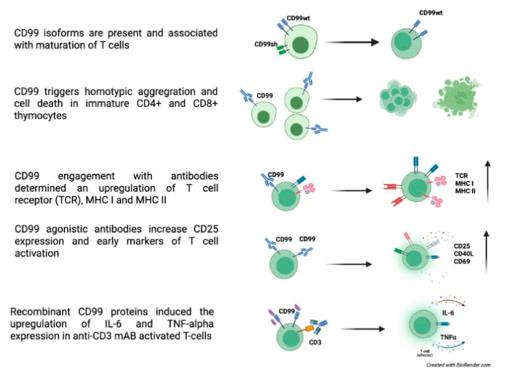 Fig. 1 CD99 roles in T cells.1
Key structural properties of CD99:
- Type 1 transmembrane glycoprotein with typical single transmembrane topology
- Extracellular domain are rich in β folding structure, forming rod rigid structure
- Conserved PKA/PKC phosphorylation sites are located at the intracellular carboxyl terminus
- There are multiple O-linked glycosylation modification sites in the extracellular region.
Functions of CD99
The main function of the CD99 gene is to regulate cell adhesion and migration. However, it is also involved in various pathological and physiological processes, including immune responses and tumor occurrence and development.
| Function | Description |
| Cell Adhesion | It mediates cell-cell adhesion through homotypic or heterotypic interactions, participates in the interaction between endothelial cells and leukocytes, and affects the transendothelial migration of immune cells. |
| Cell Migration | Regulates the reorganization of the cytoskeleton and signal transduction, promotes T cell activation and migration, and plays a crucial role in tumor cell metastasis. |
| Immune Regulation | It plays a crucial role in the differentiation of thymocytes, the activation of T cells, and the formation of immune synapses, influencing the acquired immune response. |
| Tumor Development | Its expression level is correlated with the aggressiveness of various tumors (such as Ewing's sarcoma and osteosarcoma), and can be used as a diagnostic marker and a therapeutic target. |
| Apoptosis Regulation | It involves specific apoptotic signaling pathways for certain cell types, and its regulation is cell type and microenvironment-dependent. |
The adhesion of CD99 relies on its rapid and dynamic binding to the extracellular domain, which is different from the stable binding to classical adhesion molecules such as integrins. This makes it have unique advantages in rapid and reversible intercellular interactions (such as immune surveillance).
Applications of CD99 and CD99 Antibody in Literature
1. Manara, Maria Cristina, et al. "CD99: A Key Regulator in Immune Response and Tumor Microenvironment." Biomolecules 15.5 (2025): 632. https://doi.org/10.3390/biom15050632
The article indicates that CD99 is a key membrane protein that regulates immunity and tumor development. It is highly expressed in malignant tumors and can promote tumor progression and immune evasion. Monoclonal antibodies targeting CD99 can inhibit tumor growth, regulate the tumor microenvironment, and exert a synergistic effect with immune checkpoint molecules.
2. Ali, Atham, et al. "FLT3/CD99 Bispecific Antibody–Based Nanoparticles for Acute Myeloid Leukemia." Cancer Research Communications 4.8 (2024): 1946-1962. https://doi.org/10.1158/2767-9764.CRC-24-0096
The article indicates that for FLT3-ITD type acute myeloid leukemia, a new type of dual-specificity molecule that can simultaneously target CD99 and FLT3 has been developed. This therapy can effectively eliminate leukemia cells, reduce tumor burden and prolong survival in preclinical models.
3. Fulton, Janet E., et al. "CD99 and the chicken alloantigen D blood system." Genes 14.2 (2023): 402. https://doi.org/10.3390/genes14020402
The study found that the candidate gene for the D blood group system in chickens is CD99, which is located in a specific region of chromosome 1. This gene is co-segregated with the blood group allele through non-synonymous SNPs in exons and participates in important cellular processes such as immune regulation.
4. Kerstein, Patrick C., et al. "Gbx2 identifies two amacrine cell subtypes with distinct molecular, morphological, and physiological properties." Cell reports 33.7 (2020). https://doi.org/10.1016/j.celrep.2020.108332
The research reveals that Ewing's sarcoma relies on the pre-domain of GDF6 protein to bind with CD99, and by recruiting CSK, it inhibits the activity of Src kinase to maintain growth. This pathway elucidates a new mechanism for regulating tumor proliferation.
5. Huijbers, Elisabeth JM, et al. "Targeting tumor vascular CD99 inhibits tumor growth." Frontiers in Immunology 10 (2019): 651. https://doi.org/10.3389/fimmu.2019.00651
The research reveals that CD99 is a transmembrane glycoprotein highly expressed in white blood cells and endothelial cells. The study found that it is specifically highly expressed in the blood vessels of various solid tumors. A vaccine targeting mouse CD99 can safely inhibit tumor growth, providing a new strategy for treating human CD99 subtypes.
Creative Biolabs: CD99 Antibodies for Research
Creative Biolabs specializes in the production of high-quality CD99 antibodies for research and industrial applications. Our portfolio includes monoclonal antibodies tailored for ELISA, Flow Cytometry, Western blot, immunohistochemistry, and other diagnostic methodologies.
- Custom CD99 Antibody Development: Tailor-made solutions to meet specific research requirements.
- Bulk Production: Large-scale antibody manufacturing for industry partners.
- Technical Support: Expert consultation for protocol optimization and troubleshooting.
- Aliquoting Services: Conveniently sized aliquots for long-term storage and consistent experimental outcomes.
For more details on our CD99 antibodies, custom preparations, or technical support, contact us at email.
Reference
- Manara, Maria Cristina, et al. "CD99: A Key Regulator in Immune Response and Tumor Microenvironment." Biomolecules 15.5 (2025): 632. https://doi.org/10.3390/biom15050632
Anti-CD99 antibodies
 Loading...
 Compare




Hot products 
- AActivation
- AGAgonist
- APApoptosis
- BBlocking
- BABioassay
- BIBioimaging
- CImmunohistochemistry-Frozen Sections
- CIChromatin Immunoprecipitation
- CTCytotoxicity
- CSCostimulation
- DDepletion
- DBDot Blot
- EELISA
- ECELISA(Cap)
- EDELISA(Det)
- ESELISpot
- EMElectron Microscopy
- FFlow Cytometry
- FNFunction Assay
- GSGel Supershift
- IInhibition
- IAEnzyme Immunoassay
- ICImmunocytochemistry
- IDImmunodiffusion
- IEImmunoelectrophoresis
- IFImmunofluorescence
- IGImmunochromatography
- IHImmunohistochemistry
- IMImmunomicroscopy
- IOImmunoassay
- IPImmunoprecipitation
- ISIntracellular Staining for Flow Cytometry
- LALuminex Assay
- LFLateral Flow Immunoassay
- MMicroarray
- MCMass Cytometry/CyTOF
- MDMeDIP
- MSElectrophoretic Mobility Shift Assay
- NNeutralization
- PImmunohistologyp-Paraffin Sections
- PAPeptide Array
- PEPeptide ELISA
- PLProximity Ligation Assay
- RRadioimmunoassay
- SStimulation
- SESandwich ELISA
- SHIn situ hybridization
- TCTissue Culture
- WBWestern Blot
