
FDPS Antibodies
Background
The FDPS gene encodes a key metabolic enzyme present in the cytoplasm, mainly involved in the synthesis of farniki pyrophosphate (FPP) catalyzed by the mevalonic acid pathway. This enzyme generates FPP by polymerizing isoprenyl pyrophosphate (IPP) and dimethylallyl pyrophosphate (DMAPP). This product is an important precursor for cholesterol synthesis, protein mineralization and lipid modification, and plays a significant role in cell signal transduction and membrane stability. Since its discovery in the 1990s, FDPS have become a research focus due to their regulatory roles in bone metabolic diseases and tumors (such as multiple myeloma), and their inhibitors have been developed for the treatment of related pathological conditions. In-depth research on the function and structure of this gene not only reveals the molecular mechanism of isoprene biosynthesis, but also provides a key theoretical basis for targeted therapeutic strategies.
Structure of FDPS
FDPS is a key metabolic enzyme with a molecular weight of approximately 48 kDa, and its size is highly conserved across different species. This enzyme is mainly composed of approximately 420 amino acids, and its primary structure shows a high degree of homology among different species, especially in the region of catalytic active sites.
| Species | Human | Mouse | Rat | Yeast | Arabidopsis thaliana plant |
| Molecular Weight (kDa) | 48.2 | 48.0 | 48.1 | 46.8 | 47.5 |
| Primary Structural Differences | Conservative catalytic domain | Two amino acid substitutes | Three amino acid variations | The shorter N-terminal region | Additional chloroplast transport peptides |
The FDPS protein forms a typical α-β-α sandwich structure, and its secondary structure is mainly composed of alternating α -helices and β -folds. The core region of this enzyme contains multiple highly conserved aspartic acid-rich mods (DDXXD), which work in synergy with magnesium ions to catalyze the condensation of isoprenyl pyrophosphate (IPP) and dimethylallyl pyrophosphate (DMAPP) to form farniki pyrophosphate (FPP). The active site is located in a deep fissure on the protein surface and is composed of negatively charged residues, providing a binding site for positively charged substrates. This enzyme usually functions in the form of a homodimer. The two monomers stably combine through hydrophobic interactions and hydrogen bond networks to jointly complete the catalytic process.
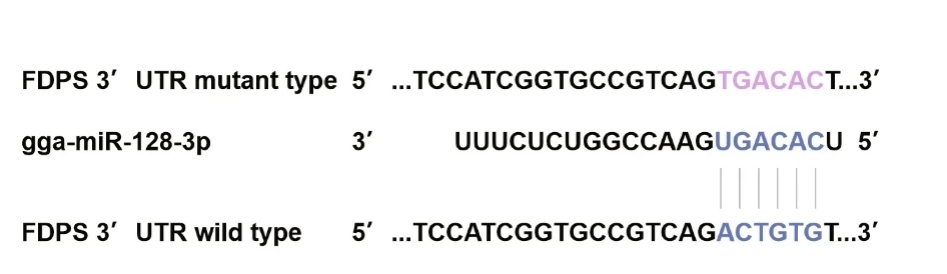 Fig. 1 The potential miR-128-3p target site in the FDPS mRNA 3'UTR was predicted by the RNAhybrid tool.1
Key structural properties of FDPS:
- Typical α-β-α sandwich folding structure
- Conservative aspartic acid concentration die bodies (DDXXD) form the catalytic center
- Magnesium ion cofactor binding sites are used to stabilize substrates and catalyze reactions
- Homologous dimer interface stable complexes by hydrophobic interactions and hydrogen bonding network structure
- Negatively charged active fissures provide specific recognition sites for substrate binding
Functions of FDPS
The core function of FDPS is to catalyze the biosynthesis of farnesic pyrophosphate (FPP). In addition, it is also involved in a variety of important cellular physiological processes, including protein modification, cell proliferation and apoptosis regulation.
| Function | Description |
| Catalysis for FPP synthesis | The catalytic condensation of IPP and DMAPP to form niki pyrophosphate (FPP) is a key step in the mevalproic acid pathway. |
| Isoprene metabolic hub | FPP is a common precursor for the synthesis of various biomolecules such as cholesterol, coenzyme Q10, and lipid-anchored proteins. |
| Regulation of cell proliferation | By providing the substrates required for the farnesization of G proteins such as Ras, it affects cell signal transduction and proliferation. |
| Regulation of osteoclast differentiation | Regulating the formation and activity of osteoclasts in bone metabolism is closely related to diseases such as osteoporosis. |
| Drug target function | Nitrogen is miscellaneous phosphonic acid salts of main drug targets, used in the treatment of multiple myeloma and bone resorption diseases. |
The reaction catalyzed by FDPS relies on magnesium ions (Mg²⁺) as a cofactor. Its enzymatic activity mechanics exhibit a sequential mechanism, and its binding to substrates is highly specific, indicating its core position in the metabolic network and its importance as a therapeutic target.
Applications of FDPS and FDPS Antibody in Literature
1. Chen, Zhuo, Guangyong Chen, and Hang Zhao. "FDPS promotes glioma growth and macrophage recruitment by regulating CCL20 via Wnt/β‐catenin signalling pathway." Journal of Cellular and Molecular Medicine 24.16 (2020): 9055-9066. https://doi.org/10.1111/jcmm.15542
Research has found that the expression of FDPS is significantly elevated in glioma and is associated with a poor prognosis. FDPS upregulates the expression of CCL20 by activating the Wnt/β-catenin signaling pathway, promoting macrophage infiltration and tumor growth. Targeting FDPS may become a potential therapeutic strategy.
2. Zhu, Shuaipeng, et al. "miR-128-3p inhibits intramuscular adipocytes differentiation in chickens by downregulating FDPS." BMC genomics 24.1 (2023): 540. https://doi.org/10.1186/s12864-023-09649-y
Research has found that miR-128-3p inhibits the differentiation of adipocytes in chicken muscle by targeting FDPS. FDPS is a key target gene of miR-128-3p. Its down-regulation will hinder the lipid metabolism process, thereby affecting meat quality. This research provides potential targets for molecular breeding to improve meat quality.
3. Ciubean, Alina Deniza, et al. "Polymorphisms of FDPS, LRP5, SOST and VKORC1 genes and their relation with osteoporosis in postmenopausal Romanian women." PLoS One 14.11 (2019): e0225776. https://doi.org/10.1371/journal.pone.0225776
Research has found that the rs2297480 polymorphism of the FDPS gene is significantly associated with bone mineral density in postmenopausal Romanian women. Individuals carrying the TT genotype and T allele have lower bone mineral density values and a higher risk of osteoporosis, suggesting that FDPS is an important genetic marker of osteoporosis in this population.
4. Chen, Juan, Huajing Rao, and Xiaoling Zheng. "Identification of novel targets associated with cholesterol metabolism in nonalcoholic fatty liver disease: a comprehensive study using Mendelian randomization combined with transcriptome analysis." Frontiers in Genetics 15 (2024): 1464865. https://doi.org/10.3389/fgene.2024.1464865
This study, through bioinformatics analysis, found that FDPS are key cholesterol metabolism genes that affect the risk of non-alcoholic fatty liver disease (NAFLD). As risk factors, FDPS are closely related to immune cell infiltration and fatty acid biosynthesis pathways, providing new targets for the diagnosis and treatment of NAFLD.
5. Jin, Tingting, et al. "Farnesyl diphosphate synthase regulated endothelial proliferation and autophagy during rat pulmonary arterial hypertension induced by monocrotaline." Molecular Medicine 28.1 (2022): 94. https://doi.org/10.1186/s10020-022-00511-7
Research has found that FDPS are upregulated in pulmonary arterial hypertension (PAH) and induce autophagy and dysfunction of endothelial cells by activating the Rac1/PI3K/AKT/mTOR pathway. Inhibiting FDPS can improve endothelial function and alleviate PAH, indicating that FDPS are potential therapeutic targets.
Creative Biolabs: FDPS Antibodies for Research
Creative Biolabs specializes in the production of high-quality FDPS antibodies for research and industrial applications. Our portfolio includes monoclonal antibodies tailored for ELISA, Flow Cytometry, Western blot, immunohistochemistry, and other diagnostic methodologies.
- Custom FDPS Antibody Development: Tailor-made solutions to meet specific research requirements.
- Bulk Production: Large-scale antibody manufacturing for industry partners.
- Technical Support: Expert consultation for protocol optimization and troubleshooting.
- Aliquoting Services: Conveniently sized aliquots for long-term storage and consistent experimental outcomes.
For more details on our FDPS antibodies, custom preparations, or technical support, contact us at email.
Reference
- Zhu, Shuaipeng, et al. "miR-128-3p inhibits intramuscular adipocytes differentiation in chickens by downregulating FDPS." BMC genomics 24.1 (2023): 540. https://doi.org/10.1186/s12864-023-09649-y
Anti-FDPS antibodies
 Loading...
 Compare




Hot products 
-
Mouse Anti-Gro Monoclonal Antibody (1) (CBMAB-0482-LY)

-
Rat Anti-CD34 Recombinant Antibody (MEC 14.7) (CBMAB-C10196-LY)

-
Mouse Anti-ACTG1 Recombinant Antibody (V2-179597) (CBMAB-A0916-YC)

-
Mouse Anti-ATP1B1 Recombinant Antibody (E4) (CBMAB-0463-LY)

-
Mouse Anti-CD24 Recombinant Antibody (HIS50) (CBMAB-C10123-LY)

-
Mouse Anti-FPR2 Recombinant Antibody (1D6) (CBMAB-F2628-CQ)

-
Mouse Anti-AKR1B1 Antibody (V2-2449) (CBMAB-1001CQ)

-
Mouse Anti-ADGRE5 Recombinant Antibody (V2-360335) (CBMAB-C2088-CQ)

-
Mouse Anti-BIRC3 Recombinant Antibody (16E63) (CBMAB-C3367-LY)

-
Mouse Anti-CCNH Recombinant Antibody (CBFYC-1054) (CBMAB-C1111-FY)

-
Mouse Anti-CD164 Recombinant Antibody (CBFYC-0077) (CBMAB-C0086-FY)

-
Mouse Anti-NSUN6 Recombinant Antibody (D-5) (CBMAB-N3674-WJ)

-
Mouse Anti-APCS Recombinant Antibody (CBYC-A663) (CBMAB-A3054-YC)

-
Mouse Anti-BAD (Phospho-Ser136) Recombinant Antibody (CBYY-0138) (CBMAB-0139-YY)

-
Mouse Anti-FTH1 Recombinant Antibody (CBXF-1896) (CBMAB-F3426-CQ)

-
Mouse Anti-Gram Positive Bacteria LTA Recombinant Antibody (CBMC-C0664) (CBMAB-V208-1410-CQ)

-
Human Anti-SARS-CoV-2 Spike Recombinant Antibody (CR3022) (CBMAB-CR014LY)

-
Mouse Anti-ADAM29 Recombinant Antibody (V2-179787) (CBMAB-A1149-YC)

-
Mouse Anti-DLC1 Recombinant Antibody (D1009) (CBMAB-D1009-YC)

-
Mouse Anti-ACKR3 Recombinant Antibody (V2-261265) (CBMAB-C1023-LY)

- AActivation
- AGAgonist
- APApoptosis
- BBlocking
- BABioassay
- BIBioimaging
- CImmunohistochemistry-Frozen Sections
- CIChromatin Immunoprecipitation
- CTCytotoxicity
- CSCostimulation
- DDepletion
- DBDot Blot
- EELISA
- ECELISA(Cap)
- EDELISA(Det)
- ESELISpot
- EMElectron Microscopy
- FFlow Cytometry
- FNFunction Assay
- GSGel Supershift
- IInhibition
- IAEnzyme Immunoassay
- ICImmunocytochemistry
- IDImmunodiffusion
- IEImmunoelectrophoresis
- IFImmunofluorescence
- IGImmunochromatography
- IHImmunohistochemistry
- IMImmunomicroscopy
- IOImmunoassay
- IPImmunoprecipitation
- ISIntracellular Staining for Flow Cytometry
- LALuminex Assay
- LFLateral Flow Immunoassay
- MMicroarray
- MCMass Cytometry/CyTOF
- MDMeDIP
- MSElectrophoretic Mobility Shift Assay
- NNeutralization
- PImmunohistologyp-Paraffin Sections
- PAPeptide Array
- PEPeptide ELISA
- PLProximity Ligation Assay
- RRadioimmunoassay
- SStimulation
- SESandwich ELISA
- SHIn situ hybridization
- TCTissue Culture
- WBWestern Blot
