
MAFB Antibodies
Background
The MAFB gene encodes a protein belonging to the basic leucine zipper (bZIP) transcription factor family, which mainly plays a key regulatory role in the development of neutrophils, monocytes, glomerular podocytes, as well as organs such as the pancreas and inner ear. This gene participates in important biological processes such as cell differentiation, organ formation and immune regulation by regulating the expression of downstream target genes. Research has found that functional abnormalities of the MAFB gene are associated with a variety of human diseases, such as translocation mutations in multiple myeloma, the occurrence of glomerulosclerosis, and some congenital immune deficiencies. Since its identification in the 1990s, MAFB has become an important model molecule for the study of cell signal transduction, transcriptional regulatory networks and pathological mechanisms due to its significant role in developmental biology and disease mechanisms.
Structure of MAFB
MAFB is a transcription factor protein with a molecular weight of approximately 32 kDa. Its precise molecular weight shows species-specific differences among different mammals, mainly due to subtle amino acid sequence variations in the DNA binding domain and regulatory regions.
| Species | Human | Mouse | Zebrafish | African clawed toad |
| Molecular Weight (kDa) | About 32 | About 31.8 | About 30.5 | About 31.2 |
| Primary Structural Differences | Contains the complete transactivation domain | Highly conserved DNA binding domain | There exists an additional regulatory sequence | The carboxyl terminal sequence is different |
This protein contains approximately 300 amino acid residues, and its core structure is composed of the basic leucine zipper (bZIP) domain. This domain contains a DNA-binding region rich in basic amino acids, which is responsible for recognizing specific DNA sequences (MARE elements), as well as an α -helical zipper region composed of repeated leucine residues, mediating protein dimerization. Its tertiary structure presents a typical "helical-ring-helix" conformation. After dimerization, it forms a Y-shaped structure similar to a "scissors", which can precisely be embedded in the DNA groove for transcriptional regulation.
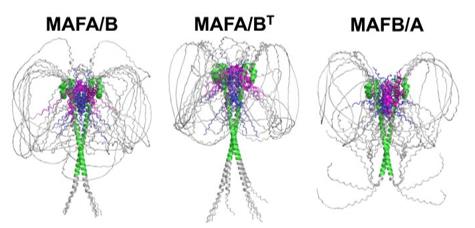 Fig. 1 The models for the MAFA/B (left), MAFA/BT (center), and MAFB/A (right) chimeras.1
Key structural properties of MAFB:
- Basic leucine zipper (bZIP) domain forms the core
- DNA-binding regions rich in basic amino acids
- Dimerization interfaces formed by leucine repeats
Functions of MAFB
The core function of the MAFB gene is to act as a transcription factor to regulate cell differentiation and organ development. In addition, it is also involved in a variety of biological processes such as immune regulation, metabolic balance and disease occurrence.
| Function | Description |
| Regulation of cell differentiation | It plays a key regulatory role in the differentiation process of lineages such as neutrophils, monocytes and pancreatic β cells, guiding precursor cells to transform into specific functional types. |
| Organ development | It participates in the morphogenesis and functional establishment of various organs and tissues such as podocytes in the kidneys, hair cells in the inner ear and bones. |
| Immune regulation | By regulating the polarization of macrophages and the expression of related cytokines, it participates in the balance between the initiation and resolution of inflammatory responses. |
| Disease Association | Its functional abnormalities are closely related to multiple myeloma (chromosomal translocation), glomerulosclerosis and some types of diabetes. |
| Metabolic regulation | Recent studies have found that it has certain regulatory effects in lipid metabolism and the maintenance of blood glucose homeostasis. |
The affinity of MAFB for DNA binding shows high sequence specificity, and its effect depends on the formation of homologous or heterodimers, which is different from hemoglobin that only forms homologous tetramers and has a synergistic effect. This reflects the precision and diversity of transcription factors in gene expression regulation.
Applications of MAFB and MAFB Antibody in Literature
1. Cha, Jeeyeon, et al. "Defining unique structural features in the MAFA and MAFB transcription factors that control Insulin gene activity." Journal of Biological Chemistry 300.12 (2024). https://doi.org/10.1016/j.jbc.2024.107938
This study found that MAFA and MAFB transcription factors have differences in structure and function. Their unique C-terminal structure affects DNA binding ability and the activity of coordinating with other pancreatic islet transcription factors to regulate insulin gene expression.
2. López-Navarro, Baltasar, et al. "Macrophage re-programming by JAK inhibitors relies on MAFB." Cellular and Molecular Life Sciences 81.1 (2024): 152. https://doi.org/10.1007/s00018-024-05196-1
Research has found that the JAK inhibitor Upadacitinib can reshap the monocyte subsets of RA patients and induce macrophages to transform into anti-inflammatory phenotypes by enhancing MAFB expression, thereby promoting inflammation regression.
3. Tian, Yang, et al. "Activation of RARα receptor attenuates neuroinflammation after SAH via promoting M1-to-M2 phenotypic polarization of microglia and regulating Mafb/Msr1/PI3K-Akt/NF-κB pathway." Frontiers in immunology 13 (2022): 839796. https://doi.org/10.3389/fimmu.2022.839796
Studies have shown that activating RARα receptors can promote the transformation of microglia to the M2 anti-inflammatory phenotype and alleviate neuroinflammatory damage after subarachnoid hemorrhage by up-regulating Mafb/Msr1 and inhibiting the PI3K-Akt/NF-κB pathway.
4. Ventura, Antonio Benedetto, et al. "MAFB: a key regulator of myeloid commitment involved in hematological diseases." Cell Death Discovery 11.1 (2025): 276.https://doi.org/10.1038/s41420-025-02551-4
Studies have shown that MAFB is a key transcription factor for monocytes and macrophages, regulating differentiation and immune homeostasis. Its expression disorder is associated with the progression of hematological malignancies and solid tumors and can serve as a biomarker and potential therapeutic target.
5. Vanneste, Domien, et al. "MafB-restricted local monocyte proliferation precedes lung interstitial macrophage differentiation." Nature immunology 24.5 (2023): 827-840.https://doi.org/10.1038/s41590-023-01468-3
Research has revealed that during the in situ regeneration of pulmonary interstitial macrophages, the recruited monocytes will proliferate locally. The transcription factor MafB regulates the key transformation from proliferation to specialization, which expands the understanding of the proliferation of the mononuclear phagocytic system.
Creative Biolabs: MAFB Antibodies for Research
Creative Biolabs specializes in the production of high-quality MAFB antibodies for research and industrial applications. Our portfolio includes monoclonal antibodies tailored for ELISA, Flow Cytometry, Western blot, immunohistochemistry, and other diagnostic methodologies.
- Custom MAFB Antibody Development: Tailor-made solutions to meet specific research requirements.
- Bulk Production: Large-scale antibody manufacturing for industry partners.
- Technical Support: Expert consultation for protocol optimization and troubleshooting.
- Aliquoting Services: Conveniently sized aliquots for long-term storage and consistent experimental outcomes.
For more details on our MAFB antibodies, custom preparations, or technical support, contact us at email.
Reference
- Cha, Jeeyeon, et al. "Defining unique structural features in the MAFA and MAFB transcription factors that control Insulin gene activity." Journal of Biological Chemistry 300.12 (2024). https://doi.org/10.1016/j.jbc.2024.107938
Anti-MAFB antibodies
 Loading...
 Compare




Hot products 
-
Mouse Anti-ADGRE5 Recombinant Antibody (V2-360335) (CBMAB-C2088-CQ)

-
Rabbit Anti-CBL Recombinant Antibody (D4E10) (CBMAB-CP0149-LY)

-
Mouse Anti-ADIPOR2 Recombinant Antibody (V2-179983) (CBMAB-A1369-YC)

-
Mouse Anti-GluRIIA Monoclonal Antibody (8B4D2) (CBMAB-0305-CN)

-
Mouse Anti-A2M Recombinant Antibody (V2-178822) (CBMAB-A0036-YC)

-
Rat Anti-CD34 Recombinant Antibody (MEC 14.7) (CBMAB-C10196-LY)

-
Armenian hamster Anti-CD40 Recombinant Antibody (HM40-3) (CBMAB-C10365-LY)

-
Rat Anti-CCR2 Recombinant Antibody (475301) (CBMAB-C1338-LY)

-
Mouse Anti-CD24 Recombinant Antibody (HIS50) (CBMAB-C10123-LY)

-
Mouse Anti-ANXA7 Recombinant Antibody (A-1) (CBMAB-A2941-YC)

-
Mouse Anti-CHRNA9 Recombinant Antibody (8E4) (CBMAB-C9161-LY)

-
Mouse Anti-EIF4G1 Recombinant Antibody (2A9) (CBMAB-A2544-LY)

-
Rat Anti-EMCN Recombinant Antibody (28) (CBMAB-E0280-FY)

-
Mouse Anti-AAV-5 Recombinant Antibody (V2-503416) (CBMAB-V208-1402-FY)

-
Mouse Anti-B2M Recombinant Antibody (CBYY-0050) (CBMAB-0050-YY)

-
Mouse Anti-BIRC3 Recombinant Antibody (315304) (CBMAB-1214-CN)

-
Mouse Anti-CD59 Recombinant Antibody (CBXC-2097) (CBMAB-C4421-CQ)

-
Mouse Anti-GIPC2 Recombinant Antibody (10) (CBMAB-G0476-LY)

-
Mouse Anti-DMPK Recombinant Antibody (CBYCD-324) (CBMAB-D1200-YC)

-
Mouse Anti-BACE1 Recombinant Antibody (61-3E7) (CBMAB-1183-CN)

- AActivation
- AGAgonist
- APApoptosis
- BBlocking
- BABioassay
- BIBioimaging
- CImmunohistochemistry-Frozen Sections
- CIChromatin Immunoprecipitation
- CTCytotoxicity
- CSCostimulation
- DDepletion
- DBDot Blot
- EELISA
- ECELISA(Cap)
- EDELISA(Det)
- ESELISpot
- EMElectron Microscopy
- FFlow Cytometry
- FNFunction Assay
- GSGel Supershift
- IInhibition
- IAEnzyme Immunoassay
- ICImmunocytochemistry
- IDImmunodiffusion
- IEImmunoelectrophoresis
- IFImmunofluorescence
- IGImmunochromatography
- IHImmunohistochemistry
- IMImmunomicroscopy
- IOImmunoassay
- IPImmunoprecipitation
- ISIntracellular Staining for Flow Cytometry
- LALuminex Assay
- LFLateral Flow Immunoassay
- MMicroarray
- MCMass Cytometry/CyTOF
- MDMeDIP
- MSElectrophoretic Mobility Shift Assay
- NNeutralization
- PImmunohistologyp-Paraffin Sections
- PAPeptide Array
- PEPeptide ELISA
- PLProximity Ligation Assay
- RRadioimmunoassay
- SStimulation
- SESandwich ELISA
- SHIn situ hybridization
- TCTissue Culture
- WBWestern Blot
