
TOM1 Antibodies
Background
The TOM1 gene encodes a membrane transport-related protein, which is mainly involved in intracellular vesicle transport and protein sorting processes. This protein is widely expressed in various mammalian tissues and helps maintain the stability of the intracellular environment by interacting with cell signal transduction pathways. It was initially identified in scientific research in the 1990s, and the TOM1 gene and its encoded protein have become important research objects in the fields of autophagy and immune regulation of cells. The elucidation of its functional mechanism has deepened our understanding of intracellular substance transportation, receptor degradation, and the regulation of inflammatory responses, providing key clues for the molecular basis research of related diseases.
Structure of TOM1
TOM1 is a protein with a molecular weight of approximately 65 kDa. The precise molecular weight varies slightly among different mammalian species. This protein is composed of 576 amino acids and its primary structure contains multiple functional domains. The VHS domain is responsible for recognizing ubiquitinated substrates, while the GAT domain mediates protein interactions related to cell membrane transport. The tertiary structure of TOM1 presents as a combination of multiple domains, formed by the combination of helical bundles and β-sheet layers to create the substrate binding interface. Its core function relies on specific tyrosine residues and leucine zipper motifs, which maintain the protein dimerization ability and the binding activity to the endosomal membrane. The C-terminal region of the protein forms a unique helical structure and directly participates in the membrane remodeling mechanism during autophagosome maturation.
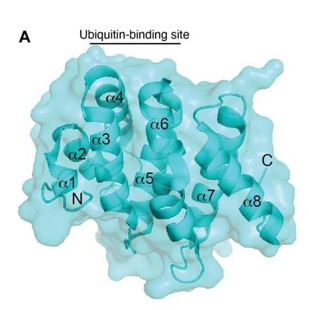 Fig. 1 Surface and ribbon representations of the TOM1 VHS.1
Key structural properties of TOM1:
- Folding configuration composed of multiple domains (including VHS, GAT and other domains)
- Hydrophobic core regions maintain structural stability and mediate protein interactions
- Leucine zipper motif regulates dimerization and membrane binding function together with specific tyrosine residues
Functions of TOM1
The main function of the protein encoded by the TOM1 gene is to participate in intracellular vesicle transport and protein sorting, and it also plays a role in cell signal transduction and immune regulation.
| Function | Description |
| Vesicle Transport Regulation | It recognizes ubiquitinated membrane proteins through its VHS domain and mediates the targeted transport of cargo molecules from endosomes to lysosomes. |
| Participation in Autophagy Process | As an autophagy-related protein, it assists in the extension and maturation of the autophagosome membrane, playing a crucial role in the autophagy process of cells. |
| Immune Signal Regulation | By negatively regulating inflammatory signaling pathways such as TLR/IL-1R, it affects the activation of NF-κB, thereby participating in the balance of innate immune responses. |
| Receptor Degradation Maintenance | It mediates the endocytosis and lysosomal degradation of specific receptors (such as growth factor receptors), maintaining the stability of cell surface receptors. |
| Virus Defense Mechanism | Some studies have shown that the TOM1 protein can recognize and respond to viral infections, and is involved in intracellular antiviral signal transduction. |
Unlike the one-way, high-affinity oxyhemoglobin, the function of the TOM1 protein is manifested as a **dynamic regulatory mode** involving the coordinated action of multiple domains - the VHS domain is responsible for substrate recognition, while the GAT domain recruits downstream effector proteins. This modular division of labor enables it to precisely respond to various intracellular signals and coordinate the complex membrane transport network.
Applications of TOM1 and TOM1 Antibody in Literature
1. Roach, Tiffany G., et al. "Protein trafficking or cell signaling: A dilemma for the adaptor protein TOM1." Frontiers in Cell and Developmental Biology 9 (2021): 643769. https://doi.org/10.3389/fcell.2021.643769
The article indicates that TOM1 is an ESCRT protein that initiates endosome sorting by recognizing ubiquitination signals, and collaborates with various proteins to regulate processes such as autophagy and immunity. Its dysfunction is associated with infection and cancer progression.
2. Lång, Heljä KM, et al. "A TOM1 variant impairs interaction with TOLLIP, autophagosome-lysosome fusion and regulation of innate immunity." Disease Models & Mechanisms 18.9 (2025): dmm052140. https://doi.org/10.1242/dmm.052140
The article indicates that the G307D variation in the TOM1 gene impairs its interaction with TOLLIP, affecting endosome transport and the fusion of autophagosomes and lysosomes, resulting in blocked autophagy and excessive activation of the inflammatory pathway, leading to early-onset severe autoimmunity and combined immunodeficiency.
3. Keskitalo, Salla, et al. "Dominant TOM1 mutation associated with combined immunodeficiency and autoimmune disease." NPJ Genomic Medicine 4.1 (2019): 14. https://doi.org/10.1038/s41525-019-0088-5
The first report indicates that the heterozygous mutation G307D of the TOM1 gene is associated with early-onset autoimmune diseases. This variation disrupts the interaction between TOM1 and TOLLIP, impairs autophagy, enhances cell apoptosis, and weakens the immune signaling pathway, resulting in antibody deficiency and a combined immunodeficiency phenotype.
4. Hu, Shichen, et al. "Structure of Myosin VI/Tom1 complex reveals a cargo recognition mode of Myosin VI for tethering." Nature communications 10.1 (2019): 3459. https://doi.org/10.1038/s41467-019-11481-6
The article reports that the C-terminal domain of myosin VI binds to TOM1 in a unique manner and simultaneously bridges the autophagy receptor, revealing a new mechanism of it functioning as an adaptor protein in the maturation of autophagosomes, and clarifying the structural basis of protein interactions.
5. Ramšak, Barbara, and Ulrich Kück. "The Penicillium chrysogenum tom1 gene a major target of transcription factor MAT1-1-1 encodes a nuclear protein involved in sporulation." Frontiers in Fungal Biology 3 (2022): 937023. https://doi.org/10.3389/ffunb.2022.937023
The article reports that in the producing Penicillium purpurogenum, TOM1 is a direct target gene of the sexual development regulatory factor MAT1-1-1. Its nuclear localization protein is involved in the regulation of sexual reproduction. The absence of TOM1 leads to a defect in spore formation, and this phenotype is particularly prominent at 31°C.
Creative Biolabs: TOM1 Antibodies for Research
Creative Biolabs specializes in the production of high-quality TOM1 antibodies for research and industrial applications. Our portfolio includes monoclonal antibodies tailored for ELISA, Flow Cytometry, Western blot, immunohistochemistry, and other diagnostic methodologies.
- Custom TOM1 Antibody Development: Tailor-made solutions to meet specific research requirements.
- Bulk Production: Large-scale antibody manufacturing for industry partners.
- Technical Support: Expert consultation for protocol optimization and troubleshooting.
- Aliquoting Services: Conveniently sized aliquots for long-term storage and consistent experimental outcomes.
For more details on our TOM1 antibodies, custom preparations, or technical support, contact us at email.
Reference
- Roach, Tiffany G., et al. "Protein trafficking or cell signaling: A dilemma for the adaptor protein TOM1." Frontiers in Cell and Developmental Biology 9 (2021): 643769. Distributed under the same Creative Commons license CC BY 4.0 as the original. Cropped from the original figure.https://doi.org/10.3389/fcell.2021.643769
Anti-TOM1 antibodies
 Loading...
 Compare




Hot products 
- AActivation
- AGAgonist
- APApoptosis
- BBlocking
- BABioassay
- BIBioimaging
- CImmunohistochemistry-Frozen Sections
- CIChromatin Immunoprecipitation
- CTCytotoxicity
- CSCostimulation
- DDepletion
- DBDot Blot
- EELISA
- ECELISA(Cap)
- EDELISA(Det)
- ESELISpot
- EMElectron Microscopy
- FFlow Cytometry
- FNFunction Assay
- GSGel Supershift
- IInhibition
- IAEnzyme Immunoassay
- ICImmunocytochemistry
- IDImmunodiffusion
- IEImmunoelectrophoresis
- IFImmunofluorescence
- IGImmunochromatography
- IHImmunohistochemistry
- IMImmunomicroscopy
- IOImmunoassay
- IPImmunoprecipitation
- ISIntracellular Staining for Flow Cytometry
- LALuminex Assay
- LFLateral Flow Immunoassay
- MMicroarray
- MCMass Cytometry/CyTOF
- MDMeDIP
- MSElectrophoretic Mobility Shift Assay
- NNeutralization
- PImmunohistologyp-Paraffin Sections
- PAPeptide Array
- PEPeptide ELISA
- PLProximity Ligation Assay
- RRadioimmunoassay
- SStimulation
- SESandwich ELISA
- SHIn situ hybridization
- TCTissue Culture
- WBWestern Blot
