
TRPV4 Antibodies
Background
TRPV4 is a calcium ion permeable non-selective cation channel protein, mainly expressed in tissues such as the kidneys, vascular endothelium, sensory neurons and skin. This protein can be activated by physical and chemical factors such as mechanical stress of cells, thermal stimulation and low osmotic pressure, and participates in physiological processes such as maintaining osmotic pressure balance, temperature perception and pain signal transmission in the body. It was independently discovered by three research teams in 2000. Its three-dimensional structure was analyzed by cryo-electron microscopy in 2017, revealing a unique tetramer conformation and gating mechanism. As a member of the TRP channel family, the research on the structure and function of TRPV4 has greatly advanced our understanding of cellular signal transduction mechanisms, and its mutations have been confirmed to be associated with various hereditary neuropathy and bone development disorders.
Structure of TRPV4
TRPV4 is a non-selective cationic channel protein with a molecular weight of approximately 87 kDa, and its molecular weight varies slightly among different mammalian species.
| Species | Human | Mouse | Rat | Bovine |
| Molecular Weight (kDa) | 87.2 | 86.9 | 87.1 | 87.3 |
| Primary Structural Differences | It contains an N-terminal ankyrin repeat domain and a C-terminal intracellular domain | The transmembrane region sequence is highly conserved | There are individual amino acid substitutions in the intracellular region | The homology with human TRPV4 is extremely high |
This protein is composed of 871 amino acid residues, forming a typical tetramer structure. Its primary structure consists of six transmembrane helices (S1-S6), among which the pore ring region between S5 and S6 constitutes the key path for ion permeability. The tertiary structure of proteins presents a unique "cantilever" conformation. The N-terminal anchin repeat domain, as an important regulatory module, can sense intracellular signal molecules and osmotic pressure changes. The conserved TRP domain acts as a molecular allosteric switch, regulating the open state of the channel through conformational changes.
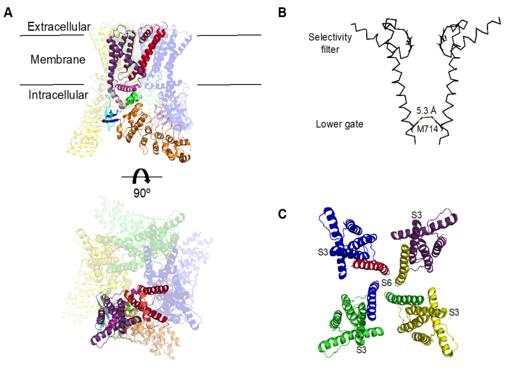 Fig. 1 Structure of the TRPV4 channel.1
Key structural properties of TRPV4:
- Unique tetramer assembly configuration
- The intracellular N-terminal ankyrin repeat domain is responsible for protein interactions
- Conservative selective filter decided to cationic permeability channel area
- The C-terminal TRP domain serves as an allosteric control switch
Functions of TRPV4
The core function of the TRPV4 channel is to act as a mechanical-thermal-osmotic pressure sensor and simultaneously participate in the regulation of multiple pathophysiological processes.
| Function | Description |
| Osmotic pressure sensing | Sensing hypotonic stimulation through extracellular domains triggers calcium influx to regulate cell volume. |
| Mechanical transduction | The perception of shear stress in endothelial cells depends on the conformational changes of the repeating domain of the N-terminal anchor protein. |
| Temperature perception | In 34 to 39 ℃ range is activated, mediated temperature signal transduction. |
| Pain regulation | Mediating inflammatory pain sensitization in sensory neurons is positively correlated with neuropathic pain. |
| Bone development | Bone growth plate differentiation is affected by regulating chondrocyte calcium signal. |
The current-voltage relationship of this channel exhibits typical outward rectification characteristics. Its calcium ion to sodium ion permeability ratio (PCa/PNa≈6) is significantly higher than that of conventional voltage-gated calcium channels. This unique ion selectivity enables it to have dual functions of signal transduction and electrophysiological regulation when regulating intracellular calcium homeostasis.
Applications of TRPV4 and TRPV4 Antibody in Literature
1. Michalick, Laura, and Wolfgang M. Kuebler. "TRPV4—a missing link between mechanosensation and immunity." Frontiers in immunology 11 (2020): 413. https://doi.org/10.3389/fimmu.2020.00413
The article indicates that TRPV4 is a mechanically sensitive cation channel that is widely expressed in innate immune cells (such as neutrophils and macrophages). It can be activated by mechanical force or pathogens, participating in the regulation of cell migration, reactive oxygen species production and phagocytosis, and playing a key role in inflammatory responses and tissue damage.
2. Kwon, Do Hoon, et al. "TRPV4-Rho GTPase complex structures reveal mechanisms of gating and disease." Nature communications 14.1 (2023): 3732. https://doi.org/10.1038/s41467-023-39345-0
The article indicates that TRPV4 is a calcium ion channel, and its abnormal function can lead to hereditary neuromuscular diseases. Studies have found that RhoA GTPase can act as an auxiliary subunit of TRPV4 and inhibit its channel activity through direct binding. Mutations at the interface between the two can disrupt this interaction, thereby enhancing TRPV4 activity and causing diseases. This mechanism provides new targets for the research and development of related drugs.
3. Orfali, Razan, et al. "TRPV4 Channel Modulators as Potential Drug Candidates for Cystic Fibrosis." International Journal of Molecular Sciences 25.19 (2024): 10551. https://doi.org/10.3390/ijms251910551
The article indicates that the TRPV4 channel plays a significant role in the pathogenesis of cystic fibrosis (CF). Its activation can regulate airway surface fluid, affect CFTR activity, and participate in cell volume regulation and inflammatory responses. Therefore, TRPV4 is regarded as a potential therapeutic target for CF, and regulating it may improve the severe respiratory complications of CF patients.
4. Shibasaki, Koji. "TRPV4 activation by core body temperature has multimodal functions in the central nervous system." The Journal of Physiological Sciences 74.1 (2024): 55. https://doi.org/10.1186/s12576-024-00948-x
The article indicates that TRPV4 is a temperature receptor in the brain, capable of converting temperature information into electrical signals to regulate neuronal discharge. Its functional abnormalities are associated with diseases such as epilepsy and depression. TRPV4 plays a crucial role in nerve cells, glial cells and blood vessels. TRPV4 dysfunction caused by high fever may exacerbate brain diseases.
5. Rosenbaum, Tamara, et al. "TRPV4: a physio and pathophysiologically significant ion channel." International journal of molecular sciences 21.11 (2020): 3837. https://doi.org/10.3390/ijms21113837
The article indicates that TRPV4 is a member of the TRP channel family and participates in various physiological processes as a non-selective cation channel. It regulates intracellular calcium balance by sensing osmotic pressure, mechanical force and other stimuli, and is crucial for maintaining vascular tension, bone homeostasis and lung and kidney functions. Abnormal TRPV4 function is associated with a variety of congenital diseases and is an important therapeutic target.
Creative Biolabs: TRPV4 Antibodies for Research
Creative Biolabs specializes in the production of high-quality TRPV4 antibodies for research and industrial applications. Our portfolio includes monoclonal antibodies tailored for ELISA, Flow Cytometry, Western blot, immunohistochemistry, and other diagnostic methodologies.
- Custom TRPV4 Antibody Development: Tailor-made solutions to meet specific research requirements.
- Bulk Production: Large-scale antibody manufacturing for industry partners.
- Technical Support: Expert consultation for protocol optimization and troubleshooting.
- Aliquoting Services: Conveniently sized aliquots for long-term storage and consistent experimental outcomes.
For more details on our TRPV4 antibodies, custom preparations, or technical support, contact us at email.
Reference
- Rosenbaum, Tamara, et al. "TRPV4: a physio and pathophysiologically significant ion channel." International journal of molecular sciences 21.11 (2020): 3837. https://doi.org/10.3390/ijms21113837
Anti-TRPV4 antibodies
 Loading...
 Compare




Hot products 
- AActivation
- AGAgonist
- APApoptosis
- BBlocking
- BABioassay
- BIBioimaging
- CImmunohistochemistry-Frozen Sections
- CIChromatin Immunoprecipitation
- CTCytotoxicity
- CSCostimulation
- DDepletion
- DBDot Blot
- EELISA
- ECELISA(Cap)
- EDELISA(Det)
- ESELISpot
- EMElectron Microscopy
- FFlow Cytometry
- FNFunction Assay
- GSGel Supershift
- IInhibition
- IAEnzyme Immunoassay
- ICImmunocytochemistry
- IDImmunodiffusion
- IEImmunoelectrophoresis
- IFImmunofluorescence
- IGImmunochromatography
- IHImmunohistochemistry
- IMImmunomicroscopy
- IOImmunoassay
- IPImmunoprecipitation
- ISIntracellular Staining for Flow Cytometry
- LALuminex Assay
- LFLateral Flow Immunoassay
- MMicroarray
- MCMass Cytometry/CyTOF
- MDMeDIP
- MSElectrophoretic Mobility Shift Assay
- NNeutralization
- PImmunohistologyp-Paraffin Sections
- PAPeptide Array
- PEPeptide ELISA
- PLProximity Ligation Assay
- RRadioimmunoassay
- SStimulation
- SESandwich ELISA
- SHIn situ hybridization
- TCTissue Culture
- WBWestern Blot
