
WWOX Antibodies
Background
The WWOX gene is a tumor suppressor gene located in the region of human chromosome 16q23.3-24.1. The protein encoded by this gene contains two WW domains and a short-chain dehydrogenase/reductase domain. This gene was initially discovered and named by the Croce research team in 2000 when they were studying the chromosomal abnormality regions related to breast cancer. It was named for its WW domains. The WWOX protein plays an important role in maintaining the normal physiological functions of cells by participating in various signaling pathways such as apoptosis, cell cycle regulation, and DNA damage response. The inactivation or down-regulation of this gene is closely related to the occurrence and development of various malignant tumors, including breast cancer, prostate cancer, lung cancer, etc. Its protein product can interact with various signaling molecules such as p53 and JNK, regulating cell fate determination. The knockout mouse model of the WWOX gene shows an increased spontaneous tumor incidence, further confirming its tumor suppressor function.
Structure of WWOX
The protein encoded by the WWOX gene has a molecular weight of approximately 47 kDa. Its size varies slightly among different species due to differences in amino acid sequences. This protein contains two conserved WW domains and a central short-chain dehydrogenase/reductase domain.
| Species | Human | Mouse | Rat | Zebrafish |
| Molecular Weight (kDa) | 47 | 46 | 46 | 48 |
| Primary Structural Differences | WW domain is highly conserved | Homology with humans is approximately 95% | C-terminal region has variations | Additionally, there is an extra repetitive sequence domain |
The protein encoded by the WWOX gene consists of 414 amino acids. Its three-dimensional structure is mainly composed of two characteristic WW domains and a central short-chain dehydrogenase/reductase domain. This protein is typically located in the Golgi apparatus within the cell, and its function depends on the cooperative interaction between these domains. The WW domains mediate the interaction between the protein and substrates, participating in signal transduction by recognizing proline-rich motifs; while the central dehydrogenase/reductase domain forms an oxidation-reduction reaction center, binding to NAD+ cofactor to participate in cellular metabolic regulation. The flexible connection region between these two domains enables the protein to adopt different conformations, thus adapting to the needs of substrate binding and catalytic reactions.
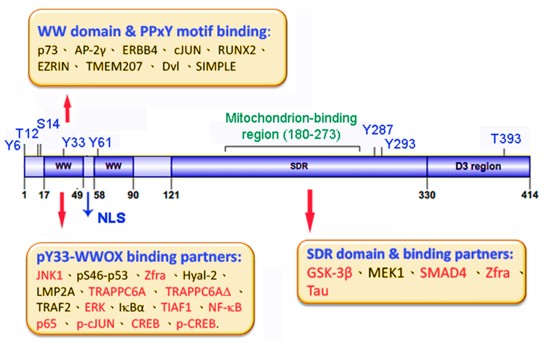 Fig. 1 WWOX binds proteins via its N-terminal WW and C-terminal SDR domains.1
Key structural properties of WWOX:
- Two consecutive WW domains
- A central short-chain dehydrogenase/reductase domain
- A nuclear localization signal sequence
- A proline-rich region, involved in signal transduction regulation
Functions of WWOX
The main function of the WWOX gene is to act as a tumor suppressor to regulate cell growth and apoptosis. However, it is also involved in various cellular processes, including DNA damage response and metabolic regulation.
| Function | Description |
| Tumor suppression | By regulating the cell cycle and promoting apoptosis, it inhibits the proliferation and transformation of tumor cells. |
| DNA damage response | Participates in the DNA damage repair pathway and plays a role in maintaining genomic stability. |
| Apoptosis regulation | Interacts with signaling molecules such as p53 and JNK, mediating cell death under stress conditions. |
| Metabolic regulation | Participates in the cell energy metabolism process through its dehydrogenase/reductase domain. |
| Transcription regulation | Interacts with transcription factors, indirectly influencing the expression of downstream genes. |
The expression regulatory network of the WWOX gene exhibits complex feedback regulation characteristics, which are different from the linear regulatory patterns of other tumor suppressor genes. Its down-regulation in various tumor tissues is often associated with promoter methylation, while the wild-type p53 can positively regulate its transcription, forming a synergistic tumor suppressor regulatory loop.
Applications of WWOX and WWOX Antibody in Literature
1. Hsu, Che-Yu, et al. "WWOX and its binding proteins in neurodegeneration." Cells 10.7 (2021): 1781. https://doi.org/10.3390/cells10071781
The article indicates that WWOX binds to Tau protein and phosphatase through its C-terminal SDR domain, thereby inhibiting the accumulation of Aβ plaques and tau tangles in elderly AD patients. Enhancing the interaction between WWOX and binding proteins can inhibit inflammation and protein aggregation, and delay the progression of Alzheimer's disease.
2. Baryła, Izabela, Katarzyna Kośla, and Andrzej K. Bednarek. "WWOX and metabolic regulation in normal and pathological conditions." Journal of Molecular Medicine 100.12 (2022): 1691-1702. https://doi.org/10.1007/s00109-022-02265-5
The article indicates that WWOX is located at the fragile site FRA16D, and its absence is associated with poor prognosis in various cancers. It regulates sugar, cholesterol and bone metabolism by binding to transcription factors, and when abnormal, it can cause metabolic syndrome and diabetes. WWOX plays a crucial role in the Warburg effect of cancer and the occurrence of diabetes.
3. Aldaz, C. Marcelo, and Tabish Hussain. "WWOX loss of function in neurodevelopmental and neurodegenerative disorders." International journal of molecular sciences 21.23 (2020): 8922. https://doi.org/10.3390/ijms21238922
The article indicates that mutations in the WWOX gene can cause spinal-cerebellar ataxia, infantile epilepsy and autism, and it is also a risk gene for Alzheimer's disease and multiple sclerosis. This gene is highly expressed in the amygdala, entorhinal cortex and cerebellum, and its functional deficiency is closely related to various neurodegenerative diseases.
4. Liu, Tsung-Yun, et al. "WWOX controls cell survival, immune response and disease progression by pY33 to pS14 transition to alternate signaling partners." Cells 11.14 (2022): 2137. https://doi.org/10.3390/cells11142137
The article indicates that WWOX promotes apoptosis and acts as an anti-cancer agent through pY33, while pS14 promotes the accumulation of lesions. The short peptide Zfra can inhibit the formation of pS14, enhance the interaction between WWOX and binding proteins, thereby degrading Aβ42, inhibiting NF-κB inflammation, slowing down the progression of Alzheimer's disease and suppressing cancer.
5. Pospiech, Karolina, Elzbieta Płuciennik, and Andrzej K. Bednarek. "WWOX tumor suppressor gene in breast cancer, a historical perspective and future directions." Frontiers in oncology 8 (2018): 345. https://doi.org/10.3389/fonc.2018.00345
The article indicates that WWOX is located at the fragile site FRA16D and is often absent in breast cancer. It regulates hormone signaling through the SDR domain and interacts with p73, HIF1α, etc., affecting transcription, DNA repair and sugar metabolism. Low expression is associated with poor prognosis and a high recurrence rate.
Creative Biolabs: WWOX Antibodies for Research
Creative Biolabs specializes in the production of high-quality WWOX antibodies for research and industrial applications. Our portfolio includes monoclonal and polyclonal antibodies tailored for ELISA, Flow Cytometry, Western blot, immunohistochemistry, and other diagnostic methodologies.
- Custom WWOX Antibody Development: Tailor-made solutions to meet specific research requirements.
- Bulk Production: Large-scale antibody manufacturing for industry partners.
- Technical Support: Expert consultation for protocol optimization and troubleshooting.
- Aliquoting Services: Conveniently sized aliquots for long-term storage and consistent experimental outcomes.
For more details on our WWOX antibodies, custom preparations, or technical support, contact us at email.
Reference
- Hsu, Che-Yu, et al. "WWOX and its binding proteins in neurodegeneration." Cells 10.7 (2021): 1781. Distributed under Open Access license CC BY 4.0, without modification. https://doi.org/10.3390/cells10071781
Anti-WWOX antibodies
 Loading...
 Compare



Hot products 
-
Mouse Anti-GST Recombinant Antibody (CBLG1-1938) (CBMAB-G5371-LY)

-
Mouse Anti-EMP3 Recombinant Antibody (CBFYE-0100) (CBMAB-E0207-FY)

-
Mouse Anti-AQP2 Recombinant Antibody (E-2) (CBMAB-A3358-YC)

-
Mouse Anti-ASH1L Monoclonal Antibody (ASH5H03) (CBMAB-1372-YC)

-
Mouse Anti-ADAM29 Recombinant Antibody (V2-179787) (CBMAB-A1149-YC)

-
Mouse Anti-CCS Recombinant Antibody (CBFYC-1093) (CBMAB-C1150-FY)

-
Mouse Anti-BRCA2 Recombinant Antibody (CBYY-1728) (CBMAB-2077-YY)

-
Human Anti-SARS-CoV-2 Spike Recombinant Antibody (CR3022) (CBMAB-CR014LY)

-
Mouse Anti-COL1A2 Recombinant Antibody (CF108) (V2LY-1206-LY626)

-
Mouse Anti-ARSA Recombinant Antibody (CBYC-A799) (CBMAB-A3679-YC)

-
Rabbit Anti-B2M Recombinant Antibody (CBYY-0059) (CBMAB-0059-YY)

-
Mouse Anti-ACE2 Recombinant Antibody (V2-179293) (CBMAB-A0566-YC)

-
Mouse Anti-BLNK Recombinant Antibody (CBYY-0623) (CBMAB-0626-YY)

-
Mouse Anti-BRD3 Recombinant Antibody (CBYY-0801) (CBMAB-0804-YY)

-
Mouse Anti-BANF1 Recombinant Antibody (3F10-4G12) (CBMAB-A0707-LY)

-
Rat Anti-EMCN Recombinant Antibody (28) (CBMAB-E0280-FY)

-
Mouse Anti-CD83 Recombinant Antibody (HB15) (CBMAB-C1765-CQ)

-
Mouse Anti-FeLV g27 Recombinant Antibody (1) (CBMAB-V208-1714-FY)

-
Mouse Anti-8-oxoguanine Recombinant Antibody (V2-7697) (CBMAB-1869CQ)

-
Mouse Anti-ELAVL4 Recombinant Antibody (6B9) (CBMAB-1132-YC)

- AActivation
- AGAgonist
- APApoptosis
- BBlocking
- BABioassay
- BIBioimaging
- CImmunohistochemistry-Frozen Sections
- CIChromatin Immunoprecipitation
- CTCytotoxicity
- CSCostimulation
- DDepletion
- DBDot Blot
- EELISA
- ECELISA(Cap)
- EDELISA(Det)
- ESELISpot
- EMElectron Microscopy
- FFlow Cytometry
- FNFunction Assay
- GSGel Supershift
- IInhibition
- IAEnzyme Immunoassay
- ICImmunocytochemistry
- IDImmunodiffusion
- IEImmunoelectrophoresis
- IFImmunofluorescence
- IGImmunochromatography
- IHImmunohistochemistry
- IMImmunomicroscopy
- IOImmunoassay
- IPImmunoprecipitation
- ISIntracellular Staining for Flow Cytometry
- LALuminex Assay
- LFLateral Flow Immunoassay
- MMicroarray
- MCMass Cytometry/CyTOF
- MDMeDIP
- MSElectrophoretic Mobility Shift Assay
- NNeutralization
- PImmunohistologyp-Paraffin Sections
- PAPeptide Array
- PEPeptide ELISA
- PLProximity Ligation Assay
- RRadioimmunoassay
- SStimulation
- SESandwich ELISA
- SHIn situ hybridization
- TCTissue Culture
- WBWestern Blot
