
CD101 Antibodies
Background
The CD101 gene encodes a type I transmembrane glycoprotein expressed on the surface of immune cells, which is mainly distributed in myeloid cells and lymphocyte subsets. As a member of the immunoglobulin superfamily, this protein regulates the activation threshold of immune responses by participating in intercellular recognition and signal transduction, especially playing a key role in the inhibition of T cell proliferation and the regulation of dendritic cell maturation. Its gene is located in the 1q24.2 region of the human chromosome. Studies have shown that genetic variations of this gene are associated with susceptibility to autoimmune diseases. For instance, specific changes in the expression level of CD101 can be observed in patients with rheumatoid arthritis and inflammatory bowel disease. In recent years, the three-dimensional conformation of its extracellular domain has been analyzed by cryo-electron microscopy technology, revealing the allosteric regulation mechanism of this molecule in the regulation of immune checkpoints, providing a structural biological basis for the development of new immunotherapies.
Structure of CD101
CD101 is a type I transmembrane glycoprotein with a molecular weight of approximately 120 kDa. This value will show certain fluctuations in different cell types due to the differences in the degree of glycosylation modification.
| Species | Human | Mouse | Rat |
| Molecular Weight (kDa) | 120 | 118 | 119 |
| Primary Structural Differences | Contains nine extracellular Ig-like domains | Has 85% homology with human CD101 | Extracellular region structure and highly conserved in mice |
This protein is composed of 949 amino acid residues, and its extracellular region contains 9 immunoglobulin-like domains, forming an extended fibrous structure. The intracellular domain of CD101 contains the immune receptor tyrosine inhibitory motif, which can transduct inhibitory signals after ligand binding. The 7th Ig-like domain near the cell membrane is responsible for specific binding to ligands, while multiple domains at the N-terminal regulate the receptor dimerization process through steric hindrance effects.
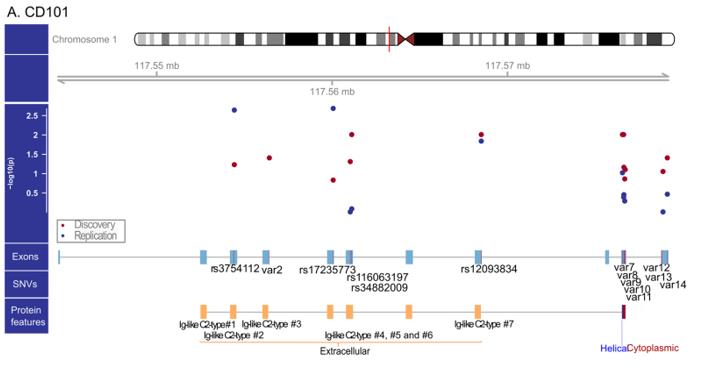 Fig. 1 Genomic structure of CD101.1
Key structural properties of CD101:
- Extracellular section contains nine immunoglobulin domain sample structure
- The transmembrane region anchors the cell membrane by hydrophobic amino acids
- Intracellular domain with immunoreceptor tyrosine inhibitory motif (ITIM)
Functions of CD101
The main functions of the protein encoded by the CD101 gene are immune regulation and signal transduction. Its specific functions are as follows:
| Function | Description |
| Immunosuppressive regulation | Intracellular ITIM domain transduces inhibitory signals to negatively regulate the proliferation and activation of T cells. |
| Inflammatory response balance | Highly expressed in dendritic cells, it limits excessive inflammatory responses and maintains immune homeostasis. |
| Cell adhesion participation | Extracellular immunoglobulin-like domains mediate the interaction between immune cells and affect cell localization and migration. |
| Autoimmune protection | Gene knockout experiments show that deletion can lead to a significant increase in susceptibility to autoimmune diseases. |
| Tolerance induction and promotion | In regulatory T cells play a role in supporting immune tolerance to establish and maintain. |
After binding to the ligand, this protein triggers phosphorylation of the ITIM domain, which in turn recruits SHP-1/2 phosphatase, forming a cascade inhibitory signal. Its mechanism of action is similar to that of an immune checkpoint, but it mainly functions during the innate immune stage.
Applications of CD101 and CD101 Antibody in Literature
1. Mackelprang, Romel D., et al. "Whole genome sequencing of extreme phenotypes identifies variants in CD101 and UBE2V1 associated with increased risk of sexually acquired HIV-1." PLoS Pathogens 13.11 (2017): e1006703. https://doi.org/10.1371/journal.ppat.1006703
This study found through whole-genome sequencing that rare variations in the CD101 and UBE2V1 genes increase the risk of HIV-1 infection through inflammatory pathways, and the risk rises with the level of viral exposure. This provides a new target for AIDS prevention.
2. Liu, Yuyang, et al. "Identification of CD101 in glioma: A novel prognostic indicator expressed on M2 macrophages." Frontiers in Immunology 13 (2022): 845223. https://doi.org/10.3389/fimmu.2022.845223
Research reveals that high expression of CD101 in glioma predicts a poor prognosis. It mainly exists on tumor-associated macrophages and is closely related to the immunosuppressive microenvironment, and can serve as a potential prognostic biomarker and a new target for immunotherapy.
3. Strongin, Zachary, et al. "The role of CD101-expressing CD4 T cells in HIV/SIV pathogenesis and persistence." PLoS Pathogens 18.7 (2022): e1010723. https://doi.org/10.1371/journal.ppat.1010723
Research has found that CD101 is a key marker of regulatory T cells. In HIV/SIV infection, these cells are preferentially depleted, leading to an increase in viral load and inflammation. After long-term treatment, the remaining CD101+ cells may become viral reservoirs and potential therapeutic targets.
4. Zhao, Yanan, et al. "CD101: a novel long‐acting echinocandin." Cellular microbiology 18.9 (2016): 1308-1316. https://doi.org/10.1111/cmi.12640
Research has found that CD101 is a new type of acanthocyanin antifungal drug. Studies have shown that it is effective against both sensitive and drug-resistant Candida, and has excellent therapeutic effects and a long half-life in animal models. It is expected to be used for the treatment and prevention of drug resistance.
5. Chetty, Alisha, et al. "Induction of Siglec-FhiCD101hi eosinophils in the lungs following murine hookworm Nippostrongylus brasiliensis infection." Frontiers in immunology 14 (2023): 1170807. https://doi.org/10.3389/fimmu.2023.1170807
Research has found that hookworm infection in rodents induces the production of a long-standing Siglec-FhiCD101hi eosinophilic subpopulation in the lungs. The activation of this cell morphology may be related to the recruitment of type 2 innate lymphocytes and the long-term immunopathology after infection.
Creative Biolabs: CD101 Antibodies for Research
Creative Biolabs specializes in the production of high-quality CD101 antibodies for research and industrial applications. Our portfolio includes monoclonal antibodies tailored for ELISA, Flow Cytometry, Western blot, immunohistochemistry, and other diagnostic methodologies.
- Custom CD101 Antibody Development: Tailor-made solutions to meet specific research requirements.
- Bulk Production: Large-scale antibody manufacturing for industry partners.
- Technical Support: Expert consultation for protocol optimization and troubleshooting.
- Aliquoting Services: Conveniently sized aliquots for long-term storage and consistent experimental outcomes.
For more details on our CD101 antibodies, custom preparations, or technical support, contact us at email.
Reference
- Mackelprang, Romel D., et al. "Whole genome sequencing of extreme phenotypes identifies variants in CD101 and UBE2V1 associated with increased risk of sexually acquired HIV-1." PLoS Pathogens 13.11 (2017): e1006703. https://doi.org/10.1371/journal.ppat.1006703
Anti-CD101 antibodies
 Loading...
 Compare




Hot products 
-
Mouse Anti-CRYAB Recombinant Antibody (A4345) (CBMAB-A4345-YC)

-
Mouse Anti-CCDC6 Recombinant Antibody (CBXC-0106) (CBMAB-C5397-CQ)

-
Mouse Anti-CARD11 Recombinant Antibody (CBFYC-0811) (CBMAB-C0866-FY)

-
Mouse Anti-GNA12 Recombinant Antibody (CBFYH-0402) (CBMAB-H1272-FY)

-
Mouse Anti-AMACR Recombinant Antibody (CB34A) (CBMAB-CA034LY)

-
Mouse Anti-ARIH1 Recombinant Antibody (C-7) (CBMAB-A3563-YC)

-
Mouse Anti-ASH1L Monoclonal Antibody (ASH5H03) (CBMAB-1372-YC)

-
Mouse Anti-COL1A2 Recombinant Antibody (CF108) (V2LY-1206-LY626)

-
Mouse Anti-C4B Recombinant Antibody (CBYY-C2996) (CBMAB-C4439-YY)

-
Mouse Anti-CTCF Recombinant Antibody (CBFYC-2371) (CBMAB-C2443-FY)

-
Mouse Anti-ATP1B3 Recombinant Antibody (1E9) (CBMAB-A4021-YC)

-
Mouse Anti-CSPG4 Recombinant Antibody (CBFYM-1050) (CBMAB-M1203-FY)

-
Mouse Anti-GPRC5C Recombinant Antibody (CBFYH-0464) (CBMAB-H0521-FY)

-
Mouse Anti-BSN Recombinant Antibody (219E1) (CBMAB-1228-CN)

-
Mouse Anti-ACKR3 Recombinant Antibody (V2-261265) (CBMAB-C1023-LY)

-
Rabbit Anti-ABL1 (Phosphorylated Y185) Recombinant Antibody (V2-443434) (PTM-CBMAB-0001YC)

-
Mouse Anti-BIRC3 Recombinant Antibody (16E63) (CBMAB-C3367-LY)

-
Mouse Anti-EIF4G1 Recombinant Antibody (2A9) (CBMAB-A2544-LY)

-
Mouse Anti-BCL6 Recombinant Antibody (CBYY-0435) (CBMAB-0437-YY)

-
Mouse Anti-BACE1 Recombinant Antibody (61-3E7) (CBMAB-1183-CN)

- AActivation
- AGAgonist
- APApoptosis
- BBlocking
- BABioassay
- BIBioimaging
- CImmunohistochemistry-Frozen Sections
- CIChromatin Immunoprecipitation
- CTCytotoxicity
- CSCostimulation
- DDepletion
- DBDot Blot
- EELISA
- ECELISA(Cap)
- EDELISA(Det)
- ESELISpot
- EMElectron Microscopy
- FFlow Cytometry
- FNFunction Assay
- GSGel Supershift
- IInhibition
- IAEnzyme Immunoassay
- ICImmunocytochemistry
- IDImmunodiffusion
- IEImmunoelectrophoresis
- IFImmunofluorescence
- IGImmunochromatography
- IHImmunohistochemistry
- IMImmunomicroscopy
- IOImmunoassay
- IPImmunoprecipitation
- ISIntracellular Staining for Flow Cytometry
- LALuminex Assay
- LFLateral Flow Immunoassay
- MMicroarray
- MCMass Cytometry/CyTOF
- MDMeDIP
- MSElectrophoretic Mobility Shift Assay
- NNeutralization
- PImmunohistologyp-Paraffin Sections
- PAPeptide Array
- PEPeptide ELISA
- PLProximity Ligation Assay
- RRadioimmunoassay
- SStimulation
- SESandwich ELISA
- SHIn situ hybridization
- TCTissue Culture
- WBWestern Blot
