
CPB1 Antibodies
Background
The CPB1 gene encodes carboxypeptidase B1, a digestive enzyme that is mainly synthesized in the exocrine pancreas and secreted into the duodenum. This enzyme participates in the protein metabolism process in the intestine by specifically hydrolyzing the basic amino acid residues (such as arginine and lysine) at the C-terminal of proteins, and plays a key role in the final digestion and nutrient absorption of dietary proteins. Clinical studies have shown that abnormal expression of CPB1 is associated with diseases such as pancreatitis, and its activity detection has been incorporated into the assessment system of pancreatic exocrine function. As a member of the serine carboxypeptidase family, the crystal structure analysis of CPB1 reveals its typical α/β hydrolase folding conformation and catalytic trivalent characteristics, providing a structural biology basis for the development of molecular diagnostic tools for digestive system diseases.
Structure of CPB1
CPB1 is a carboxypeptidase with a molecular weight of approximately 47 kDa, and its precise molecular weight varies slightly among different species.
| Species | Human | Mouse | Rat | Bovine |
| Molecular Weight (kDa) | 47.2 | 46.8 | 47.1 | 47.3 |
| Primary Structural Differences | 417 amino acids containing signal peptides | The catalytic domain is highly conserved | The substrate binding sites are slightly different | Homology with humans reaches 89% |
This enzyme is composed of 417 amino acids, and its primary structure contains typical signal peptides and catalytic domains. The tertiary structure of CPB1 exhibits the characteristic folding of α/β hydrolases. The active center is composed of a catalytic triad of Ser199, His455 and Glu270, which precisely recognizes the basic amino acid residues at the C-terminal of the substrate through a charge relay network. The substrate specificity of this enzyme is mainly determined by the hydrophobic pocket composed of tyrosine at position 268. This structural feature enables it to efficiently hydrolyze arginine and lysine, while the N-linked glycosylation modification affects its enzyme stability and secretion efficiency.
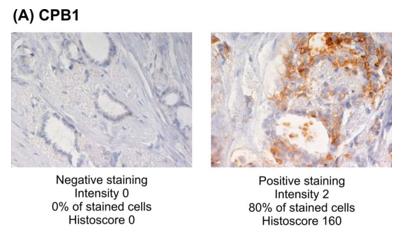 Fig. 1 Representative examples of CPB1 IHC in luminal A grade 1 tumors.1
Key structural properties of CPB1:
- Typical α/β hydrolase folding conformation
- Catalytic triad consisting of Ser199, His455 and Glu270
- Hydrophobic substrate binding pockets that specifically recognize basic amino acids
- Zinc ion-dependent enzyme active centers and stable disulfide bond networks
Functions of CPB1
The main function of CPB1 is to catalyze the hydrolysis of basic amino acids at the C-terminal of proteins. In addition, it is also involved in various physiological and pathological processes, including digestive regulation and disease risk assessment.
| Function | Description |
| Substrate-specific hydrolysis | Specifically cleft the arginine and lysine residues at the C-terminal of proteins to complete the final digestion step of dietary proteins. |
| Exocrine pancreas | Synthesized by pancreatic acinar cells and secreted into the duodenum, it is a key component of pancreatic juice digestive enzyme system. |
| Inflammatory markers | The changes in serum CPB1 levels are correlated with the severity of acute pancreatitis and are clinically used as a diagnostic indicator for pancreatic exocrine function. |
| Metabolic regulation | By regulating the C-terminal basic amino acids of bioactive peptides, it indirectly affects the activity of intestinal hormones and the efficiency of nutrient absorption. |
| Organizational Reshaping | Under pathological conditions, it may participate in tissue repair and fibrosis processes by modifying the extracellular matrix components. |
The catalytic efficiency of CPB1 is strictly regulated by pH. Its activity in the alkaline environment of the duodenum is significantly higher than that in the acidic environment. This characteristic distinguishes it from the continuous substrate cleavage mode of the trypsin family, reflecting the cascade specificity of the enzyme activation process in the digestive system.
Applications of CPB1 and CPB1 Antibody in Literature
1. Szmola, Richárd, et al. "Chymotrypsin C is a co-activator of human pancreatic procarboxypeptidases A1 and A2." Journal of Biological Chemistry 286.3 (2011): 1819-1827.https://doi.org/10.1074/jbc.M110.187369
Research has found that chymosin C can selectively enhance the activity of trypsin-activated carboxypeptidases A1 and A2, but is ineffective against CPB1, revealing its key regulatory role in the activation of digestive proenzymes.
2. Cristiani, Costanza Maria, et al. "Proximity elongation assay and ELISA for the identification of serum diagnostic biomarkers in Parkinson's disease and progressive supranuclear palsy." International Journal of Molecular Sciences 25.21 (2024): 11663. https://doi.org/10.3390/ijms252111663
Research has found that the level of serum CPB1 is related to the severity of Parkinson's disease. Combining multiple proteins can distinguish Parkinson's disease from progressive supranuclear palsy, but the results of different detection methods vary.
3. Yin, Lingdi, et al. "Prevalence of germline sequence variations among patients with pancreatic cancer in China." JAMA network open 5.2 (2022): e2148721-e2148721. https://doi.org/10.1001/jamanetworkopen.2021.48721
Research has revealed a unique genetic map of pancreatic cancer patients in China: gene variations such as BRCA2 and PALB2 increase the risk of disease, while no pathogenic mutations in the pancreatic enzyme gene CPB1 have been detected.
4. Kothari, Charu, et al. "Is carboxypeptidase B1 a prognostic marker for ductal carcinoma in situ?." Cancers 13.7 (2021): 1726. https://doi.org/10.3390/cancers13071726
Studies have confirmed that carboxypeptidase B1 is specifically highly expressed in ductal carcinoma in situ of the breast, which can effectively distinguish benign hyperplasia from carcinoma in situ and predict the risk of its transformation into invasive cancer, providing a new basis for precise clinical diagnosis and treatment.
5. Bouchal, Pavel, et al. "Combined proteomics and transcriptomics identifies carboxypeptidase B1 and nuclear factor κB (NF-κB) associated proteins as putative biomarkers of metastasis in low grade breast cancer." Molecular & Cellular Proteomics 14.7 (2015): 1814-1830. https://doi.org/10.1074/mcp.M114.041335
Research has found that carboxypeptidase B1 is specifically highly expressed in low-grade Luminal A breast cancer and is significantly associated with the risk of early lymph node metastasis, which can be used as a novel biomarker for prognosis assessment of patients with this type.
Creative Biolabs: CPB1 Antibodies for Research
Creative Biolabs specializes in the production of high-quality CPB1 antibodies for research and industrial applications. Our portfolio includes monoclonal antibodies tailored for ELISA, Flow Cytometry, Western blot, immunohistochemistry, and other diagnostic methodologies.
- Custom CPB1 Antibody Development: Tailor-made solutions to meet specific research requirements.
- Bulk Production: Large-scale antibody manufacturing for industry partners.
- Technical Support: Expert consultation for protocol optimization and troubleshooting.
- Aliquoting Services: Conveniently sized aliquots for long-term storage and consistent experimental outcomes.
For more details on our CPB1 antibodies, custom preparations, or technical support, contact us at email.
Reference
- Bouchal, Pavel, et al. "Combined proteomics and transcriptomics identifies carboxypeptidase B1 and nuclear factor κB (NF-κB) associated proteins as putative biomarkers of metastasis in low grade breast cancer." Molecular & Cellular Proteomics 14.7 (2015): 1814-1830. https://doi.org/10.1074/mcp.M114.041335
Anti-CPB1 antibodies
 Loading...
 Compare




Hot products 
-
Mouse Anti-EIF4G1 Recombinant Antibody (2A9) (CBMAB-A2544-LY)

-
Mouse Anti-ALB Recombinant Antibody (V2-180650) (CBMAB-A2186-YC)

-
Mouse Anti-CD33 Recombinant Antibody (6C5/2) (CBMAB-C8126-LY)

-
Mouse Anti-CECR2 Recombinant Antibody (CBWJC-2465) (CBMAB-C3533WJ)

-
Mouse Anti-APOA1 Monoclonal Antibody (CBFYR0637) (CBMAB-R0637-FY)

-
Mouse Anti-CALR Recombinant Antibody (CBFYC-0763) (CBMAB-C0818-FY)

-
Mouse Anti-ABIN2 Recombinant Antibody (V2-179106) (CBMAB-A0349-YC)

-
Mouse Anti-CRTAM Recombinant Antibody (CBFYC-2235) (CBMAB-C2305-FY)

-
Mouse Anti-DDC Recombinant Antibody (8E8) (CBMAB-0992-YC)

-
Mouse Anti-ACTB Recombinant Antibody (V2-179553) (CBMAB-A0870-YC)

-
Armenian hamster Anti-CD40 Recombinant Antibody (HM40-3) (CBMAB-C10365-LY)

-
Mouse Anti-GFP Recombinant Antibody (28) (CBMAB-G3038-LY)

-
Mouse Anti-ASB9 Recombinant Antibody (1D8) (CBMAB-A0529-LY)

-
Rabbit Anti-Acetyl-Histone H4 (Lys16) Recombinant Antibody (V2-623415) (CBMAB-CP1021-LY)

-
Mouse Anti-APC Recombinant Antibody (CBYC-A661) (CBMAB-A3036-YC)

-
Mouse Anti-AP4E1 Recombinant Antibody (32) (CBMAB-A2996-YC)

-
Mouse Anti-BCL6 Recombinant Antibody (CBYY-0435) (CBMAB-0437-YY)

-
Mouse Anti-AQP2 Recombinant Antibody (E-2) (CBMAB-A3358-YC)

-
Mouse Anti-ENO1 Recombinant Antibody (CBYC-A950) (CBMAB-A4388-YC)

-
Rat Anti-CD63 Recombinant Antibody (7G4.2E8) (CBMAB-C8725-LY)

- AActivation
- AGAgonist
- APApoptosis
- BBlocking
- BABioassay
- BIBioimaging
- CImmunohistochemistry-Frozen Sections
- CIChromatin Immunoprecipitation
- CTCytotoxicity
- CSCostimulation
- DDepletion
- DBDot Blot
- EELISA
- ECELISA(Cap)
- EDELISA(Det)
- ESELISpot
- EMElectron Microscopy
- FFlow Cytometry
- FNFunction Assay
- GSGel Supershift
- IInhibition
- IAEnzyme Immunoassay
- ICImmunocytochemistry
- IDImmunodiffusion
- IEImmunoelectrophoresis
- IFImmunofluorescence
- IGImmunochromatography
- IHImmunohistochemistry
- IMImmunomicroscopy
- IOImmunoassay
- IPImmunoprecipitation
- ISIntracellular Staining for Flow Cytometry
- LALuminex Assay
- LFLateral Flow Immunoassay
- MMicroarray
- MCMass Cytometry/CyTOF
- MDMeDIP
- MSElectrophoretic Mobility Shift Assay
- NNeutralization
- PImmunohistologyp-Paraffin Sections
- PAPeptide Array
- PEPeptide ELISA
- PLProximity Ligation Assay
- RRadioimmunoassay
- SStimulation
- SESandwich ELISA
- SHIn situ hybridization
- TCTissue Culture
- WBWestern Blot
