
HMGA1 Antibodies
Background
HMGA1 is a non-histone chromatin-binding protein that mainly exists in the cell nucleus. It regulates gene transcription by binding to the AT-rich regions of DNA. This protein does not have transcriptional activity, but it can promote the assembly of transcription factor complexes by altering chromatin conformation, playing a crucial role in embryonic development, cell cycle, and stress response. HMGA1 is highly expressed in various malignant tumors, and its abnormal upregulation is closely related to tumor invasion, metastasis, and drug resistance, making it a potential target for anti-cancer treatment. This gene was first cloned and identified in the early 1990s. Subsequent studies have found that it produces two isoforms, HMGA1a and HMGA1b, through alternative splicing. Despite having a molecular weight of less than 20 kDa, HMGA1 achieves multiple protein interaction network regulation through its highly disordered flexible structure. This "conformational plasticity" mechanism has profoundly changed the academic understanding of non-classical transcriptional regulatory patterns.
Structure of HMGA1
HMGA1 is a non-histone chromatin-binding protein with a molecular weight of approximately 12 kDa. There are sequence differences among different species, mainly reflected in the length and charge distribution of the acidic C-terminal domain.
| Species | Human | Mouse | Rat | Pig | Bovine |
| Molecular Weight (kDa) | 11.9 | 12.0 | 12.0 | 11.8 | 11.9 |
| Primary Structural Differences | Contains two AT-hook domains and a conserved acidic tail at the C-terminus | High homology with humans, with some amino acids replaced | The genetic similarity to humans is approximately 98% | Shorter sequence, slightly acidic area | Very similar to others |
HMGA1 has a total of 107 amino acids and no fixed secondary structure. It presents a naturally disordered conformation. This protein contains three AT-hook motifs, each approximately 10 amino acids long, and binds to the AT-rich region of the DNA groove through the R-G-R-P sequence. The acidic C-terminal domain contains multiple phosphorylation sites, with a high negative charge, which is responsible for protein-protein interactions. The linker region between the AT-hooks is rich in proline and lysine, maintaining the overall flexible conformation, allowing HMGA1 to simultaneously interact with multiple nuclear molecules.
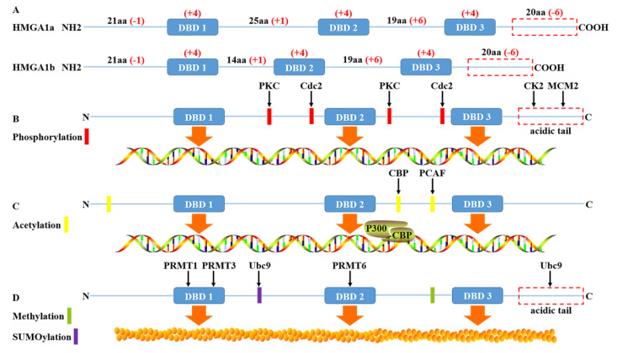 Fig. 1 The structure and post-translational modification of the HMGA1 protein.1
Key structural properties of HMGA1:
- Three AT-hook DNA binding motifs
- The C-terminal acidic tail region is rich in phosphorylation sites
- Naturally disordered conformation, without fixed secondary structure
- The proline-lysine enriched linker region maintains overall flexibility
Functions of HMGA1
The main function of HMGA1 is to regulate gene transcription and chromatin structure. Additionally, it is involved in various cellular processes, such as embryonic development, cell cycle progression, and stress response.
| Function | Description |
| Chromatin remodeling | HMGA1 binds to the DNAAT enrichment region, alters the chromatin conformation, and promotes the assembly of transcription factor complexes. |
| Transcription regulation | It has no transcriptional activity on its own, but by recruiting transcription factors, it can enhance or inhibit the expression of target genes. |
| Embryonic development | It is highly expressed in the early stage of embryonic development and participates in cell differentiation and organ formation. |
| Tumor progression | It is upregulated in various malignant tumors, promoting epithelial-mesenchymal transition, invasion and metastasis, as well as drug resistance. |
| Cell stress response | It participates in DNA damage repair and hypoxia response, maintaining genomic stability. |
HMGA1 binds to the DNA minor groove through its AT-hook motif, without relying on a fixed secondary structure. This conformational plasticity enables it to interact with multiple intranuclear molecules simultaneously, thereby realizing a flexible transcriptional regulatory network.
Applications of HMGA1 and HMGA1 Antibody in Literature
1. Wang, Lu, et al. "High mobility group A1 (HMGA1): structure, biological function, and therapeutic potential." International journal of biological sciences 18.11 (2022): 4414. https://doi.org/10.7150/ijbs.72952
The article indicates that HMGA1 is rare in adults, but is highly expressed in various tumors. It promotes cancer progression by regulating signaling pathways such as Wnt/β-catenin, and is associated with chemotherapy resistance. It is an important potential therapeutic target.
2. Wang, Yuhong, et al. "HMGA1 in cancer: Cancer classification by location." Journal of cellular and molecular medicine 23.4 (2019): 2293-2302. https://doi.org/10.1111/jcmm.14082
The article indicates that HMGA1, as a transcriptional regulatory factor, remodels chromatin structure in various malignant tumors and promotes tumor occurrence and metastasis. This article reviews its structure, carcinogenic characteristics, upstream and downstream regulatory mechanisms, and its role in different cancer types, providing a reference basis for HMGA1 as a tumor diagnostic marker and therapeutic target.
3. Yang, Jing-Yu, et al. "HMGA1 drives chemoresistance in esophageal squamous cell carcinoma by suppressing ferroptosis." Cell Death & Disease 15.2 (2024): 158. https://doi.org/10.1038/s41419-024-06467-2
The article indicates that HMGA1 maintains redox balance and inhibits ferroptosis by promoting the binding of ATF4 to SLC7A11, thereby mediating cisplatin resistance in esophageal squamous cell carcinoma. Targeted inhibition of HMGA1 can promote ferroptosis and enhance chemotherapy sensitivity.
4. Cai, Zhu-Lan, et al. "The effect of HMGA1 in LPS-induced myocardial inflammation." International Journal of Biological Sciences 16.11 (2020): 1798. https://doi.org/10.7150/ijbs.39947
The article indicates that HMGA1 is upregulated in septic cardiomyopathy. Overexpression of HMGA1 exacerbates myocardial cell inflammation and apoptosis by upregulating COX-2; conversely, inhibiting HMGA1 can downregulate STAT3 to alleviate inflammation, but simultaneously aggravates cell apoptosis.
5. Pujals, Mireia, Linda Resar, and Josep Villanueva. "HMGA1, moonlighting protein function, and cellular real estate: location, location, location!." Biomolecules 11.9 (2021): 1334. https://doi.org/10.3390/biom11091334
The article indicates that in addition to being a chromatin regulatory factor, HMGA1 can also be secreted extracellularly in tumor cells such as triple-negative breast cancer, and it drives tumor invasion and metastasis through the RAGE receptor pathway, suggesting that it can serve as a new therapeutic target.
Creative Biolabs: HMGA1 Antibodies for Research
Creative Biolabs specializes in the production of high-quality HMGA1 antibodies for research and industrial applications. Our portfolio includes monoclonal and polyclonal antibodies tailored for ELISA, Flow Cytometry, Western blot, immunohistochemistry, and other diagnostic methodologies.
- Custom HMGA1 Antibody Development: Tailor-made solutions to meet specific research requirements.
- Bulk Production: Large-scale antibody manufacturing for industry partners.
- Technical Support: Expert consultation for protocol optimization and troubleshooting.
- Aliquoting Services: Conveniently sized aliquots for long-term storage and consistent experimental outcomes.
For more details on our HMGA1 antibodies, custom preparations, or technical support, contact us at info@creative-biolabs.com.
Reference
- Han, Jun, et al. "Effect of changes in the structure of myoglobin on the color of meat products." Food Materials Research 4.1 (2024). Distributed under Open Access license CC BY 4.0, without modification. https://doi.org/10.7150/ijbs.72952
Anti-HMGA1 antibodies
 Loading...
 Compare




Hot products 
-
Rabbit Anti-AKT3 Recombinant Antibody (V2-12567) (CBMAB-1057-CN)

-
Mouse Anti-ACTN4 Recombinant Antibody (V2-6075) (CBMAB-0020CQ)

-
Mouse Anti-Gro Monoclonal Antibody (1) (CBMAB-0482-LY)

-
Mouse Anti-AKT1/AKT2/AKT3 (Phosphorylated T308, T309, T305) Recombinant Antibody (V2-443454) (PTM-CBMAB-0030YC)

-
Mouse Anti-GP1BA Recombinant Antibody (6D1) (CBMAB-0271-CN)

-
Mouse Anti-CD33 Recombinant Antibody (P67.6) (CBMAB-C10189-LY)

-
Mouse Anti-ELAVL4 Recombinant Antibody (6B9) (CBMAB-1132-YC)

-
Mouse Anti-GFAP Recombinant Antibody (20) (CBMAB-G2914-LY)

-
Mouse Anti-CD83 Recombinant Antibody (HB15) (CBMAB-C1765-CQ)

-
Rabbit Anti-ATF4 Recombinant Antibody (D4B8) (CBMAB-A3872-YC)

-
Mouse Anti-CD2AP Recombinant Antibody (BR083) (CBMAB-BR083LY)

-
Mouse Anti-CCT6A/B Recombinant Antibody (CBXC-0168) (CBMAB-C5570-CQ)

-
Mouse Anti-HTLV-1 gp46 Recombinant Antibody (CBMW-H1006) (CBMAB-V208-1154-FY)

-
Mouse Anti-FN1 Monoclonal Antibody (71) (CBMAB-1241CQ)

-
Mouse Anti-FOXA3 Recombinant Antibody (2A9) (CBMAB-0377-YC)

-
Mouse Anti-BZLF1 Recombinant Antibody (BZ.1) (CBMAB-AP705LY)

-
Mouse Anti-4-Hydroxynonenal Recombinant Antibody (V2-502280) (CBMAB-C1055-CN)

-
Mouse Anti-APOA1 Monoclonal Antibody (CBFYR0637) (CBMAB-R0637-FY)

-
Rabbit Anti-CBL Recombinant Antibody (D4E10) (CBMAB-CP0149-LY)

-
Mouse Anti-CGAS Recombinant Antibody (CBFYM-0995) (CBMAB-M1146-FY)

- AActivation
- AGAgonist
- APApoptosis
- BBlocking
- BABioassay
- BIBioimaging
- CImmunohistochemistry-Frozen Sections
- CIChromatin Immunoprecipitation
- CTCytotoxicity
- CSCostimulation
- DDepletion
- DBDot Blot
- EELISA
- ECELISA(Cap)
- EDELISA(Det)
- ESELISpot
- EMElectron Microscopy
- FFlow Cytometry
- FNFunction Assay
- GSGel Supershift
- IInhibition
- IAEnzyme Immunoassay
- ICImmunocytochemistry
- IDImmunodiffusion
- IEImmunoelectrophoresis
- IFImmunofluorescence
- IGImmunochromatography
- IHImmunohistochemistry
- IMImmunomicroscopy
- IOImmunoassay
- IPImmunoprecipitation
- ISIntracellular Staining for Flow Cytometry
- LALuminex Assay
- LFLateral Flow Immunoassay
- MMicroarray
- MCMass Cytometry/CyTOF
- MDMeDIP
- MSElectrophoretic Mobility Shift Assay
- NNeutralization
- PImmunohistologyp-Paraffin Sections
- PAPeptide Array
- PEPeptide ELISA
- PLProximity Ligation Assay
- RRadioimmunoassay
- SStimulation
- SESandwich ELISA
- SHIn situ hybridization
- TCTissue Culture
- WBWestern Blot
