
LAMP2 Antibodies
Background
The LAMP2 gene encodes a key transmembrane protein located on the lysosomal membrane. It mainly participates in the fusion process of autophagosomes and lysosomes, maintaining intracellular homeostasis and substance degradation. This protein is highly expressed in the heart, skeletal muscle, and nervous system. Abnormalities in its function are associated with various diseases, especially Danon disease (an X-linked dominant hereditary cardiomyopathy). LAMP2 was first identified in 1988, and the structural analysis has deepened our understanding of the functions of lysosome-related organelles and the autophagy mechanism. The continuous research on this gene has significantly advanced the molecular-level understanding of lysosomal storage diseases, autophagy-related metabolic disorders, and aging mechanisms.
Structure of LAMP2
The LAMP2 protein is a lysosomal membrane protein with a molecular weight of approximately 45 kDa. This value varies slightly among different subtypes. The protein is composed of approximately 410 amino acid residues and its structure includes a cytoplasmic N-terminal tail, a highly glycosylated transmembrane domain, and a C-terminal domain that extends into the lysosomal lumen. Its primary structure exhibits characteristic glycoprotein features, with the extracellular domain rich in glycosylation modifications, which are crucial for maintaining protein stability and the integrity of the lysosomal membrane. The tertiary structure enables it to act as a bridging protein, facilitating the membrane fusion process between autophagosomes and lysosomes.
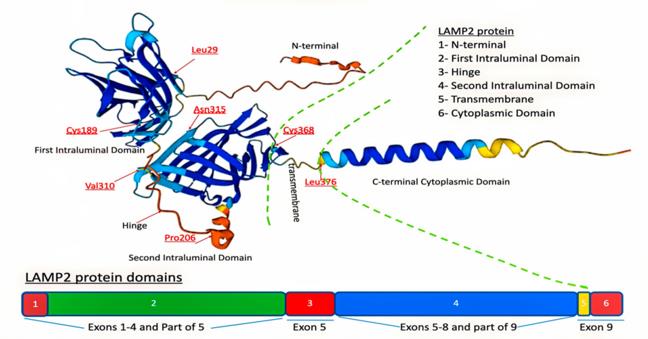 Fig. 1 LAMP2 protein and domains.1
Key structural properties of myoglobin:
- Highly glycosylated intracellular domain
- Single transmembrane helical anchoring to the lysosomal membrane
- Cytoplasmic short-tailed form contains interaction sites for autophagy-related proteins
Functions of LAMP2
The main function of the LAMP2 gene is to maintain the integrity of lysosomes and regulate the autophagy process. However, it is also involved in a variety of crucial cellular physiological activities, including the clearance of intracellular metabolic waste, antigen presentation, and the regulation of apoptosis.
| Function | Description |
| Autophagy Regulation | As a key membrane protein for the fusion of autophagosomes and lysosomes, it mediates the transport and degradation of autophagic substrates to the lysosomes. |
| Lysosomal Stability | The highly glycosylated intracellular domain forms a protective layer, maintaining the integrity of the lysosomal membrane and preventing the leakage of enzymes. |
| Endocytosis | It is involved in the fusion process between late endosomes and lysosomes, assisting in the degradation and metabolism of extracellular substances. |
| Immune Response | In antigen-presenting cells, it is involved in the antigen processing and presentation pathway of MHC II molecules. |
| Disease Association | The absence of its function directly leads to Danon disease (a lysosomal storage disorder that affects the heart, skeletal muscles, and nervous system), and it is also associated with various neurodegenerative diseases and metabolic syndromes. |
Unlike single-functional oxygen-binding proteins, LAMP2 integrates multiple interactions through its multiple domains, demonstrating a core role as a "multifunctional hub" in maintaining cellular homeostasis. The precise regulation of its expression level and function is crucial for cells to adapt to nutritional changes, stress responses, and tissue development.
Applications of LAMP2 and LAMP2 Antibody in Literature
1. Shalata, Adel, et al. "Danon Disease: Entire LAMP2 Gene Deletion with Unusual Clinical Presentation—Case Report and Review of the Literature." Genes 14.8 (2023): 1539. https://doi.org/10.3390/genes14081539
This article reports a father-daughter pair with Danon disease, presenting with mild clinical manifestations. The father was diagnosed with pre-excitation syndrome at the age of 13 and developed visual impairment at 25; the daughter was 3 years old and only showed mild electrocardiogram abnormalities. Genetic testing revealed a microdeletion in the Xq24 region affecting the LAMP2 gene. This article discusses the diagnosis, treatment, and management of this disease in conjunction with relevant literature.
2. Rodrigues, Pedro M., et al. "LAMP2 regulates autophagy in the thymic epithelium and thymic stroma-dependent CD4 T cell development." Autophagy 19.2 (2023): 426-439. https://doi.org/10.1080/15548627.2022.2074105
The research reveals that in the epithelial cells of the thymic cortex, LAMP2 regulates the autophagy-lysosome pathway, influencing the processing of self-peptide-MHC II complexes, thereby playing a crucial role in positive selection of CD4 T cells and the diversity of TCR receptor libraries.
3. Liu, Shan-peng, et al. "LAMP2 as a biomarker related to prognosis and immune infiltration in esophageal cancer and other cancers: a comprehensive pan-cancer analysis." Frontiers in oncology 12 (2022): 884448. https://doi.org/10.3389/fonc.2022.884448
This study, through pan-cancer analysis, revealed that LAMP2 is significantly upregulated in malignant tumors such as esophageal cancer. Its expression level is correlated with patient prognosis, clinical pathological features, and immune cell infiltration, suggesting that it can serve as a potential therapeutic target.
4. Zheng, Hao, et al. "Lamp2 inhibits epithelial-mesenchymal transition by suppressing Snail expression in HCC." Oncotarget 9.54 (2018): 30240. https://doi.org/10.18632/oncotarget.25367
The study found that LAMP2 is expressed at a low level in hepatocellular carcinoma and is associated with poor prognosis and metastasis in patients. Mechanistically, LAMP2 reverses epithelial-mesenchymal transition by inhibiting Snail expression, thereby suppressing tumor metastasis.
5. Sun, Chuanyu, et al. "Ferroptosis‐Related Prognostic Gene LAMP2 Is a Potential Biomarker Differential Expressed in Castration Resistant Prostate Cancer." Disease Markers 2023.1 (2023): 8295113. https://doi.org/10.1155/2023/8295113
Studies have shown that the iron death-related gene LAMP2 is significantly expressed in prostate cancer. Its expression level affects immune infiltration and is related to the survival prognosis of patients, and it may serve as a potential biomarker.
Creative Biolabs: LAMP2 Antibodies for Research
Creative Biolabs specializes in the production of high-quality LAMP2 antibodies for research and industrial applications. Our portfolio includes monoclonal and polyclonal antibodies tailored for ELISA, Flow Cytometry, Western blot, immunohistochemistry, and other diagnostic methodologies.
- Custom LAMP2 Antibody Development: Tailor-made solutions to meet specific research requirements.
- Bulk Production: Large-scale antibody manufacturing for industry partners.
- Technical Support: Expert consultation for protocol optimization and troubleshooting.
- Aliquoting Services: Conveniently sized aliquots for long-term storage and consistent experimental outcomes.
For more details on our LAMP2 antibodies, custom preparations, or technical support, contact us at info@creative-biolabs.com.
Reference
- Shalata, Adel, et al. "Danon Disease: Entire LAMP2 Gene Deletion with Unusual Clinical Presentation—Case Report and Review of the Literature." Genes 14.8 (2023): 1539. Distributed under Open Access license CC BY 4.0, without modification. https://doi.org/10.3390/genes14081539
Anti-LAMP2 antibodies
 Loading...
 Compare



Hot products 
-
Mouse Anti-ADGRE5 Recombinant Antibody (V2-360335) (CBMAB-C2088-CQ)

-
Rabbit Anti-ENO2 Recombinant Antibody (BA0013) (CBMAB-0272CQ)

-
Mouse Anti-EPO Recombinant Antibody (CBFYR0196) (CBMAB-R0196-FY)

-
Mouse Anti-C1QC Recombinant Antibody (CBFYC-0600) (CBMAB-C0654-FY)

-
Mouse Anti-CD33 Recombinant Antibody (P67.6) (CBMAB-C10189-LY)

-
Rat Anti-C5AR1 Recombinant Antibody (8D6) (CBMAB-C9139-LY)

-
Mouse Anti-C5b-9 Recombinant Antibody (aE11) (CBMAB-AO138LY)

-
Mouse Anti-BHMT Recombinant Antibody (CBYY-0547) (CBMAB-0550-YY)

-
Mouse Anti-ATP1B3 Recombinant Antibody (1E9) (CBMAB-A4021-YC)

-
Mouse Anti-CORO1A Recombinant Antibody (4G10) (V2LY-1206-LY806)

-
Mouse Anti-ADIPOR1 Recombinant Antibody (V2-179982) (CBMAB-A1368-YC)

-
Rat Anti-AChR Recombinant Antibody (V2-12500) (CBMAB-0990-CN)

-
Mouse Anti-CD24 Recombinant Antibody (HIS50) (CBMAB-C10123-LY)

-
Mouse Anti-FTH1 Recombinant Antibody (CBXF-1896) (CBMAB-F3426-CQ)

-
Mouse Anti-HTLV-1 gp46 Recombinant Antibody (CBMW-H1006) (CBMAB-V208-1154-FY)

-
Mouse Anti-ADAM29 Recombinant Antibody (V2-179787) (CBMAB-A1149-YC)

-
Mouse Anti-C5AR1 Recombinant Antibody (R63) (CBMAB-C9553-LY)

-
Mouse Anti-CDK7 Recombinant Antibody (CBYY-C1783) (CBMAB-C3221-YY)

-
Mouse Anti-FOSB Recombinant Antibody (CBXF-3593) (CBMAB-F2522-CQ)

-
Mouse Anti-F11R Recombinant Antibody (402) (CBMAB-0026-WJ)

- AActivation
- AGAgonist
- APApoptosis
- BBlocking
- BABioassay
- BIBioimaging
- CImmunohistochemistry-Frozen Sections
- CIChromatin Immunoprecipitation
- CTCytotoxicity
- CSCostimulation
- DDepletion
- DBDot Blot
- EELISA
- ECELISA(Cap)
- EDELISA(Det)
- ESELISpot
- EMElectron Microscopy
- FFlow Cytometry
- FNFunction Assay
- GSGel Supershift
- IInhibition
- IAEnzyme Immunoassay
- ICImmunocytochemistry
- IDImmunodiffusion
- IEImmunoelectrophoresis
- IFImmunofluorescence
- IGImmunochromatography
- IHImmunohistochemistry
- IMImmunomicroscopy
- IOImmunoassay
- IPImmunoprecipitation
- ISIntracellular Staining for Flow Cytometry
- LALuminex Assay
- LFLateral Flow Immunoassay
- MMicroarray
- MCMass Cytometry/CyTOF
- MDMeDIP
- MSElectrophoretic Mobility Shift Assay
- NNeutralization
- PImmunohistologyp-Paraffin Sections
- PAPeptide Array
- PEPeptide ELISA
- PLProximity Ligation Assay
- RRadioimmunoassay
- SStimulation
- SESandwich ELISA
- SHIn situ hybridization
- TCTissue Culture
- WBWestern Blot
