
NMBR Antibodies
Background
NMBR gene encoding a G protein coupled receptors, the main distribution of the central nervous system and digestive system. This receptor participates in regulating various physiological functions such as smooth muscle contraction, pain perception and appetite control by binding to neuromodulin B (NMB). Research has found that NMBR is abnormally expressed in the airways of asthma patients, which may be related to the pathological mechanism of bronchoconstriction. This gene was first cloned by Japanese scholars in 1992. The analysis of its three-dimensional structure provides an important basis for the development of targeted drugs for respiratory diseases. As a key component of the neuropeptide signaling pathway, the ligand recognition mechanism and downstream signal transduction pathways of NMBR have become a hot area in current neuropharmacological research.
Structure of NMBR
The Neuromedin B Receptor encoded by the NMBR gene is a G protein-coupled receptor with a molecular weight of approximately 42-45 kDa, and its precise molecular weight may vary slightly depending on the degree of glycosylation modification.
| Species | Human | Mouse | Rat |
| Molecular Weight (kDa) | 16.7 | 16.9 | 16.8 |
| Primary Structural Differences | Containing 7 transmembrane domains, extracellular N-terminal glycosylation | Highly homologous to humans, with conserved ligand binding regions | The transmembrane region sequences are similar, and the signal transduction mechanisms are also similar |
NMBR is composed of 390 to 400 amino acids and has a typical GPCR topological structure, including 7 transmembrane α-helicles and an extracellular N-terminal domain. Its ligand binding pocket is located in the transmembrane region and relies on key residues on the 3rd, 5th, and 6th helices (such as Arg126 and Tyr220) to recognize neuromodulin B (NMB). After receptor activation, it mediates the phospholipase C signaling pathway through the Gq protein, regulating smooth muscle contraction and neural excitability. The structural variation of the third intracellular loop (ICL3) in NMBR is relatively large, which may affect the specificity of downstream signals.
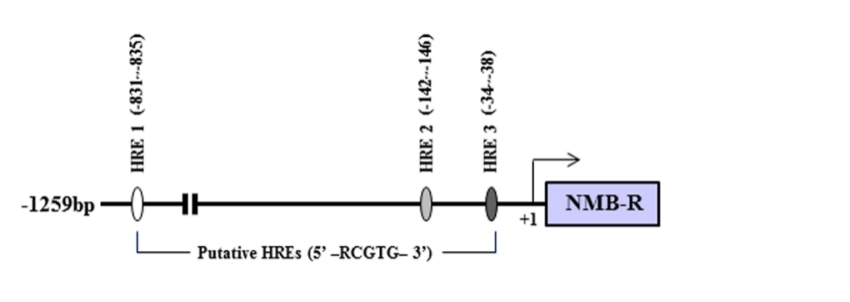 Fig. 1 Identification and functional verification of hypoxia response elements (HRE) in the promoter region of human NMBR.1
Key structural properties of NMBR:
- 7-time transmembrane α-helical structure
- Conservative ligand-binding pocket
- Intracellular signal regulation module
Functions of NMBR
As a G protein-coupled receptor (GPCR), NMBR mainly mediates the signal transduction of neuromodulin B (NMB) and participates in various physiological and pathological processes:
| Function | Description |
| Regulation of smooth muscle contraction | Calcium signals are activated through the Gq-PLCβ-IP3 pathway to regulate the tension of smooth muscles in the respiratory tract, digestive tract, etc. |
| Pain perception regulation | Expressed in spinal dorsal horn neurons, it enhances nociceptive signal transmission and is associated with the formation of chronic pain. |
| Appetite and metabolic regulation | The activation of NMBR in the hypothalamus promotes feeding behavior and there is cross-regulation with the leptin signaling pathway. |
| Regulation of the tumor microenvironment | It is abnormally activated in some cancers (such as lung cancer and prostate cancer), promoting the proliferation of tumor cells and angiogenesis. |
| Participation in stress response | It regulates sympathetic nerve output through the central nervous system and affects the cardiovascular stress response. |
The signal kinetics of NMBR shows ligand concentration dependence: low concentrations of NMB preferentially activate the Gq pathway, while high concentrations can trigger the recruitment of β-arrestin to induce receptor internalization. Compared with GRPR (gastrin-releasing peptide receptor) of the same family, the affinity of NMBR for NMB (Kd≈0.3 nM) is significantly higher than that of GRPR, demonstrating the specificity of its signal transduction. Under pathological conditions (such as asthma), abnormal activation of NMBR can lead to airway hyperresponsiveness and become a potential therapeutic target.
Applications of NMBR and NMBR Antibody in Literature
1. Meng, Qing-Tao, et al. "BNP facilitates NMB-encoded histaminergic itch via NPRC-NMBR crosstalk." Elife 10 (2021): e71689. https://doi.org/10.7554/eLife.71689
This study revealed that gastrin-releasing peptide (GRP) and neuroregulatory peptide B (NMBR) in the spinal cord of mice respectively transmit histamine-dependent and non-dependent pruritus. Research has found that B-type natriuretic peptide (BNP) forms cross-signals with NMBR through NPRC receptors, specifically enhancing NMBR-mediated histaminergic pruritus rather than the GRP pathway. Mechanically, BNP-NPRC promotes pruritus transmission of NMBR by activating the GQ-coupled PLCβ-Ca2+ signaling pathway.
2. Gao, aoyan, et al. "Cervical cancer-produced neuromedin-B reprograms Schwann cells to initiate perineural invasion." Cell death & disease 15.8 (2024): 636. https://doi.org/10.1038/s41419-024-07030-9
This study revealed that cervical cancer cells secrete neuroregulatory peptide B (NMB) by activating the NMB receptor (NMBR) on the surface of Schwann cells, triggering PKA-mediated T-type calcium channel opening, inducing Schwann cells to reprogram and secrete CCL2 to promote nerve infiltration (PNI). The combined detection of serum NMB and CCL2 can predict PNI, providing a basis for neuro-preserving surgery.
3. Ma, Zhiyu, et al. "Neuromedin B and its receptor: gene cloning, tissue distribution and expression levels of the reproductive axis in pigs." PLoS One 11.3 (2016): e0151871. https://doi.org/10.1371/journal.pone.0151871
This study reveals that the research on the porcine NMB/NMBR system indicates that NMBR is highly expressed in various peripheral tissues (such as endocrine glands and reproductive organs), while NMB is mainly distributed in the central nervous system. NMBR shows a dynamic expression pattern during the estrus cycle of sows and the developmental stage of boars, suggesting that it plays an important role in reproductive regulation.
4. Zhang, Yuan, et al. "Neuromedin B receptor stimulation of Cav3. 2 T-type Ca2+ channels in primary sensory neurons mediates peripheral pain hypersensitivity." Theranostics 11.19 (2021): 9342. https://www.thno.org/v11p9342.htm
This study reveals that neuroregulatory peptide B (Nmb) enhances the Cav3.2T type calcium channel current in trigeminal ganglion neurons by activating Nmb receptors (NmbR), and the mechanism depends on the Gq protein-PKA /AMPK signaling pathway, which leads to increased neuronal excitability and induces hyperalgesia. Blocking NmbR can relieve inflammatory pain.
5. Park, Hyun-Joo, et al. "Hypoxia regulates the expression of the neuromedin B receptor through a mechanism dependent on hypoxia-inducible factor-1α." Plos one 8.12 (2013): e82868. https://doi.org/10.1371/journal.pone.0082868
Research has found that hypoxia significantly upregulates the expression of neurokinin B receptor (NMBR) in breast cancer cells by directly binding HIF-1α to the hypoxia-responsive element in the NMBR promoter region. Clinical sample analysis confirmed that NMBR was positively correlated with the expression of HIF-1α, revealing a new mechanism by which the hypoxic microenvironment regulates the expression of NMBR.
Creative Biolabs: NMBR Antibodies for Research
Creative Biolabs specializes in the production of high-quality NMBR antibodies for research and industrial applications. Our portfolio includes monoclonal antibodies tailored for ELISA, Flow Cytometry, Western blot, immunohistochemistry, and other diagnostic methodologies.
- Custom NMBR Antibody Development: Tailor-made solutions to meet specific research requirements.
- Bulk Production: Large-scale antibody manufacturing for industry partners.
- Technical Support: Expert consultation for protocol optimization and troubleshooting.
- Aliquoting Services: Conveniently sized aliquots for long-term storage and consistent experimental outcomes.
For more details on our NMBR antibodies, custom preparations, or technical support, contact us at email.
Reference
- Park, Hyun-Joo, et al. "Hypoxia regulates the expression of the neuromedin B receptor through a mechanism dependent on hypoxia-inducible factor-1α." Plos one 8.12 (2013): e82868. https://doi.org/10.1371/journal.pone.0082868
Anti-NMBR antibodies
 Loading...
 Compare




Hot products 
-
Mouse Anti-GIPC2 Recombinant Antibody (10) (CBMAB-G0476-LY)

-
Mouse Anti-CD19 Recombinant Antibody (CBXC-1224) (CBMAB-C1491-CQ)

-
Mouse Anti-BRCA2 Recombinant Antibody (CBYY-1728) (CBMAB-2077-YY)

-
Mouse Anti-BRD3 Recombinant Antibody (CBYY-0801) (CBMAB-0804-YY)

-
Mouse Anti-Acetyl-α-Tubulin (Lys40) Recombinant Antibody (V2-623485) (CBMAB-CP2897-LY)

-
Mouse Anti-BCL2L1 Recombinant Antibody (H5) (CBMAB-1025CQ)

-
Mouse Anti-CRYAB Recombinant Antibody (A4345) (CBMAB-A4345-YC)

-
Rabbit Anti-Acetyl-Histone H4 (Lys16) Recombinant Antibody (V2-623415) (CBMAB-CP1021-LY)

-
Mouse Anti-ATP5F1A Recombinant Antibody (51) (CBMAB-A4043-YC)

-
Rat Anti-ADGRE4 Recombinant Antibody (V2-160163) (CBMAB-F0011-CQ)

-
Mouse Anti-CASP7 Recombinant Antibody (10-01-62) (CBMAB-C2005-LY)

-
Mouse Anti-AQP2 Recombinant Antibody (E-2) (CBMAB-A3358-YC)

-
Rabbit Anti-DLK1 Recombinant Antibody (9D8) (CBMAB-D1061-YC)

-
Mouse Anti-ALOX5 Recombinant Antibody (33) (CBMAB-1890CQ)

-
Mouse Anti-BZLF1 Recombinant Antibody (BZ.1) (CBMAB-AP705LY)

-
Mouse Anti-4-Hydroxynonenal Recombinant Antibody (V2-502280) (CBMAB-C1055-CN)

-
Mouse Anti-CD63 Recombinant Antibody (CBXC-1200) (CBMAB-C1467-CQ)

-
Mouse Anti-BACE1 Recombinant Antibody (61-3E7) (CBMAB-1183-CN)

-
Mouse Anti-CD59 Recombinant Antibody (CBXC-2097) (CBMAB-C4421-CQ)

-
Mouse Anti-DLG1 Monolconal Antibody (4F3) (CBMAB-0225-CN)

- AActivation
- AGAgonist
- APApoptosis
- BBlocking
- BABioassay
- BIBioimaging
- CImmunohistochemistry-Frozen Sections
- CIChromatin Immunoprecipitation
- CTCytotoxicity
- CSCostimulation
- DDepletion
- DBDot Blot
- EELISA
- ECELISA(Cap)
- EDELISA(Det)
- ESELISpot
- EMElectron Microscopy
- FFlow Cytometry
- FNFunction Assay
- GSGel Supershift
- IInhibition
- IAEnzyme Immunoassay
- ICImmunocytochemistry
- IDImmunodiffusion
- IEImmunoelectrophoresis
- IFImmunofluorescence
- IGImmunochromatography
- IHImmunohistochemistry
- IMImmunomicroscopy
- IOImmunoassay
- IPImmunoprecipitation
- ISIntracellular Staining for Flow Cytometry
- LALuminex Assay
- LFLateral Flow Immunoassay
- MMicroarray
- MCMass Cytometry/CyTOF
- MDMeDIP
- MSElectrophoretic Mobility Shift Assay
- NNeutralization
- PImmunohistologyp-Paraffin Sections
- PAPeptide Array
- PEPeptide ELISA
- PLProximity Ligation Assay
- RRadioimmunoassay
- SStimulation
- SESandwich ELISA
- SHIn situ hybridization
- TCTissue Culture
- WBWestern Blot
