
SYNM Antibodies
Background
SYNM is a kind of intermediate filament protein, mainly existing in the skeletal muscle, cardiac muscle and smooth muscle cells of vertebrates. This protein forms a cytoskeletal network through polymerization and plays a crucial role in maintaining the mechanical stability and structural integrity of muscle cells. The SYNM protein is also involved in cellular signal transduction and nuclear localization regulation during muscle development and injury repair. This gene was first identified in the 1990s. The synemin protein encoded by it, as an important component of muscle-specific intermediate filaments, stabilizes the structure of muscle fibers by interacting with proteins such as desmin. Its unique molecular structure and dynamic assembly characteristics have become important models for the study of muscle cell mechanics and the exploration of the pathological mechanism of muscular dystrophy, promoting the development of cytoskeletal biology and the field of muscle diseases.
Structure of SYNM
SYNM is a large intermediate filament protein with a molecular weight of approximately 180 kDa. This molecular weight varies among different species, mainly due to different subtype splicing and post-translational modifications.
| Species | Human | Mouse | Rat | Chicken |
| Molecular Weight (kDa) | ~172 | ~172 | ~172 | ~172 |
| Primary Structural Differences | There are multiple subtypes (α, β), each with a unique tail domain | The sequences are highly homologous, but the tail domains are different | The SYNM structure of humans is highly conserved | The basic structure of silk protein among vertebrates characteristics |
The primary structure of the SYNM protein consists of a head domain, a central α-helical rod-shaped domain, and a relatively long tail domain. Its core secondary structure is composed of a long α-helix in the central rod-shaped area, and this structure achieves polymerization through the coil-helix interaction. The tail domain contains multiple phosphorylation sites, which can specifically bind to other cytoskeletal proteins such as dystrophin and vimentin, thereby anchoring the intermediate filament network at the Z disk and costal structures of myofibrils and maintaining the mechanical integrity of muscle cells.
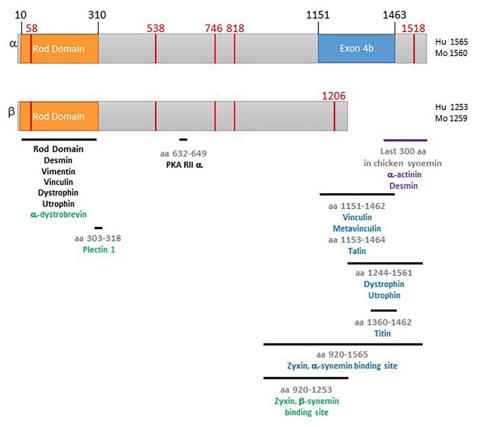 Fig. 1 Schematic of α- and β-synemin.1
Key structural properties of SYNM:
- The protein has a typical three-domain structure of intermediate filaments (head, rod and tail)
- The rod-shaped area is a long α-helix
- The unique tail domain can bind actin, vimentin and other cytoskeletal proteins
- Adjusted dynamically by phosphorylation modification with the Z disk, rib structure of anchoring effect
Functions of SYNM
The main function of the SYNM gene is to provide structural support in muscle cells and participate in mechanical signal transduction. In addition, it also involves processes such as muscle development, injury repair, and maintaining nuclear stability.
| Function | Description |
| Structural support | As a constituent protein of the intermediate filament network, it interacts with keratin and others, providing mechanical stability for myofibrils and resisting physical stress during contraction. |
| Mechanical signal transmission | Mechanical stimuli are transmitted from the cytoskeleton to the nucleus at the Z disk and costal structures, influencing gene expression and muscle adaptability. |
| Muscle development and repair | In muscle and expression in the process of regeneration after injury, assist muscle tube fusion and of new muscle fibers to mature. |
| Nuclear anchoring | Through its tail domain, it helps to locate and anchor the nucleus in specific positions of muscle fibers to maintain cellular structural order. |
| Disease association | Abnormal function or disordered expression of SYNM is associated with certain pathological processes of muscular dystrophy and cardiomyopathy. |
SYNM proteins do not have direct oxygen-binding capacity. Their core function lies in forming the cytoskeleton and integrating mechanical and biochemical signals. This is fundamentally different from myoglobin, which has high oxygen affinity and is mainly responsible for gas storage and transportation, in terms of mechanism of action.
Applications of SYNM and SYNM Antibody in Literature
- Zlotina, Anna, et al. "Rare case of ulnar-mammary-like syndrome with left ventricular tachycardia and lack of TBX3 mutation." Frontiers in Genetics 9 (2018): 209. https://doi.org/10.3389/fgene.2018.00209
In this study, a missense variation (c.173C>T) of the SYNM gene was first identified through whole exome sequencing in a Russian female patient suspected of having ulnar and mammary syndrome. Combining the tissue expression characteristics of this gene and the phenotype of the mouse model, it is proposed that SYNM may be involved in the occurrence of cardial-limb syndrome, providing new clues for the genetic mechanism of related diseases.
- Chen, Siyu, et al. "A risk model of gene signatures for predicting platinum response and survival in ovarian cancer." Journal of Ovarian Research 15.1 (2022): 39. https://doi.org/10.1186/s13048-022-00969-3
In this study, through multi-omics analysis of ovarian cancer samples, a 10-gene classifier capable of accurately predicting the sensitivity to platinum-based chemotherapy and prognosis was constructed. Among them, PNLDC1, SLC5A1 and SYNM have been identified as key hub genes and can serve as potential biomarkers for the treatment of ovarian cancer.
- Shao, Quanfeng, et al. "Construction of a novel five programmed cell death-related gene signature as a promising prognostic model for triple negative breast cancer." PeerJ 13 (2025): e19359. https://doi.org/10.7717/peerj.19359
In this study, a prognostic model of TNBC was constructed based on PCD-related genes. It was established that the five-gene tag composed of SEPTIN3, SCARB1, CHML, SYNM and COL5A3 could effectively predict patient survival, and its risk score was significantly correlated with immune infiltration and drug sensitivity.
- Yu, Hengwei, et al. "Genome-wide association study reveals novel loci associated with body conformation traits in Qinchuan cattle." Animals 13.23 (2023): 3628. https://doi.org/10.3390/ani13233628
In this study, through genome-wide association analysis, 250 candidate loci related to 14 body type traits were screened out from 254 Qinchuan cattle. It was ultimately confirmed that eight core genes, including SYNM (such as ADAMTS17, MEF2A, etc.), may regulate the growth and development of cattle, providing key molecular markers for subsequent breeding strategies.
- Wang, Lei, et al. "Identification of hub genes in bladder cancer based on weighted gene co‐expression network analysis from TCGA database." Cancer Reports 5.9 (2022): e1557. https://doi.org/10.1002/cnr2.1557
In this study, by integrating bioinformatics analysis, nine key genes related to the progression and prognosis of patients with muscle-invasive bladder cancer (MIBC) were screened out, including CNKSR1, SYNM, etc. The research further verified through experiments that CNKSR1 can serve as a potential therapeutic target for MIBC, providing a new basis for individualized diagnosis and treatment.
Creative Biolabs: SYNM Antibodies for Research
Creative Biolabs specializes in the production of high-quality SYNM antibodies for research and industrial applications. Our portfolio includes monoclonal antibodies tailored for ELISA, Flow Cytometry, Western blot, immunohistochemistry, and other diagnostic methodologies.
- Custom SYNM Antibody Development: Tailor-made solutions to meet specific research requirements.
- Bulk Production: Large-scale antibody manufacturing for industry partners.
- Technical Support: Expert consultation for protocol optimization and troubleshooting.
- Aliquoting Services: Conveniently sized aliquots for long-term storage and consistent experimental outcomes.
For more details on our SYNM antibodies, custom preparations, or technical support, contact us at email.
Reference
- Russell, Mary A. "Synemin redefined: multiple binding partners results in multifunctionality." Frontiers in cell and developmental biology 8 (2020): 159. https://doi.org/10.3389/fcell.2020.00159
Anti-SYNM antibodies
 Loading...
 Compare




Hot products 
- AActivation
- AGAgonist
- APApoptosis
- BBlocking
- BABioassay
- BIBioimaging
- CImmunohistochemistry-Frozen Sections
- CIChromatin Immunoprecipitation
- CTCytotoxicity
- CSCostimulation
- DDepletion
- DBDot Blot
- EELISA
- ECELISA(Cap)
- EDELISA(Det)
- ESELISpot
- EMElectron Microscopy
- FFlow Cytometry
- FNFunction Assay
- GSGel Supershift
- IInhibition
- IAEnzyme Immunoassay
- ICImmunocytochemistry
- IDImmunodiffusion
- IEImmunoelectrophoresis
- IFImmunofluorescence
- IGImmunochromatography
- IHImmunohistochemistry
- IMImmunomicroscopy
- IOImmunoassay
- IPImmunoprecipitation
- ISIntracellular Staining for Flow Cytometry
- LALuminex Assay
- LFLateral Flow Immunoassay
- MMicroarray
- MCMass Cytometry/CyTOF
- MDMeDIP
- MSElectrophoretic Mobility Shift Assay
- NNeutralization
- PImmunohistologyp-Paraffin Sections
- PAPeptide Array
- PEPeptide ELISA
- PLProximity Ligation Assay
- RRadioimmunoassay
- SStimulation
- SESandwich ELISA
- SHIn situ hybridization
- TCTissue Culture
- WBWestern Blot
