
CBX4 Antibodies
Background
CBX4 is a transcriptional regulatory protein expressed in various tissues and is an important component of the Polycomb Group (PcG) family. This protein mainly participates in chromatin modification and gene transcriptional repression by recognizing and binding to the trimethylation modifications on histone H3 (H3K9me3 or H3K27me3), thereby influencing key biological processes such as cell cycle, differentiation, and aging. Studies have shown that CBX4 plays a significant role in maintaining stem cell characteristics, regulating skeletal muscle regeneration, and tumor development. In 2002, scientists first identified CBX4 as a binding component of the Polycomb Group complex in mammalian cells. Subsequently, the structural analysis revealed its unique chromatin binding domain and functional mechanism, providing an important foundation for understanding the epigenetic regulatory network. With the continuous deepening of research on CBX4, its potential value in developmental biology and disease treatment has also received increasing attention.
Structure of CBX4
The molecular weight of the CBX4 protein is approximately 56 kDa. It varies slightly among different species due to sequence differences, and its amino acid length is approximately 560. As a member of the multi-coil protein family, CBX4 mainly recognizes histone methylation modifications through its N-terminal chromatin domain, thereby participating in the inhibition regulation of gene transcription. This protein also contains a conserved C-terminal multi-coil box domain, which mediates its interaction with other protein components to form a functional complex. In the structure of CBX4, these functional domains work together to enable it to play a crucial regulatory role in processes such as chromatin modification, cell cycle, and differentiation.
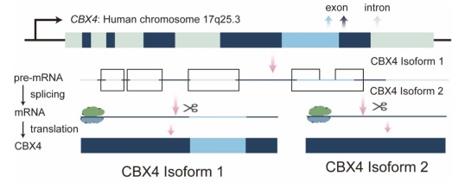 Fig. 1 Alternative splicing of CBX4.1
Key structural properties of CBX4:
- Conserved chromatin domains recognize histone methylation
- Multi-comb box domains mediate protein complex assembly
- The C-end is rich in regions involved in transcriptional regulation
- Ubiquitination-related domains affect substrate recognition
Functions of CBX4
The main function of CBX4 is to act as a transcriptional regulatory factor and participate in the epigenetic regulation of gene expression. However, it is also involved in various physiological processes, including stem cell maintenance, cell senescence, and tumor formation.
| Function | Description |
| Transcriptional inhibition | CBX4 recognizes the modifications of histone H3K9me3 or H3K27me3 and recruits the multi-coil protein complex to inhibit the expression of target genes. |
| Stem cell maintenance | It participates in regulating the self-renewal and differentiation balance of embryonic stem cells and adult stem cells, maintaining the characteristics of stem cells. |
| Cell senescence regulation | It interacts with aging-related factors such as p53 to affect the cell aging process. |
| DNA damage repair | In the DNA damage response, CBX4 is recruited to the damage site and participates in the regulation of the repair process. |
| Tumor regulation | It is expressed abnormally in various cancers and exerts dual effects of promoting or inhibiting cancer through regulating downstream genes. |
The chromatin binding of CBX4 shows a dynamic regulatory pattern. The binding strength with the target gene is affected by cellular signals and environmental factors, thereby precisely regulating the expression level of downstream genes.
Applications of CBX4 and CBX4 Antibody in Literature
1. Hu, Qianxing, et al. "CBX4 regulation of senescence and associated diseases: molecular pathways and mechanisms." Pharmacological Research 215 (2025): 107705. https://doi.org/10.1016/j.phrs.2025.107705
The article indicates that CBX4, as the core subunit of PRC1 and a SUMO E3 ligase, plays a crucial role in cell migration, aging, metabolism, inflammation, and tumors by regulating the SUMOylation modification. It is a potential therapeutic target for delaying aging and inhibiting tumors.
2. Wang, Jingzeng, et al. "CBX4 suppresses CD8+ T cell antitumor immunity by reprogramming glycolytic metabolism." Theranostics 14.10 (2024): 3793. https://doi.org/10.7150/thno.95748
The study found that CBX4 is highly expressed in tumor-infiltrating CD8+ T cells. By sumoylation modification, it upregulates Aldob, inhibits glycolysis and ATP synthesis, thereby weakening the function of T cells. Targeting CBX4 may enhance the efficacy of anti-PD-1 immunotherapy.
3. Chen, Fangzhen, et al. "CBX4 deletion promotes tumorigenesis under KrasG12D background by inducing genomic instability." Signal Transduction and Targeted Therapy 8.1 (2023): 343. https://doi.org/10.1038/s41392-023-01623-0
The study found that the absence of CBX4 leads to chromosomal instability in the context of KrasG12D mutation, resulting in cell apoptosis and carcinogenesis, and promoting the progression of lung adenocarcinoma. Clinical data show that low expression of CBX4 is associated with poor prognosis in patients with Kras mutations.
4. Zhao, Ran, et al. "CBX4 plays a bidirectional role in transcriptional regulation and lung adenocarcinoma progression." Cell Death & Disease 15.5 (2024): 378. https://doi.org/10.1038/s41419-024-06745-z
The study found that CBX4 regulates tumor progression in lung adenocarcinoma in a bidirectional manner: it promotes proliferation by upregulating PHGDH through GCN5, and inhibits metastasis by suppressing ZEB2 through PRC1. Its function depends on the interaction with different epigenetic regulatory factors.
5. Chen, Yu-Hsiu, et al. "CBX4 regulates replicative senescence of WI‐38 fibroblasts." Oxidative medicine and cellular longevity 2022.1 (2022): 5503575. https://doi.org/10.1155/2022/5503575
The study found that the expression of CBX4 protein was downregulated in replicative senescent WI-38 fibroblasts. Activation of CBX4 could reduce the expression of aging markers as well as p16 and DPP4, indicating its potential in regulating aging.
Creative Biolabs: CBX4 Antibodies for Research
Creative Biolabs specializes in the production of high-quality CBX4 antibodies for research and industrial applications. Our portfolio includes monoclonal and polyclonal antibodies tailored for ELISA, Flow Cytometry, Western blot, immunohistochemistry, and other diagnostic methodologies.
- Custom CBX4 Antibody Development: Tailor-made solutions to meet specific research requirements.
- Bulk Production: Large-scale antibody manufacturing for industry partners.
- Technical Support: Expert consultation for protocol optimization and troubleshooting.
- Aliquoting Services: Conveniently sized aliquots for long-term storage and consistent experimental outcomes.
For more details on our CBX4 antibodies, custom preparations, or technical support, contact us at email.
Reference
- Hu, Qianxing, et al. "CBX4 regulation of senescence and associated diseases: molecular pathways and mechanisms." Pharmacological Research 215 (2025): 107705. Distributed under Open Access license CC BY 4.0, without modification. https://doi.org/10.1016/j.phrs.2025.107705
Anti-CBX4 antibodies
 Loading...
 Compare




Hot products 
- AActivation
- AGAgonist
- APApoptosis
- BBlocking
- BABioassay
- BIBioimaging
- CImmunohistochemistry-Frozen Sections
- CIChromatin Immunoprecipitation
- CTCytotoxicity
- CSCostimulation
- DDepletion
- DBDot Blot
- EELISA
- ECELISA(Cap)
- EDELISA(Det)
- ESELISpot
- EMElectron Microscopy
- FFlow Cytometry
- FNFunction Assay
- GSGel Supershift
- IInhibition
- IAEnzyme Immunoassay
- ICImmunocytochemistry
- IDImmunodiffusion
- IEImmunoelectrophoresis
- IFImmunofluorescence
- IGImmunochromatography
- IHImmunohistochemistry
- IMImmunomicroscopy
- IOImmunoassay
- IPImmunoprecipitation
- ISIntracellular Staining for Flow Cytometry
- LALuminex Assay
- LFLateral Flow Immunoassay
- MMicroarray
- MCMass Cytometry/CyTOF
- MDMeDIP
- MSElectrophoretic Mobility Shift Assay
- NNeutralization
- PImmunohistologyp-Paraffin Sections
- PAPeptide Array
- PEPeptide ELISA
- PLProximity Ligation Assay
- RRadioimmunoassay
- SStimulation
- SESandwich ELISA
- SHIn situ hybridization
- TCTissue Culture
- WBWestern Blot
