
DROSHA Antibodies
Background
The DROSHA gene encodes a ribonuclease, which acts as the "molecular scissors" for processing microRNAs within the organism. It primarily functions in the cell nucleus and is responsible for cutting long-chain primary microRNA transcripts into approximately 70-nucleotide precursors, thereby initiating the RNA interference process and regulating gene expression. This gene is crucial for the differentiation of embryonic stem cells and tissue development. In 2000, the laboratory of Gregory Hannon was the first to discover DROSHA in fruit flies, confirming that it is the core of the microRNA generation pathway. Its unique double ribonuclease structural domain ensures precise cutting, and this discovery has greatly advanced scientists' understanding of post-transcriptional gene regulation and disease mechanisms such as cancer.
Structure of DROSHA
DROSHA is a relatively large ribonuclease with a molecular weight of approximately 159 kDa. This protein exhibits differences in length and sequence among different species.
| Species | Human | Mouse | Fruit fly | Zebrafish |
|---|---|---|---|---|
| Molecular Weight (kDa) | 159 | 158 | 140 | 160 |
| Primary Structural Differences | Containing two RNase III domains and dsRBD | High homology with humans | The structure is simpler and represents the first discovery source of the microRNA pathway | Incorporating a conservative catalytic core |
The DROSHA protein consists of approximately 1300 amino acids and forms a microprocessor complex through interaction with the DGCR8 protein. Its secondary structure is mainly composed of multiple α-helices and β-sheets, forming two consecutive RNase III domains (for the cutting function) and a dsRBD domain (for binding to double-stranded RNA). This protein precisely cuts to produce precursor microRNAs by recognizing the characteristic structures at the ends of the primary microRNA (such as the basal stem loop and single-stranded RNA overhang), initiating the process of gene silencing.
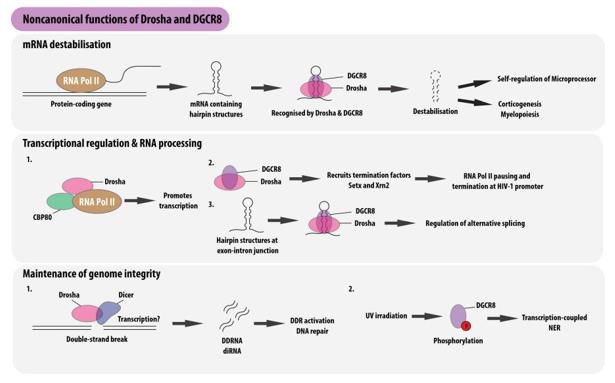 Fig. 1 Noncanonical functions of Drosha and DGCR8.1
Key structural properties of DROSHA:
- Large multi-domain ribonuclease
- Two consecutive RNase III catalytic domains form an intramolecular dimer
- The double-stranded RNA binding domain (dsRBD) recognizes the substrate
- The region rich in proline and arginine mediates the interaction with the DGCR8 protein
- The N-terminal ubiquitin-like folding domain participates in the assembly of proteins
Functions of DROSHA
The main function of DROSHA is to initiate the biosynthesis of microRNAs and precisely cut the primary transcripts within the cell nucleus. However, it also plays a role in various physiological processes, including the regulation of gene silencing and the maintenance of genomic stability.
| Function | Description |
|---|---|
| MicroRNA Processing | DROSHA, as an RNase III enzyme, cuts the primary microRNA and releases a precursor hairpin structure consisting of approximately 60-70 nucleotides. |
| Gene expression regulation | By generating mature microRNAs, it indirectly regulates the expression of thousands of target genes, influencing cell differentiation and proliferation. |
| Embryonic Development Support | Maintaining the ability to self-renew in embryonic stem cells, knocking out DROSHA results in the death of mouse embryos at an early stage. |
| Heterochromatin Maintenance | It participates in the post-transcriptional regulation of some heterochromatin regions, helping to maintain the structural stability of chromosomes. |
| Stress Response Regulation | Under conditions of DNA damage or oxidative stress, the expression and activity of DROSHA can be regulated to adapt to changes in the cellular state. |
The recognition of substrates by DROSHA depends on the unique terminal loop structure and stem length of the primary microRNA. This precise spatial recognition mechanism ensures that only the correct transcripts are processed, avoiding non-specific cleavage.
Applications of DROSHA and DROSHA Antibody in Literature
1. Pong, Sheng K., and Monika Gullerova. "Noncanonical functions of micro RNA pathway enzymes–Drosha, DGCR 8, Dicer and Ago proteins." FEBS letters 592.17 (2018): 2973-2986. https://doi.org/10.1002/1873-3468.13196
The article indicates that the Drosha, DGCR8, Dicer and Ago proteins in the microRNA generation pathway, in addition to their classical functions, also have non-classical roles that are independent of microRNAs, and are involved in various biological processes such as development, transcriptional regulation and maintenance of genomic stability.
2. Cho, Soo Jung, et al. "DROSHA-dependent AIM2 inflammasome activation contributes to lung inflammation during idiopathic pulmonary fibrosis." Cells 8.8 (2019): 938. https://doi.org/10.3390/cells8080938
The article indicates that in the alveolar macrophages of patients with idiopathic pulmonary fibrosis and mouse models, the expressions of DROSHA and AIM2 are elevated. The absence of DROSHA can inhibit the activation of the AIM2 inflammasome. Studies have shown that DROSHA, by promoting the activation of the AIM2 inflammasome, exacerbates the pulmonary inflammation during the process of idiopathic pulmonary fibrosis.
3. Wen, Jing, et al. "Association of miRNA biosynthesis genes DROSHA and DGCR8 polymorphisms with cancer susceptibility: a systematic review and meta-analysis." Bioscience reports 38.3 (2018): BSR20180072. https://doi.org/10.1042/BSR20180072
The article indicates that the meta-analysis of the polymorphisms of the DROSHA and DGCR8 genes shows that the rs417309 locus of DGCR8 is significantly associated with an increased risk of various cancers. The rs10719 and rs6877842 loci of DROSHA are respectively related to cancer susceptibility in specific subgroups (Asian population, laryngeal cancer).
4. Kiessling, Eva, et al. "HIF1 and DROSHA are involved in MMACHC repression in hypoxia." Biochimica et Biophysica Acta (BBA)-General Subjects 1866.9 (2022): 130175. https://doi.org/10.1016/j.bbagen.2022.130175
Research has shown that hypoxia can inhibit the expression of the vitamin B12 metabolism gene MMACHC in both mice and human cells. This down-regulation effect does not rely on known transcription factors, but is partially mediated through the hypoxia-inducible factor HIF1A and the microRNA processing enzyme DROSHA, revealing a potential new mechanism by which hypoxic stress affects B12 metabolism.
5. Cabrini, Matteo, et al. "DROSHA is recruited to DNA damage sites by the MRN complex to promote non-homologous end joining." Journal of Cell Science 134.6 (2021): jcs249706. https://doi.org/10.1242/jcs.249706
The study found that DROSHA can be recruited to the break site by the MRN complex during the DNA damage response. It operates independently of the classical damage signals and guides the repair choice towards non-homologous end joining by promoting the recruitment of 53BP1, thereby affecting genomic stability.
Creative Biolabs: DROSHA Antibodies for Research
Creative Biolabs specializes in the production of high-quality DROSHA antibodies for research and industrial applications. Our portfolio includes monoclonal and polyclonal antibodies tailored for ELISA, Flow Cytometry, Western blot, immunohistochemistry, and other diagnostic methodologies.
- Custom DROSHA Antibody Development: Tailor-made solutions to meet specific research requirements.
- Bulk Production: Large-scale antibody manufacturing for industry partners.
- Technical Support: Expert consultation for protocol optimization and troubleshooting.
- Aliquoting Services: Conveniently sized aliquots for long-term storage and consistent experimental outcomes.
For more details on our DROSHA antibodies, custom preparations, or technical support, contact us at email.
Reference
- Pong, Sheng K., and Monika Gullerova. "Noncanonical functions of micro RNA pathway enzymes–Drosha, DGCR 8, Dicer and Ago proteins." FEBS letters 592.17 (2018): 2973-2986. Distributed under Open Access license CC BY 4.0, without modification. https://doi.org/10.1002/1873-3468.13196
Anti-DROSHA antibodies
Products List
 Loading...
 Compare



Hot products 
-
Mouse Anti-ACLY Recombinant Antibody (V2-179314) (CBMAB-A0610-YC)

-
Mouse Anti-BZLF1 Recombinant Antibody (BZ.1) (CBMAB-AP705LY)

-
Mouse Anti-ATP1B1 Recombinant Antibody (E4) (CBMAB-0463-LY)

-
Mouse Anti-DISP2 Monoclonal Antibody (F66A4B1) (CBMAB-1112CQ)

-
Mouse Anti-AP4E1 Recombinant Antibody (32) (CBMAB-A2996-YC)

-
Mouse Anti-ESR1 Recombinant Antibody (Y31) (CBMAB-1208-YC)

-
Mouse Anti-CCNH Recombinant Antibody (CBFYC-1054) (CBMAB-C1111-FY)

-
Mouse Anti-Acetyl SMC3 (K105/K106) Recombinant Antibody (V2-634053) (CBMAB-AP052LY)

-
Mouse Anti-BAD (Phospho-Ser136) Recombinant Antibody (CBYY-0138) (CBMAB-0139-YY)

-
Mouse Anti-CHRNA9 Recombinant Antibody (8E4) (CBMAB-C9161-LY)

-
Mouse Anti-BBS2 Recombinant Antibody (CBYY-0253) (CBMAB-0254-YY)

-
Mouse Anti-C4B Recombinant Antibody (CBYY-C2996) (CBMAB-C4439-YY)

-
Mouse Anti-CD8 Recombinant Antibody (C1083) (CBMAB-C1083-LY)

-
Rabbit Anti-Acetyl-Histone H3 (Lys36) Recombinant Antibody (V2-623395) (CBMAB-CP0994-LY)

-
Rabbit Anti-B2M Recombinant Antibody (CBYY-0059) (CBMAB-0059-YY)

-
Rabbit Anti-ATF4 Recombinant Antibody (D4B8) (CBMAB-A3872-YC)

-
Mouse Anti-ADV Recombinant Antibody (V2-503423) (CBMAB-V208-1364-FY)

-
Mouse Anti-CCDC25 Recombinant Antibody (CBLC132-LY) (CBMAB-C9786-LY)

-
Mouse Anti-ABL2 Recombinant Antibody (V2-179121) (CBMAB-A0364-YC)

-
Mouse Anti-CD33 Recombinant Antibody (P67.6) (CBMAB-C10189-LY)

- AActivation
- AGAgonist
- APApoptosis
- BBlocking
- BABioassay
- BIBioimaging
- CImmunohistochemistry-Frozen Sections
- CIChromatin Immunoprecipitation
- CTCytotoxicity
- CSCostimulation
- DDepletion
- DBDot Blot
- EELISA
- ECELISA(Cap)
- EDELISA(Det)
- ESELISpot
- EMElectron Microscopy
- FFlow Cytometry
- FNFunction Assay
- GSGel Supershift
- IInhibition
- IAEnzyme Immunoassay
- ICImmunocytochemistry
- IDImmunodiffusion
- IEImmunoelectrophoresis
- IFImmunofluorescence
- IGImmunochromatography
- IHImmunohistochemistry
- IMImmunomicroscopy
- IOImmunoassay
- IPImmunoprecipitation
- ISIntracellular Staining for Flow Cytometry
- LALuminex Assay
- LFLateral Flow Immunoassay
- MMicroarray
- MCMass Cytometry/CyTOF
- MDMeDIP
- MSElectrophoretic Mobility Shift Assay
- NNeutralization
- PImmunohistologyp-Paraffin Sections
- PAPeptide Array
- PEPeptide ELISA
- PLProximity Ligation Assay
- RRadioimmunoassay
- SStimulation
- SESandwich ELISA
- SHIn situ hybridization
- TCTissue Culture
- WBWestern Blot
