
INHBE Antibodies
Background
The INHBE gene encodes a secreted protein that is mainly expressed in the liver - the βE subunit of inhibin. This protein is a component of the activin-inhibitor complex and participates in regulating the energy metabolism balance of the body. Studies have found that this gene plays a significant role in regulating body weight and insulin sensitivity by influencing the pathways of fat breakdown and glucose metabolism. Its dysfunction is associated with obesity and the risk of metabolic syndrome. This gene was first identified in the early 21st century. Its unique metabolic regulatory mechanism has made it one of the hotspots in the research of metabolic diseases. The related achievements have deepened the academic understanding of the energy homeostasis regulatory network and provided potential targets for developing intervention strategies against metabolic disorders.
Structure of INHBE
The inhibin βE subunit encoded by the INHBE gene is a secreted protein, with a monomer molecular weight of approximately 15 kDa. This weight may vary slightly among different species due to amino acid substitutions or glycosylation modifications.
| Species | Human | Mouse | Rat | Zebrafish |
| Molecular Weight (kDa) | Approximately 15.0 | Approximately 14.8 | Approximately 14.9 | Approximately 14.5 |
| Primary Structural Differences | Having the typical TGF-β domain | Highly similar to humans | Conservative cysteine residues | The core structural domain is retained, while the N-terminal region has undergone significant changes. |
This protein belongs to the transforming growth factor-β superfamily. Its primary structure contains a characteristic cysteine knot structural motif, which is stabilized by multiple conserved disulfide bonds. Its core three-dimensional structure is composed of a group of antiparallel β-sheet folds, forming a rigid scaffold called the "cysteine knot", and the internal hydrophobic pocket is crucial for maintaining the structural integrity. A key α-helical region is located on the molecular surface and is directly related to receptor recognition and binding, while a variable N-terminal propeptide is cleaved during protein maturation and secretion.
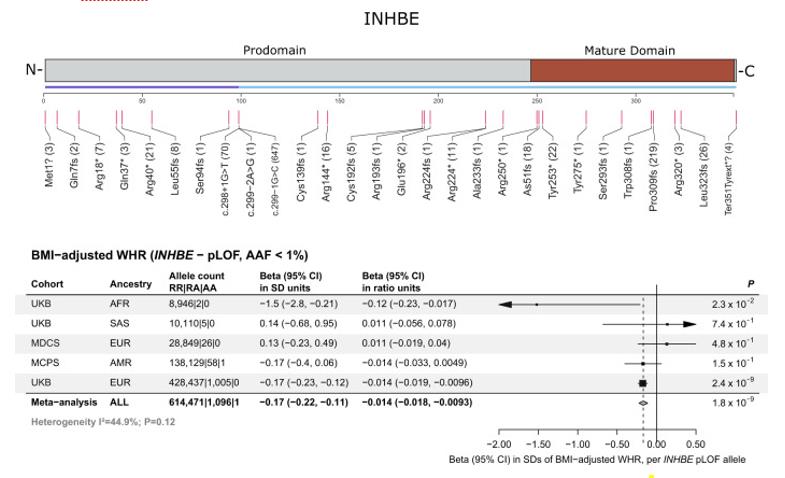 Fig. 1 Protein-truncating variants in INHBE associated with favorable fat distribution.1
Key structural properties of INHBE:
- Having a typical folding configuration of the transforming growth factor-β (TGF-β) domain
- The core is formed by a rigid scaffold composed of conservative cysteine motif sequences
- Variable ring surface exposed area is responsible for the specific receptor recognition and combination
- Function as homologous or heterodimer by disulfide bond connection
Functions of INHBE
The inhibin βE subunit encoded by the INHBE gene mainly participates in regulating the energy metabolism balance, and also plays significant roles in fat breakdown, insulin sensitivity and inflammatory responses.
| Function | Description |
| Regulate Fat Breakdown | By inhibiting lipolysis in adipose tissue and regulating the release of free fatty acids, it affects the overall energy utilization throughout the body. |
| Improving Insulin Sensitivity | It participates in enhancing the response of tissues such as skeletal muscle to insulin, helping to maintain blood sugar stability. |
| Energy Homeostasis Regulation | Responding to changes in nutritional status, coordinating the metabolic adaptations of the liver and adipose tissues, and maintaining energy balance. |
| Impact on Weight and Obesity | The absence or alteration of its function is associated with lower body fat percentage and a reduced risk of obesity, suggesting its role in weight regulation. |
| Potential Inflammation Regulation | It may affect the low-level chronic inflammatory state through indirect metabolic pathways and is associated with metabolic syndrome. |
This protein mainly exerts its effect by antagonizing the activin signaling pathway. Its mechanism of action is different from the classical hormone feedback regulation. Instead, it tends to finely regulate the activity of metabolic pathways in a paracrine/self-paracrine manner within the local microenvironment of the tissue.
Applications of INHBE and INHBE Antibody in Literature
1. Akbari, Parsa, et al. "Multiancestry exome sequencing reveals INHBE mutations associated with favorable fat distribution and protection from diabetes." Nature communications 13.1 (2022): 4844. https://doi.org/10.1038/s41467-022-32398-7
The research has found that rare mutations in the INHBE gene can improve fat distribution and reduce the risk of type 2 diabetes by 28%. This gene is mainly expressed in the liver and may exert its effect by inhibiting fat storage, suggesting its potential as a therapeutic target for metabolic diseases.
2. Deaton, Aimee M., et al. "Rare loss of function variants in the hepatokine gene INHBE protect from abdominal obesity." Nature Communications 13.1 (2022): 4319. https://doi.org/10.1038/s41467-022-31757-8
The research has found that the loss-of-function mutation of the INHBE gene can reduce the waist-to-hip ratio and decrease abdominal fat. The activin E encoded by this gene is mainly secreted by the liver, and the variation of its receptor gene ACVR1C also affects fat distribution. This suggests that the activin E pathway is a potential new target for treating abdominal obesity.
3. Sugiyama, Masakazu, et al. "Inhibin βE (INHBE) is a possible insulin resistance-associated hepatokine identified by comprehensive gene expression analysis in human liver biopsy samples." PloS one 13.3 (2018): e0194798. https://doi.org/10.1371/journal.pone.0194798
The research has found that INHBE is a new type of liver factor, which is expressed at higher levels in the livers of obese and insulin-resistant humans and mice. Knocking down its expression can reduce fat and increase ketone bodies, suggesting that it regulates metabolism by inhibiting fat consumption and may become a potential intervention target.
4. Ren, Zhi, et al. "Mechanistic insights into Y-box binding protein-1 mediated regulation of lipid metabolism and oxidative stress in NAFLD via INHBE/TNF-β pathway." Biomolecules and Biomedicine 25.7 (2024): 1528. https://doi.org/10.17305/bb.2024.11249
This study reveals that YB1 is highly expressed in non-alcoholic fatty liver disease (NAFLD). Knockdown of YB1 can down-regulate INHBE, inhibit the TNF-β/TGF-β1/Smad signaling pathway, thereby improving lipid metabolism and alleviating cellular oxidative stress, providing a new target for the treatment of NAFLD.
5. Pirrotte, Patrick, et al. "Hepatic steatosis in postmenopausal women is characterized by distinct serum extracellular vesicle proteomic signatures." BMC medicine (2025). https://doi.org/10.1186/s12916-025-04571-4
The study found that in postmenopausal women with fatty liver disease, the protein profile of serum extracellular vesicles was significantly altered. The INHBE protein was continuously elevated in multiple subgroups, suggesting that it may become a novel biomarker for metabolic-related fatty liver disease.
Creative Biolabs: INHBE Antibodies for Research
Creative Biolabs specializes in the production of high-quality INHBE antibodies for research and industrial applications. Our portfolio includes monoclonal antibodies tailored for ELISA, Flow Cytometry, Western blot, immunohistochemistry, and other diagnostic methodologies.
- Custom INHBE Antibody Development: Tailor-made solutions to meet specific research requirements.
- Bulk Production: Large-scale antibody manufacturing for industry partners.
- Technical Support: Expert consultation for protocol optimization and troubleshooting.
- Aliquoting Services: Conveniently sized aliquots for long-term storage and consistent experimental outcomes.
For more details on our INHBE antibodies, custom preparations, or technical support, contact us at email.
Reference
- Akbari, Parsa, et al. "Multiancestry exome sequencing reveals INHBE mutations associated with favorable fat distribution and protection from diabetes." Nature communications 13.1 (2022): 4844. Distributed under Open Access license CC BY 4.0, without modification. https://doi.org/10.1038/s41467-022-32398-7
Anti-INHBE antibodies
 Loading...
 Compare



Hot products 
-
Mouse Anti-EIF4G1 Recombinant Antibody (2A9) (CBMAB-A2544-LY)

-
Mouse Anti-CD19 Recombinant Antibody (CBXC-1224) (CBMAB-C1491-CQ)

-
Mouse Anti-CRYAB Recombinant Antibody (A4345) (CBMAB-A4345-YC)

-
Mouse Anti-AOC3 Recombinant Antibody (CBYY-0014) (CBMAB-0014-YY)

-
Mouse Anti-CD33 Recombinant Antibody (P67.6) (CBMAB-C10189-LY)

-
Mouse Anti-ATM Recombinant Antibody (2C1) (CBMAB-A3970-YC)

-
Mouse Anti-CCND2 Recombinant Antibody (DCS-3) (CBMAB-G1318-LY)

-
Mouse Anti-CD164 Recombinant Antibody (CBFYC-0077) (CBMAB-C0086-FY)

-
Mouse Anti-FOSB Recombinant Antibody (CBXF-3593) (CBMAB-F2522-CQ)

-
Mouse Anti-ACTG1 Recombinant Antibody (V2-179597) (CBMAB-A0916-YC)

-
Mouse Anti-AMACR Recombinant Antibody (CB34A) (CBMAB-CA034LY)

-
Mouse Anti-dsDNA Recombinant Antibody (22) (CBMAB-AP1954LY)

-
Mouse Anti-ADAM29 Recombinant Antibody (V2-179787) (CBMAB-A1149-YC)

-
Mouse Anti-ARSA Recombinant Antibody (CBYC-A799) (CBMAB-A3679-YC)

-
Mouse Anti-APC Recombinant Antibody (CBYC-A661) (CBMAB-A3036-YC)

-
Mouse Anti-AAV8 Recombinant Antibody (V2-634028) (CBMAB-AP022LY)

-
Mouse Anti-FLT1 Recombinant Antibody (11) (CBMAB-V0154-LY)

-
Mouse Anti-FTH1 Recombinant Antibody (CBXF-1896) (CBMAB-F3426-CQ)

-
Mouse Anti-FOXL1 Recombinant Antibody (CBXF-0845) (CBMAB-F0462-CQ)

-
Mouse Anti-C5AR1 Recombinant Antibody (R63) (CBMAB-C9553-LY)

- AActivation
- AGAgonist
- APApoptosis
- BBlocking
- BABioassay
- BIBioimaging
- CImmunohistochemistry-Frozen Sections
- CIChromatin Immunoprecipitation
- CTCytotoxicity
- CSCostimulation
- DDepletion
- DBDot Blot
- EELISA
- ECELISA(Cap)
- EDELISA(Det)
- ESELISpot
- EMElectron Microscopy
- FFlow Cytometry
- FNFunction Assay
- GSGel Supershift
- IInhibition
- IAEnzyme Immunoassay
- ICImmunocytochemistry
- IDImmunodiffusion
- IEImmunoelectrophoresis
- IFImmunofluorescence
- IGImmunochromatography
- IHImmunohistochemistry
- IMImmunomicroscopy
- IOImmunoassay
- IPImmunoprecipitation
- ISIntracellular Staining for Flow Cytometry
- LALuminex Assay
- LFLateral Flow Immunoassay
- MMicroarray
- MCMass Cytometry/CyTOF
- MDMeDIP
- MSElectrophoretic Mobility Shift Assay
- NNeutralization
- PImmunohistologyp-Paraffin Sections
- PAPeptide Array
- PEPeptide ELISA
- PLProximity Ligation Assay
- RRadioimmunoassay
- SStimulation
- SESandwich ELISA
- SHIn situ hybridization
- TCTissue Culture
- WBWestern Blot
