
NPY Antibodies
Background
NPY is a small molecule neuropeptide composed of 36 amino acids, mainly distributed in the central and peripheral nervous systems of vertebrates. As one of the most abundant peptides in the mammalian nervous system, NPY regulates multiple physiological processes such as energy metabolism, emotional stress, and cardiovascular function by binding to G protein-coupled receptors. The high expression of NPY in diving mammals is believed to be closely related to their adaptive physiological regulation in response to hypoxic environments. This neuropeptide was first isolated and identified from pig brain tissue by Tatemoto's team in 1982. Its unique tyrosine residue structure (with one tyrosine at the N-terminal and one at the C-terminal, hence the name) provides an important template for subsequent neurotransmitter research. The discovery of NPY and its receptor system not only deepens people's understanding of neuroendocrine regulation, but also opens up new avenues for targeted therapy of metabolic diseases and mental disorders.
Structure of NPY
NPY is a conserved neuropeptide with a molecular weight of approximately 4.2 kDa. There are slight differences in its molecular weight among different species, mainly due to C-terminal amidation modification and individual amino acid substitution.
| Species | Human | Rats | Mice | Pigs | Bovine |
| Molecular Weight (kDa) | 4.23 | 4.21 | 4.20 | 4.22 | 4.24 |
| Primary Structural Differences | Highly conservative | Alanine replacement at position 17 | Leucine mutation at position 6 | C-terminal amidation | Serine mutation at position 27 |
This neuropeptide is composed of 36 amino acids, and its tertiary structure shows a characteristic "hairpin" fold: the N-terminal (1-8 residues) forms a polyproline helix, the middle segment (9-21 residues) forms a hydrophobic core, and the C-terminal (22-36 residues) forms an amphiphilic α -helix. The key functional domains include the N-terminal tyrosine residue (Tyr1) responsible for receptor recognition, the C-terminal Tyr36 involved in receptor activation, and the "signal transduction core" formed by amino acids at positions 20 to 24. This unique structure enables NPY to specifically bind to multiple G protein-coupled receptors such as Y1/Y2/Y4/Y5/Y6 simultaneously.
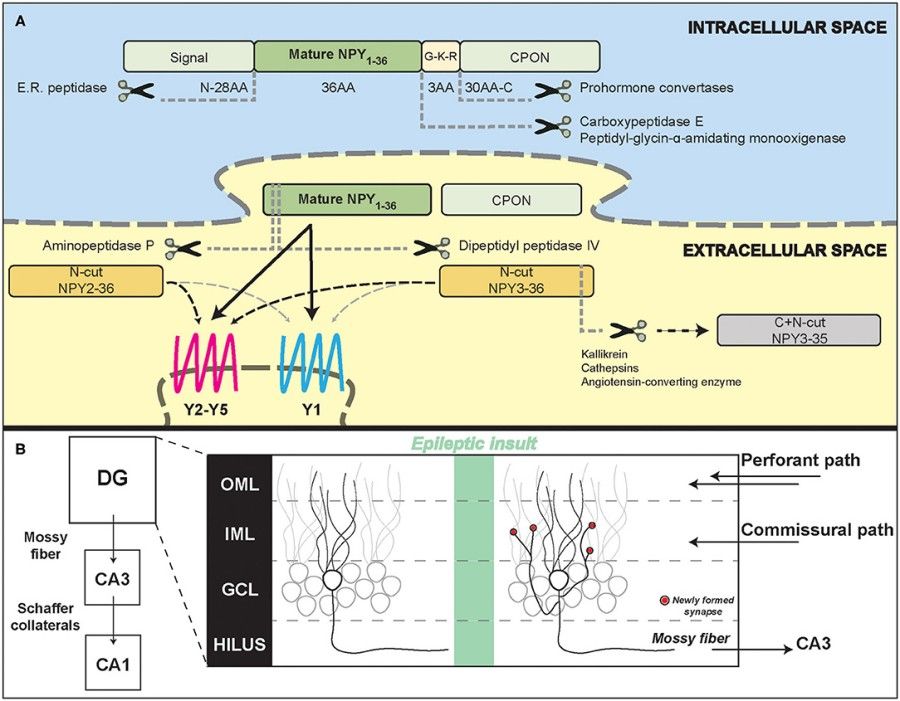 Fig. 1 Neuropeptide Y processing and its potential role in the epileptic hippocampal network.1
Key structural properties of NPY:
- Conservative PP-fold spatial configuration
- The hydrophobic core region is composed of Phe7/Trp21/Leu24/Leu30
- Tyr1/Tyr27/Tyr36 form the "aromatic triangle" receptor recognition site
- Arg33/Arg35 diarginine structure maintains the conformational stability of the C-terminal
Functions of NPY
The core function of NPY is to regulate energy metabolism and coordinate stress responses, and it also plays a significant role in multiple physiological systems:
| Function | Description |
| Energy balance regulation | Activating hypothalamic arcuate nucleus neurons through Y1/Y5 receptors promotes appetite and fat storage. |
| Regulation of stress response | Inhibit the activity of CRH neurons in the amygdala and reduce anxiety and fear responses. |
| Regulation of cardiovascular function | Y1 receptor mediates vasoconstriction to maintain blood pressure homeostasis. |
| Maintenance of circadian rhythm | Regulating the discharge frequency of neurons in the suprachiasmatic nucleus affects the synchronization of the biological clock. |
| Neuroprotective effect | Inhibit the excessive release of glutamate in the hippocampal region and alleviate ischemia-reperfusion injury. |
The dose-effect curve of NPY exhibits a unique "biphase feature" : low concentrations (pM level) inhibit neuronal activity through Y2 receptors, while high concentrations (nM level) activate downstream signaling pathways through Y1/Y5 receptors. This concentration-dependent regulatory mode makes it a "multifunctional regulatory switch" for the neuroendocrine system. Compared with single-function neurotransmitters, the pleiotropy of NPY stems from its ability to simultaneously act on six G protein-coupled receptor subtypes (Y1/Y2/Y4/Y5/Y6/y6), each of which has a different tissue distribution and signal transduction pathway.
Applications of NPY and NPY Antibody in Literature
1. Chen, Qing-Chang, and Yan Zhang. "The role of NPY in the regulation of bone metabolism." Frontiers in Endocrinology 13 (2022): 833485. https://doi.org/10.3389/fendo.2022.833485
This article reviews the regulatory role of neuropeptide Y (NPY) in bone metabolism. NPY participates in bone formation and resorption through receptors in the nervous system and bone tissue, affects the differentiation of bone marrow mesenchymal cells, and plays an important role in bone remodeling under physiological and pathological conditions. However, its specific mechanism still needs to be further explored.
2. Baldock, Paul A., et al. "Neuropeptide Y knockout mice reveal a central role of NPY in the coordination of bone mass to body weight." PloS one 4.12 (2009): e8415. https://doi.org/10.1371/journal.pone.0008415
The article indicates that NPY regulates bone mass by sensing energy states: the increased expression of NPY during starvation inhibits osteogenesis and reduces bone mass. A decrease in NPY during obesity promotes bone formation. The research also found that osteoblasts themselves express NPY, suggesting that they may coordinate bone metabolism through both central and peripheral pathways.
3. Tang, Tingting, et al. "Receptor-specific recognition of NPY peptides revealed by structures of NPY receptors." Science Advances 8.18 (2022): eabm1232. https://doi.org/10.1126/sciadv.abm1232
The study resolved the complex structures of human Y1, Y2 and Y4 receptors with neuropeptide Y (NPY) or pancreatic polypeptide (PP) and Gi1 protein, revealing that NPY binds to different receptors in different ways through conformational plasticity, and its N-terminal specifically interacts with the Y1 receptor. This discovery provides a structural basis for the development of selective drugs targeting NPY receptors.
4. Cattaneo, Stefano, et al. "NPY and gene therapy for epilepsy: how, when,... and Y." Frontiers in molecular neuroscience 13 (2021): 608001. https://doi.org/10.3389/fnmol.2020.608001
The article describes that neuropeptide Y (NPY) exerts an antiepileptic effect in the central nervous system, mainly by inhibiting neuronal excitability through Y2/Y5 receptors. Studies have shown that overexpression of NPY can inhibit epileptic seizures in animal models. Gene therapy based on NPY provides a new strategy for drug-resistant epilepsy, but its pluripotency characteristics still need to be carefully evaluated.
5. Rafiei, Neda, et al. "Chemogenetic activation of arcuate nucleus NPY and NPY/AgRP neurons increases feeding behaviour in mice." Neuropeptides 107 (2024): 102454. https://doi.org/10.1016/j.npep.2024.102454
Research has found that after being activated through chemogenetics, NPY neurons in the arcuate nucleus of the hypothalamus (including both AgRP positive and negative subgroups) can specifically respond to heat signals, significantly promote eating behavior and favor fat intake, and their effect is comparable to that of AgRP neuron activation. This study reveals the crucial role of NPY neurons in the regulation of energy homeostasis.
Creative Biolabs: NPY Antibodies for Research
Creative Biolabs specializes in the production of high-quality NPY antibodies for research and industrial applications. Our portfolio includes monoclonal antibodies tailored for ELISA, Flow Cytometry, Western blot, immunohistochemistry, and other diagnostic methodologies.
- Custom NPY Antibody Development: Tailor-made solutions to meet specific research requirements.
- Bulk Production: Large-scale antibody manufacturing for industry partners.
- Technical Support: Expert consultation for protocol optimization and troubleshooting.
- Aliquoting Services: Conveniently sized aliquots for long-term storage and consistent experimental outcomes.
For more details on our NPY antibodies, custom preparations, or technical support, contact us at email.
Reference
- Cattaneo, Stefano, et al. "NPY and gene therapy for epilepsy: how, when,... and Y." Frontiers in molecular neuroscience 13 (2021): 608001. https://doi.org/10.3389/fnmol.2020.608001
Anti-NPY antibodies
Products List
 Loading...
 Compare




Hot products 
-
Mouse Anti-EMP3 Recombinant Antibody (CBFYE-0100) (CBMAB-E0207-FY)

-
Rabbit Anti-DLK1 Recombinant Antibody (9D8) (CBMAB-D1061-YC)

-
Mouse Anti-CCNH Recombinant Antibody (CBFYC-1054) (CBMAB-C1111-FY)

-
Mouse Anti-FLT1 Recombinant Antibody (11) (CBMAB-V0154-LY)

-
Mouse Anti-ASTN1 Recombinant Antibody (H-9) (CBMAB-1154-CN)

-
Mouse Anti-APP Recombinant Antibody (DE2B4) (CBMAB-1122-CN)

-
Mouse Anti-CD33 Recombinant Antibody (6C5/2) (CBMAB-C8126-LY)

-
Mouse Anti-AAV-5 Recombinant Antibody (V2-503417) (CBMAB-V208-1369-FY)

-
Mouse Anti-AFDN Recombinant Antibody (V2-58751) (CBMAB-L0408-YJ)

-
Mouse Anti-CAT Recombinant Antibody (724810) (CBMAB-C8431-LY)

-
Mouse Anti-4-Hydroxynonenal Recombinant Antibody (V2-502280) (CBMAB-C1055-CN)

-
Mouse Anti-ENO2 Recombinant Antibody (H14) (CBMAB-E1341-FY)

-
Mouse Anti-CD63 Recombinant Antibody (CBXC-1200) (CBMAB-C1467-CQ)

-
Human Anti-SARS-CoV-2 Spike Recombinant Antibody (CBC05) (CBMAB-CR005LY)

-
Mouse Anti-BLNK Recombinant Antibody (CBYY-0623) (CBMAB-0626-YY)

-
Mouse Anti-ALPL Antibody (B4-78) (CBMAB-1009CQ)

-
Mouse Anti-COL12A1 Recombinant Antibody (CBYY-C3117) (CBMAB-C4560-YY)

-
Mouse Anti-AKT1 (Phosphorylated S473) Recombinant Antibody (V2-505430) (PTM-CBMAB-0067LY)

-
Mouse Anti-BZLF1 Recombinant Antibody (BZ.1) (CBMAB-AP705LY)

-
Mouse Anti-C5b-9 Recombinant Antibody (aE11) (CBMAB-AO138LY)

- AActivation
- AGAgonist
- APApoptosis
- BBlocking
- BABioassay
- BIBioimaging
- CImmunohistochemistry-Frozen Sections
- CIChromatin Immunoprecipitation
- CTCytotoxicity
- CSCostimulation
- DDepletion
- DBDot Blot
- EELISA
- ECELISA(Cap)
- EDELISA(Det)
- ESELISpot
- EMElectron Microscopy
- FFlow Cytometry
- FNFunction Assay
- GSGel Supershift
- IInhibition
- IAEnzyme Immunoassay
- ICImmunocytochemistry
- IDImmunodiffusion
- IEImmunoelectrophoresis
- IFImmunofluorescence
- IGImmunochromatography
- IHImmunohistochemistry
- IMImmunomicroscopy
- IOImmunoassay
- IPImmunoprecipitation
- ISIntracellular Staining for Flow Cytometry
- LALuminex Assay
- LFLateral Flow Immunoassay
- MMicroarray
- MCMass Cytometry/CyTOF
- MDMeDIP
- MSElectrophoretic Mobility Shift Assay
- NNeutralization
- PImmunohistologyp-Paraffin Sections
- PAPeptide Array
- PEPeptide ELISA
- PLProximity Ligation Assay
- RRadioimmunoassay
- SStimulation
- SESandwich ELISA
- SHIn situ hybridization
- TCTissue Culture
- WBWestern Blot
