
TKTL1 Antibodies
Background
The TKTL1 gene encodes a transketoalkase-like protein, which mainly participates in the metabolic regulation of the pentose phosphate pathway and is highly expressed in proliferating cells (such as tumor cells). This protein maintains the biosynthesis and REDOX balance required for rapid cell growth by influencing the flow of sugar metabolism, supporting nucleic acid synthesis and antioxidative stress. Research has found that the expression of TKTL1 is abnormally elevated in various malignant tumors, and its activity is closely related to tumor invasion, metastasis and poor prognosis. Since its first identification in 1996, TKTL1 has become a research hotspot due to its crucial role in tumor metabolic reprogramming. The study of related mechanisms not only deepens the understanding of tumor energy metabolism but also provides potential new strategies for metabolism-targeted anti-tumor therapies.
Structure of TKTL1
The transketoalkase-like protein encoded by the TKTL1 gene is a key metabolic enzyme with a molecular weight of approximately 66 kDa. The specific value may fluctuate slightly due to different subtypes or post-translational modifications. This protein mainly participates in the pentose phosphate pathway (PPP), and its core function is to regulate the flow of glucose metabolism to provide the ribose precursors needed for nucleic acid synthesis in rapidly proliferating cells (such as tumor cells), and maintain the balance of reduced nicotinamide adenine dinucleotide phosphate (NADPH) to cope with oxidative stress.
Structurally, the TKTL1 protein contains a typical transketoalkase domain, and its activity depends on thiamine pyrophosphate (TPP) as a cofactor. The three-dimensional structure of this protein contributes to its catalytic substrate specificity and influences metabolic reprogramming in the tumor microenvironment. Studies have shown that TKTL1 is upregulated in various malignant tumors, and its activity is significantly associated with the invasiveness, metastatic potential and poor prognosis of the tumor. Therefore, it is regarded as a potential target for tumor metabolic therapy.
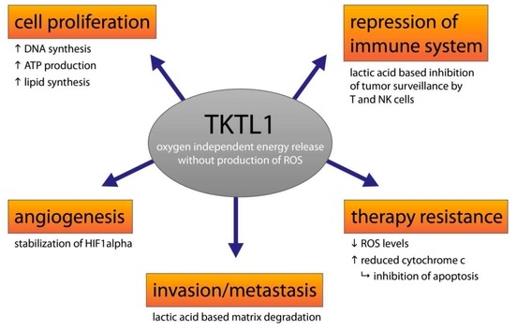 Fig. 1 Role of TKTL1 in cancer cells.1
Key structural properties of TKTL1:
- As a member of the transketolase family, it has a conserved thiamine pyrophosphate (TPP) binding domain
- The protein catalyzes the carbon chain transfer reaction in the pentose phosphate pathway through its active site specific
- The expression and activity by hypoxia inducing factor (HIF - 1 alpha) tumor microenvironment signal control
Functions of TKTL1
The main function of the TKTL1 gene is to participate in the pentose phosphate pathway (PPP), regulating intracellular metabolic flow and REDOX balance. However, it also plays a key role in the occurrence and development of tumors, especially in promoting the proliferation, invasion and treatment resistance of tumor cells.
| Function | Description |
| Metabolic reprogramming | Highly expressed in tumor cells, it directs glucose metabolism from glycolysis to PPP, provides ribose-5-phosphate precursors for nucleic acid synthesis, and supports rapid cell proliferation. |
| REDOX homeostasis is maintained | By promoting the oxidative branching of PPP and increasing the generation of NADPH, it helps cells resist oxidative stress and enhances the survival ability of tumor cells in harsh microenvironments. |
| Promoting tumor invasion and metastasis | Its expression level is positively correlated with the invasiveness, metastatic potential and poor prognosis of various cancers, such as colorectal cancer, breast cancer and glioma. |
| Adaptation to hypoxia | In the hypoxic microenvironment of tumors, its expression is often upregulated by factors such as HIF-1α, helping tumor cells adapt to hypoxic stress and maintain metabolic requirements. |
| Treatment resistance | By providing NADPH and biosynthetic precursors, it helps tumor cells resist DNA damage and oxidative stress induced by radiotherapy, chemotherapy and other therapies, thereby generating therapeutic resistance. |
The metabolic regulatory function of TKTL1 makes it a key branch node in the "Warburg effect" of tumor cells. Unlike the mode that mainly acquires energy through glycolysis, the high expression of TKTL1 guides metabolic resources to biosynthesis and antioxidation, which explains its general upregulation in aggressive tumors and makes it a promising target for tumor metabolic therapy.
Applications of TKTL1 and TKTL1 Antibody in Literature
1. Baptista, Inês, et al. "TKTL1 knockdown impairs hypoxia-induced glucose-6-phosphate dehydrogenase and glyceraldehyde-3-phosphate dehydrogenase overexpression." International Journal of Molecular Sciences 23.7 (2022): 3574. https://doi.org/10.3390/ijms23073574
This article reveals that in THP-1 leukemia cells, TKTL1 mediates metabolic reprogramming under hypoxia conditions by regulating the activities of G6PD and GAPDH, affects the pentose phosphate pathway and glycolysis, and plays a key role in cell adaptation to hypoxia.
2. Coy, Johannes F. "EDIM-TKTL1/Apo10 blood test: an innate immune system based liquid biopsy for the early detection, characterization and targeted treatment of cancer." International journal of molecular sciences 18.4 (2017): 878. https://doi.org/10.3390/ijms18040878
This article reveals that the monocyte epitope detection technology utilizes tumor markers internalized by macrophages for liquid biopsy. The detection of Apo10 and TKTL1 can diagnose various solid tumors with high sensitivity and specificity, among which TKTL1 also offers the possibility of drug target therapy.
3. Malcher, Agnieszka, et al. "TKTL1: a new candidate gene in non-obstructive azoospermia." Reproductive BioMedicine Online (2025): 104895. https://doi.org/10.1016/j.rbmo.2025.104895
This article reveals that the TKTL1 gene participates in the early regulation of spermatogenesis by regulating the expression of genes such as HERC5. Its mutation can lead to down-regulation of gene expression and is associated with the onset of non-obstructive azoospermia.
4. Kämmerer, Ulrike, et al. "TKTL1 expression in human malign and benign cell lines." BMC cancer 15.1 (2015): 2. https://doi.org/10.1186/1471-2407-15-2
This study found that in various human malignant tumor and benign cell lines, the TKTL1 protein and mRNA were generally expressed at low levels or were negative. Its expression has no significant correlation with glycolytic levels or chemoradiotherapy resistance, challenging the common view that TKTL1 is a key biomarker for tumor metabolism and resistance.
5. Zhu, Yingping, Yu Qiu, and Xueqin Zhang. "TKTL1 participated in malignant progression of cervical cancer cells via regulating AKT signal mediated PFKFB3 and thus regulating glycolysis." Cancer Cell International 21.1 (2021): 678. https://doi.org/10.1186/s12935-021-02383-z
The article indicates that TKTL1 plays a key role in the malignant progression by activating the AKT signaling pathway, upregulating the expression of HK2 and PFKFB3, enhancing the glycolytic level of cervical cancer cells, thereby promoting their proliferation, migration and inhibiting apoptosis.
Creative Biolabs: TKTL1 Antibodies for Research
Creative Biolabs specializes in the production of high-quality TKTL1 antibodies for research and industrial applications. Our portfolio includes monoclonal antibodies tailored for ELISA, Flow Cytometry, Western blot, immunohistochemistry, and other diagnostic methodologies.
- Custom TKTL1 Antibody Development: Tailor-made solutions to meet specific research requirements.
- Bulk Production: Large-scale antibody manufacturing for industry partners.
- Technical Support: Expert consultation for protocol optimization and troubleshooting.
- Aliquoting Services: Conveniently sized aliquots for long-term storage and consistent experimental outcomes.
For more details on our TKTL1 antibodies, custom preparations, or technical support, contact us at email.
Reference
- Coy, Johannes F. "EDIM-TKTL1/Apo10 blood test: an innate immune system based liquid biopsy for the early detection, characterization and targeted treatment of cancer." International journal of molecular sciences 18.4 (2017): 878. https://doi.org/10.3390/ijms18040878
Anti-TKTL1 antibodies
 Loading...
 Compare




Hot products 
-
Mouse Anti-AFM Recombinant Antibody (V2-634159) (CBMAB-AP185LY)

-
Mouse Anti-ANXA7 Recombinant Antibody (A-1) (CBMAB-A2941-YC)

-
Mouse Anti-GFP Recombinant Antibody (28) (CBMAB-G3038-LY)

-
Mouse Anti-ACO2 Recombinant Antibody (V2-179329) (CBMAB-A0627-YC)

-
Mouse Anti-ENO1 Recombinant Antibody (CBYC-A950) (CBMAB-A4388-YC)

-
Mouse Anti-AAV8 Recombinant Antibody (V2-634028) (CBMAB-AP022LY)

-
Mouse Anti-FN1 Monoclonal Antibody (D6) (CBMAB-1240CQ)

-
Rabbit Anti-ALK (Phosphorylated Y1278) Recombinant Antibody (D59G10) (PTM-CBMAB-0035YC)

-
Mouse Anti-BCL6 Recombinant Antibody (CBYY-0435) (CBMAB-0437-YY)

-
Mouse Anti-GZMA Recombinant Antibody (CBLG1-2197) (CBMAB-G5901-LY)

-
Mouse Anti-GP1BA Recombinant Antibody (6D1) (CBMAB-0271-CN)

-
Mouse Anti-FLI1 Recombinant Antibody (CBXF-0733) (CBMAB-F0435-CQ)

-
Mouse Anti-GPR34 Recombinant Antibody (CBFYH-0457) (CBMAB-H1331-FY)

-
Mouse Anti-ASH1L Monoclonal Antibody (ASH5H03) (CBMAB-1372-YC)

-
Mouse Anti-AMH Recombinant Antibody (5/6) (CBMAB-A2527-YC)

-
Mouse Anti-Gro Monoclonal Antibody (1) (CBMAB-0482-LY)

-
Mouse Anti-C4B Recombinant Antibody (CBYY-C2996) (CBMAB-C4439-YY)

-
Mouse Anti-FOXL1 Recombinant Antibody (CBXF-0845) (CBMAB-F0462-CQ)

-
Mouse Anti-BLNK Recombinant Antibody (CBYY-0623) (CBMAB-0626-YY)

-
Mouse Anti-APC Recombinant Antibody (CBYC-A661) (CBMAB-A3036-YC)

- AActivation
- AGAgonist
- APApoptosis
- BBlocking
- BABioassay
- BIBioimaging
- CImmunohistochemistry-Frozen Sections
- CIChromatin Immunoprecipitation
- CTCytotoxicity
- CSCostimulation
- DDepletion
- DBDot Blot
- EELISA
- ECELISA(Cap)
- EDELISA(Det)
- ESELISpot
- EMElectron Microscopy
- FFlow Cytometry
- FNFunction Assay
- GSGel Supershift
- IInhibition
- IAEnzyme Immunoassay
- ICImmunocytochemistry
- IDImmunodiffusion
- IEImmunoelectrophoresis
- IFImmunofluorescence
- IGImmunochromatography
- IHImmunohistochemistry
- IMImmunomicroscopy
- IOImmunoassay
- IPImmunoprecipitation
- ISIntracellular Staining for Flow Cytometry
- LALuminex Assay
- LFLateral Flow Immunoassay
- MMicroarray
- MCMass Cytometry/CyTOF
- MDMeDIP
- MSElectrophoretic Mobility Shift Assay
- NNeutralization
- PImmunohistologyp-Paraffin Sections
- PAPeptide Array
- PEPeptide ELISA
- PLProximity Ligation Assay
- RRadioimmunoassay
- SStimulation
- SESandwich ELISA
- SHIn situ hybridization
- TCTissue Culture
- WBWestern Blot
