
DND1 Antibodies
Background
The DND1 gene encodes an RNA-binding protein that is mainly expressed in the reproductive cells of vertebrates. This protein regulates the stability or translation efficiency of target genes by recognizing specific sequences in the 3' untranslated region of mRNA, thereby maintaining the normal function of reproductive stem cells. Model organisms such as zebrafish rely on DND1 to ensure the survival and migration of primordial reproductive cells, and its dysfunction can lead to the loss of reproductive cells or infertility. It was initially identified in model organism screening, and subsequent studies have found that DND1 mutations are associated with certain congenital infertility diseases in humans. This protein contains a typical RRM domain and functions by binding to specific RNA motifs. Due to its importance as a reproductive cell marker and a key regulatory factor, the research on DND1 provides important clues for understanding the mechanism of reproductive cell development and the molecular basis of related infertility disorders.
Structure of DND1
DND1 is a relatively small protein with a molecular weight of approximately 38 kDa. Due to the differences in amino acid sequences among different species, there may be slight variations in molecular weight.
| Species | Human | Mouse | Zebrafish | Toad |
| Molecular Weight (kDa) | 38.3 | 38.1 | 37.8 | 38.0 |
| Primary Structural Differences | Containing typical RRM domains | High homology with humans | In the process of germ cell development | The expression patterns of early embryos are unique |
The DND1 protein contains two conserved RNA recognition motifs (RRM), and its overall structure is compact and spherical. This protein specifically recognizes the 3' untranslated region of target mRNA through its RRM domain, regulating the stability or translation efficiency of the mRNA. DND1 is mainly located in the cytoplasm and is highly expressed in germ cells. Its spatial structure is composed of multiple β-sheets and α-helices, forming a specific RNA binding interface, which is crucial for maintaining the normal function of germ stem cells. The binding of this protein to the target RNA is regulated by sequence specificity, ensuring the normal development of germ cells.
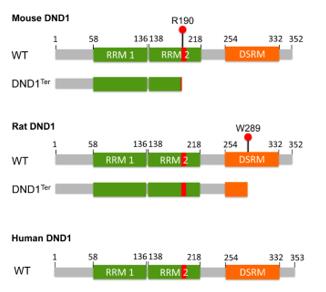 Fig. 1 Schematic representation of the structure of mouse, rat, and human DND1 proteins.1
Key structural properties of DND1:
- Two conservative RNA recognition motifs (RRM)
- Glycine-rich RGG domain
- Nuclear localization and nuclear export signal sequence
- Regulation of target recognition through RNA binding interface
Functions of DND1
The main function of DND1 is to maintain the survival and development of germ cells. This gene plays a regulatory role in multiple physiological processes, including RNA metabolism and cell cycle regulation.
| Function | Description |
| Maintenance of germ cells | DND1 binds to the 3'UTR of the target mRNA, regulating its stability or translation efficiency, ensuring the survival of germ cells. |
| Regulation of cell migration | Participates in the directional migration process of primordial germ cells, ensuring they reach the germ ridge correctly. |
| Activation of developmental programs | Activates the specific gene expression programs of germ cells in the early stages of embryonic development. |
| Inhibition of apoptosis | Regulates the expression of apoptosis-related genes to prevent premature death of germ cells. |
| Maintenance of pluripotency | Participates in maintaining the stem cell characteristics of germ cells, preventing differentiation into somatic cells. |
The expression of DND1 is highly tissue-specific, mainly concentrated in the germ cell lineage, and its expression level is closely related to the developmental stage of germ cells.
Applications of DND1 and DND1 Antibody in Literature
1. Godavarthi, Jyotsna D., Abie Williams-Villalobo, and Shahrazad Polk. "The Role of DND1 in Cancers." Cancers 13.15 (2021): 3679. https://doi.org/10.3390/cancers13153679
The article indicates that the DND1 protein regulates gene expression through multiple mechanisms, and its deficiency can lead to reproductive cell tumors in vertebrates. The latest research has found that DND1 may also be involved in the occurrence of various human cancers outside the reproductive glands, exerting both oncogenic and tumor-suppressing effects.
2. Xu, Gongquan, et al. "High DND1 level indicates a poor prognostic factor in prostate cancer." Disease Markers 2021.1 (2021): 9948241. https://doi.org/10.1155/2021/9948241
The article indicates that DND1 is highly expressed in prostate cancer and is positively correlated with clinical stage, ISUP grade, seminal vesicle invasion, and PSA density. It suggests a poor prognosis for patients and may serve as a new prognostic marker.
3. Gu, Wei, et al. "Dnd1-mediated epigenetic control of teratoma formation in mouse." Biology open 7.1 (2018): bio032318. https://doi.org/10.1242/bio.032318
The article indicates that the DND1 gene mutation reduces H3K27me3 modification by down-regulating the miR-26a/Ezh2 axis and up-regulates Ccnd1, thereby disrupting epigenetic regulation and promoting the reprogramming of primordial germ cells, thus inducing testicular teratoma.
4. Ruthig, Victor A., et al. "The RNA binding protein DND1 is elevated in a subpopulation of pro-spermatogonia and targets chromatin modifiers and translational machinery during late gestation." PLoS Genetics 19.3 (2023): e1010656. https://doi.org/10.1371/journal.pgen.1010656
The article indicates that DND1 maintains the characteristics of male germ cells by binding and regulating epigenetic and translation-related mRNAs. The cell subpopulations with high expression of DND1 are enriched with pluripotency and spermatogonial differentiation genes, avoiding being engulfed and ensuring normal development.
5. Baloch, Abdul Rasheed, et al. "Dnd1 knockout in sturgeons by CRISPR/Cas9 generates germ cell free host for surrogate production." Animals 9.4 (2019): 174. https://doi.org/10.3390/ani9040174
The article indicates that by using CRISPR/Cas9 to knockout the dnd1 gene in the juvenile sturgeon, the original germ cells can be lost or reduced, successfully preparing infertile hosts. This method has the highest embryo survival rate and hatching rate, providing a new approach for large sturgeon in vitro fertilization.
Creative Biolabs: DND1 Antibodies for Research
Creative Biolabs specializes in the production of high-quality DND1 antibodies for research and industrial applications. Our portfolio includes monoclonal and polyclonal antibodies tailored for ELISA, Flow Cytometry, Western blot, immunohistochemistry, and other diagnostic methodologies.
- Custom DND1 Antibody Development: Tailor-made solutions to meet specific research requirements.
- Bulk Production: Large-scale antibody manufacturing for industry partners.
- Technical Support: Expert consultation for protocol optimization and troubleshooting.
- Aliquoting Services: Conveniently sized aliquots for long-term storage and consistent experimental outcomes.
For more details on our DND1 antibodies, custom preparations, or technical support, contact us at email.
Reference
- Godavarthi, Jyotsna D., Abie Williams-Villalobo, and Shahrazad Polk. "The Role of DND1 in Cancers." Cancers 13.15 (2021): 3679. Distributed under Open Access license CC BY 4.0, without modification. https://doi.org/10.3390/cancers13153679
Anti-DND1 antibodies
 Loading...
 Compare



Hot products 
-
Mouse Anti-CCN2 Recombinant Antibody (CBFYC-2383) (CBMAB-C2456-FY)

-
Rabbit Anti-AKT2 (Phosphorylated S474) Recombinant Antibody (V2-556130) (PTM-CBMAB-0605LY)

-
Mouse Anti-ADIPOR1 Recombinant Antibody (V2-179982) (CBMAB-A1368-YC)

-
Mouse Anti-GNA12 Recombinant Antibody (CBFYH-0402) (CBMAB-H1272-FY)

-
Mouse Anti-EGR1 Recombinant Antibody (CBWJZ-100) (CBMAB-Z0289-WJ)

-
Mouse Anti-CFL1 (Phospho-Ser3) Recombinant Antibody (CBFYC-1770) (CBMAB-C1832-FY)

-
Rat Anti-AChR Recombinant Antibody (V2-12500) (CBMAB-0990-CN)

-
Mouse Anti-BHMT Recombinant Antibody (CBYY-0547) (CBMAB-0550-YY)

-
Mouse Anti-COL12A1 Recombinant Antibody (CBYY-C3117) (CBMAB-C4560-YY)

-
Mouse Anti-AQP2 Recombinant Antibody (E-2) (CBMAB-A3358-YC)

-
Human Anti-SARS-CoV-2 Spike Recombinant Antibody (CBC05) (CBMAB-CR005LY)

-
Mouse Anti-AMOT Recombinant Antibody (CBYC-A564) (CBMAB-A2552-YC)

-
Mouse Anti-CEMIP Recombinant Antibody (3C12) (CBMAB-K0296-LY)

-
Mouse Anti-dsDNA Recombinant Antibody (22) (CBMAB-AP1954LY)

-
Mouse Anti-GST Recombinant Antibody (CBLG1-1938) (CBMAB-G5371-LY)

-
Mouse Anti-AFM Recombinant Antibody (V2-634159) (CBMAB-AP185LY)

-
Rabbit Anti-DLK1 Recombinant Antibody (9D8) (CBMAB-D1061-YC)

-
Mouse Anti-FOSB Recombinant Antibody (CBXF-3593) (CBMAB-F2522-CQ)

-
Mouse Anti-ARIH1 Recombinant Antibody (C-7) (CBMAB-A3563-YC)

-
Rat Anti-ADAM10 Recombinant Antibody (V2-179741) (CBMAB-A1103-YC)

- AActivation
- AGAgonist
- APApoptosis
- BBlocking
- BABioassay
- BIBioimaging
- CImmunohistochemistry-Frozen Sections
- CIChromatin Immunoprecipitation
- CTCytotoxicity
- CSCostimulation
- DDepletion
- DBDot Blot
- EELISA
- ECELISA(Cap)
- EDELISA(Det)
- ESELISpot
- EMElectron Microscopy
- FFlow Cytometry
- FNFunction Assay
- GSGel Supershift
- IInhibition
- IAEnzyme Immunoassay
- ICImmunocytochemistry
- IDImmunodiffusion
- IEImmunoelectrophoresis
- IFImmunofluorescence
- IGImmunochromatography
- IHImmunohistochemistry
- IMImmunomicroscopy
- IOImmunoassay
- IPImmunoprecipitation
- ISIntracellular Staining for Flow Cytometry
- LALuminex Assay
- LFLateral Flow Immunoassay
- MMicroarray
- MCMass Cytometry/CyTOF
- MDMeDIP
- MSElectrophoretic Mobility Shift Assay
- NNeutralization
- PImmunohistologyp-Paraffin Sections
- PAPeptide Array
- PEPeptide ELISA
- PLProximity Ligation Assay
- RRadioimmunoassay
- SStimulation
- SESandwich ELISA
- SHIn situ hybridization
- TCTissue Culture
- WBWestern Blot
